Tag: war

  • Maggie’s Kitchen

    Maggie’s Kitchen

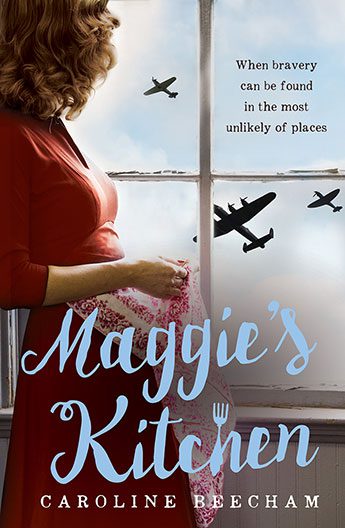
    For many of us in Australia, the day to day lives of those who lived in London during the Second World War are rather hazy. Caroline has shed light on how it was to be living with the ever present threat of running to a bomb shelter and the difficulty in finding enough food to eat. In this Historical Fiction, she explores what it is like to be Maggie, a young woman who has lost her love, and who has a passion to cook for others.

     Maggie works in the kitchen of a large factory providing food for the workers.  When the call comes out from the Ministry of Food for people to open their own kitchens, Maggie applies for the position, having found a site and some co- workers to help. The red tape she has to go through slows things down, but she is eventually accepted, and food deliveries are arranged. After the enormous task of cleaning up the site and adding her own personal touches, Maggie is finally ready to serve up the menu that the Ministry has suggested. Although rather boring, the provisions she is given restrict her ability to be creative with her cooking.

     As the Kitchen begins to develop, and the workers learn to cope with new demands, Robbie, a twelve year old boy, becomes close to Maggie, and she supports him. He is waiting for his father to come home from the Navy, and doesn’t want to leave the dock area in case he misses his Dad. Janek is a Polish man who has fled Europe, and still keeps in touch with the Polish Resistance. He begins a garden for Maggie, growing some herbs and vegetables, adding to her staple menus. Many factory workers and busy people come to the kitchen to get a little taste of well cooked food, and some rare vegetables. However this causes friction with the Ministry representative who insists that Maggie sticks to the menus issued.

     There are many problems to overcome and developing relationships to nurture. This is indeed a snapshot of life in London in 1941 during World War 2. The wonderful Chapter Markers are excerpts from the Ministry of Food war cookery leaflets. They give a great sense of the time and help to understand the food shortages. “Chapter Eighteen begins … Dishes using cooked vegetables should , as far as possible, be served with a fresh salad or a serving of freshly cooked greens to make up for the Vitamin C lost in cooking or reheating.” Another authentic touch is the recipes included at the end of the story. There is “Mutton Stew, Offal Pie, Liver and Sausage Hotpot, and Turnip Top Salad”, to name a few.

     Woven into this story is a mystery of Maggie’s missing mother. There are many threads to the story to keep our interest, but none of them are fully developed. However this is an interesting angle from which to view London, with food always revealing much about the times and society who consume it.



  • The Summer Before the War

    The Summer Before the War

    Set in East Sussex in 1914, this story tells of a wonderful summer in a small village where so many aspects of life have not changed for hundreds of years. There are still the ruling class, the workers and the gypsies. However, progress and change are looming large, and not all for the good. The many characters we meet come from different backgrounds and walks of life with a particular focus on poets. We are reminded of a time of different values and judgements.

     One of the main characters is Agatha who has been the mistress of an influential home in the village. She had decided that the new Latin teacher at the school should be a young woman who has applied for the job and convinces the board to employ her. This is indeed progress!

     Agatha’s adored nephews live with her and fear there will be a war. Hugh is a medical student, and Daniel is a poet. Within the village there are many rivalries and petty issues that have probably existed forever, which are both amusing and exasperating to follow.

     However, the rumours are correct, and war is declared. A group of Belgian refugees is sent to the village of Rye with committees set up to help these people. The young Latin teacher, Beatrice Nash, has found herself in the middle of this turmoil and tries her best to fit in. With Agatha’s and her nephews’ support, she begins to enjoy village life. When war is declared Hugh decides his medical training will be needed at the front and enlists.  A young gypsy boy, who has a gift for Latin, but would never be given a chance to further himself, also enlists. He is fifteen!

     The carefully researched chapters about life in the trenches highlight the stupidity of many actions of the wealthy, which although they have commissions, have no training or common sense to support their troops. One such leader insisted on a band to welcome an inspection from England. The enemy were able to precisely pinpoint the location of the English troops and adjusted their weapons accordingly.  No mercy was shown to their own troops if rules were broken.

     Some of the war poetry written at this time reflects the horror and helplessness of the men.

     The picture painted of village life before the war is idyllic with the relationships between the characters developing appropriately. The many humorous actions by the Mayor’s wife, who truly feels the importance of her role in the village, are something we can all relate too. There is a parade, and floats, and cake baking, with all as it should be.

     Beatrice, meanwhile, will find the love of her life after believing she has been cast upon the world as a penniless spinster. There are many satisfying aspects of this saga as it brings many a smile.

  • Australian Woman War Reporters: Boer War to Vietnam

    Australian Woman War Reporters: Boer War to Vietnam

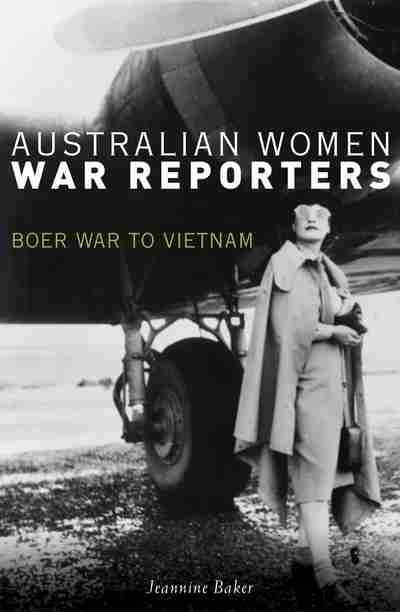
    In today’s news world it is the considered norm for women to be reporting from war torn regions, in the thick of the fighting or amidst the devastation of an earthquake or other dramatic world event. The women in the front line are there to do a job, the fact that they are female has little to nothing to do with the quality of the reporting, or the events they are there to cover.

    In today’s world the reporters, whether they be male or female are  in nearly all there on their own as modern technology is very transportable, consisting of a smart phone, a laptop and a good camera mounted with sound gear. This era in journalism is like none other: it is the era of the photojournalist; on the spot, highly mobile sending instant broadcasts to the world

    But this was not always the case. For women to have been able to be considered equal in what was traditionally a male dominated workplace, there had to be the pioneering women; the women, who took themselves off to war to report in most instances, the ‘female perspective or the woman’s angle’ of war for the likes of the ‘Catholic Press’, the ‘Advertiser’ and the’ Adelaide Chronicle’ to name a few.

    Between 1900 and 1975 more than thirty Australasian women reported from conflict areas; the first of these being Agnes Macready, who paid her own passage to South Africa at the time of the Boer War, as both a nurse with the New South Wales Army Nursing Service Reserve and reporter for the Catholic Times. Her first article was written on the eve of a battle which was a slightly reflective piece on being both an Australian and a woman in a war zone. She remained in South Africa until August 1901 and was considered as one of the final two reporters to leave the battlefields.

    Edith Dickenson, following in her footstep’s, also went to the Boer War and was one of the very few to write about the appalling conditions in the ‘concentration camps’; a report which was to be considered significant in the historic events which followed. Louise Mack came next and is reportedly the only woman reporter to have been present at the German Invasion of Antwerp, at the commencement of World War I, in 1914.

    Over the many years in-between women are now, and have been, present at all the major conflicts in world politics. They are treated with respect; do not have to garnish their stories with embellishments or report from a woman’s point of view, as they are there in the thick of the world news, the events which will be recorded in history. On returning to a life they left far behind, they suffer the reality of what they have seen, reported on and absorbed.

    In telling the stories of so many women war reporters Jeannine Baker has created a wonderful tribute to the immensely  significant contribution these women have made, and are still making, not just to the Australian and New Zealand public for more than 100 years, but to world history.

  • From Gallipoli to Coopers Creek

    From Gallipoli to Coopers Creek

    Lieutenant Bruce Campbell was returning from the ravages of World War 1, still a young man, but one who has seen far too much; too much bloodshed, too much horror, too much senseless carnage to ever be the same man that left Australia several years before to take part in an adventure like no other.

    His life as he knew it before joining the Australian Imperials Forces was over; his life a s soldier was in its last days as he sailed towards Australia and demobbing in Sydney.

    As he reflects on the changes within himself he wonders just how he and the men under his command are going to be able to fit back into their families, what he will do to earn a living and how, in general, will he be able to cope with the changes.

    He realises his family will not be able to understand what has changed him. He is also worried that his romance with fiancé Dottie was coming to an end but is unsure just why.

    Cate Davis with the assistance of her father’s diaries has given us a firsthand look at one man’s war; the war that was brutal in so many ways and the aftermath left behind.

    How Bruce Campbell found himself after losing his soul on the battlefields of Europe is riveting, as it is based on the diaries of a young man, Bruce Campbell who lived, served and paid the price for volunteering for his country, along with the many men struggling to fit back into a society that refused to accept so much had changed.

    Bruce takes up an offer of a 2,000 acre block at a place called Coopers Creek, and begins to rebuild a once variable property, rebuilding his life along the way. He meets Grace, a woman who has also been tragically affected by the war and together they go on to build a successful life together.

    Reading his story is like stepping back into a time when things were swept under the carpet, societies rules were set in stone and people were simply expected to fit back in, regardless of trauma and distress.

    The firsthand account of how the Australian Officers and Soldiers viewed what was happening in Europe during the long and horrific days of the war is fascinating and throws and altogether different perspective on what was the popular, or government, version of the day!

    There is also a strong social commentary on the depression and social diseases that followed in the wake of the war and the often tragic endings to the lives of the men who did return, injured physically and mentally, and the families who struggled to cope.

    On all fronts this biographical story of Cate Davis father, Bruce Campbell, makes fascinating reading.