Tag: war

  • The Orphan from Verona

    The Orphan from Verona

    Verona, Italy May, 1944; a time when Verona was being bombed nightly by Allied forces, people were living in terror from the bombing by night and the German Army by day. But when you are five years old, and Mamma and Papi, along with brother Roberto are keeping you safe, life is manageable, until it is not.

    With their home demolished, their parents dead and the Germans looking out for able bodied young men to conscript into the army, Eliza and Robi must seek safe shelter, which is far from easy in a city that lives in fear.

    It is now 2000 in New York where Elisa has spent more than fifty years of her life, building a successful career as an Architect and latterly an artist. Mourning the death of her beloved husband, she tells her daughter Claudia she is going to return to Verona to see if she can find any trace of her brother Robi.

    Claudia is astonished to discover she may have an Uncle but has reservations about returning to a place that she loved that had caused her terrible heartache. Nevertheless, she agrees to go with her mother on her pilgrimage into the past, a past Eliza had never really spoken about.

    The Orphan from Verona is a heart wrenching tale of love, loss and hope as the tragedy of German occupation in Verona unfolds and the horror of wartime is bought to life through the eyes of a little girl and then an older woman, as she desperately seeks to discover whether the bother she loved is still alive or died as a member of the Resistance movement.

    This is a story of the people who survived the German occupation, not knowing if beloved family members survived, many never knowing, which makes the tale of The Orphan from Verona very poignant.

  • Australian Heroes of World War II

    Australian Heroes of World War II

    Remarkable stories of battlefield courage

    Mark Johnston is a leading authority on the Australian Army in World War 2. He is a Historian and head of History at Scotch college Melbourne. Mark has written twelve books including “Derrick VC in His Own Words.”

    This retelling is a detailed account of the bravery of soldiers when facing overwhelming odds in various field of battle. To begin the book, Mark has included a list of contents showing individual aspects of that time with several chapters referring to, “The advance to Benghazi, Kokoda, El Alamein, the siege of Tobruk, the unsung heroes of the Syrian campaign”, and many more.

    Next comes a list of maps, which show at the beginning of each chapter, where the fighting took place. In the introduction we are exposed to thoughtful ideas about individuals and bravery as well as how fear is felt by all soldiers, and how they all react differently.

    There is an example of Sergeant Ron Patrick who was a “pious, laconic teetotaller, who only became aggressive when sent into ‘No Man’s Land’.” He was renowned for leading his men to protect them, rather than ordering them on.

    In the notes on style, the author explains the meaning of words such as “citation, and recommendations.” He then goes on to list the Military Awards and explains who they could be given to and for what reason. There is also a table which shows Military units and commanders. For example,’ A Brigade consists of 700-860 men overseen by a Brigadier’.

    With the description of the battles the author also mentions individuals and their achievements. One man of great courage and bravery went on to murder a couple after the war. The Judge mused on whether the war may have affected his behaviour. The stories of the strategies, battles and personal lives of the men involved make fascinating reading.

    Australian Heroes of World War 2 is a lasting treasure for Australian people to acknowledge.

  • War After Ukraine

    War After Ukraine

    Making Sense of War

    War After Ukraine draws to a finale the three book series on making Sense of War from Christopher K Pike in which he details the How, Why, Where, When and What of War in order to try and further understand the continuum that is war; an apparently senseless and bloody undertaking that has occurred since history has been recorded but is something that goes back further than that; to the very beginning of mankind.

    Written as a series Pike conceptualises the political aspect of war along with the additional facets that are necessary to consider one country taking up arms against another and the reasons for this undertaking, or War to commence.

    War After Ukraine was in draft form when Russia made the decision to invade Ukraine to gain back what it considered its lawful territory, that of Ukraine to create once again what is nostalgically referred to as the old Soviet Union.

    Unfortunately, it is proving to be one of the most cataclysmic decisions undertaken since the cessation of World War II and one which is going to have far reaching effects, many of which are still unknown with the collapse of the Russian Federation within the next ten years, considered as high on the list of probable repercussions.

    In 2025 this tragedy is still unfolding but analytically it is proving to be all or everything that Pike discusses in this series: politics, ego, wealth, history, power and man’s violent nature!

    Over centuries many have tried to understand War with little success, have spent many hours in analysis, and have all come to the same or similar conclusion, that war is an intricate segment of man which before Napolean,  was considered as a normal process of life and which eventually results in the resolution of differences between Countries or  Nation States.

    Over five specific segments’, some of which reiterate points from the earlier books, About War and War In Context Pike once again ponders with well researched fact the illusive answer to what really causes War!

     Suitable for anyone who has an interest in War, is a scholar or simply enjoys reading a fascinating and well-constructed history of one aspect of man’s journey on this earth, War After Ukraine and the previous books are well worth the time required to dig deep into what is essentially the psychology of man down through the Centuries.

    To end on a quote to ponder from Trotsky (1879-1940) …’you may not be interested in war, but war may be interested in you’.

  • The Spy Keeper of Marseille

    The Spy Keeper of Marseille

    The Spy Keeper of Marseille is a gripping and evocative story set between 1941-1944 based around a clandestine group of Resistance Operatives as the Nazi Empire is slowly taking over France, utilising the  many aspects of the Performing Arts in ‘Free France’ to try to convince the citizens of France they are not the brutal race they appear to be, but civilised people!

    Zelie Bellarose is a young woman, a widow and the mother of two young children. She is an operative in an information gathering group that report to the British MI6 and has been tasked with finding new recruits to establish a wider network throughout Paris.

    Marcel Laurent has just been released from a Nazi POW camp in a prisoner exchange. Why he was chosen he is not sure and when he meets his benefactor Monsieur Grigoryan, a man of immense influence in Paris, even in these challenging times, he is even more confused. He is a well-known and respected Concert Pianist.

    He is told exactly why he was released and what they are asking of him, but he is unsure as to whether he is the man for the job. He makes the decision to join forces, to use his skills to do what he can to fight back, even if it means working under the ever-watchful eye of the SS.

    As the days, weeks and months unfold tragedy strikes the group with their leader Navarre captured and executed leaving Zelie to take on the task of running the group, no small undertaking in a patriarchal world, especially when they work so closely with the British.

    Betrayal from within shatters the tightly knit group with far reaching results which sees Zelie’s family fleeing to Switzerland and the group having to reform, relocate and hold their network together while the German forces slowly draw the strings of their occupation tighter.

    When an agent becomes a double agent everyone’s lives are at risk. Zelie begins to doubt whether any of them will survive to grow old, and whether she and Marcel will ever be able to allow their growing feelings for one another to bloom.

    Well researched and written, other than a few too many Americanisms used The Spy Keeper of Marseille shines a light on the bravery of the many who worked often in full view of the Germans to gather information, rescue downed airmen and cause general disruption through the long, brutal and devastating years of World War II.

  • War In Context

    War In Context

    Making Sense of War 

    War in Context is book two in the tribology Making Sense of War in which Christopher K Pike reviews the conflicts since the cessation of hostilities ending World War 2 in 1945/6 and the politics behind what passes for peace.

    In the first book, About War, he set out the reasons for war, and the very distinct differences between War and Warfare which he now takes further, investigating the reasons why war is still waged and what influence this is having on the future of world stability.

    Using the United Kingdon and their policies as a benchmark, Pike looks at the recent past with the Russian influence and genuine fear of being overtaken,  the American  persistence with fighting war, and if there is not a conflict somewhere to become involved with, finding one, the lessons that fail to be learned and the endless attempts of Politicians to create yet more strategies which become unwieldy and unmanageable.

    Terrorism comes into the mix of war, siting the ongoing effects of the 9/11 bombing as a case in point to illustrate the very fine line that places an act such as this in the criminal rather than Warfare   category and why this is so. This is a fascinating chapter as this event is lodged firmly in memory. He then traces back through history some of the many terrorist activities that have taken place over decades, which influenced but did not change to any large degree history.

    Nuclear War has also been a major player in the past 70 years as Rusia and America have gone side by side in the arms race to have the biggest, the most and the best nuclear armaments. This has led to most first world and even some third world countries now equipped with nuclear armaments, all of whom are governed by a treaty to behave with these weapons in a responsible manner. In other words, do not use them; North Korea is the exception.

    Cyberspace is having an effect on the planning and execution of War. This is an area that is relatively new, particularly in the field of AI aided research and is largely considered as a tool to be used. Is it worrisome, yes, but the future will dictate how this plays out.

    Pike possesses the question about Pacifism and is it possible to have this occur, when over the years it has proven to be more philosophical than factual, sadly, no matter what form it takes.  

    The final and concluding chapter states ‘There is no glory in war’ which is reiterated by the men and women who have been involved in these bloody conflicts. Unfortunately, the men who sit in their offices creating the ‘rules’ and structures of the next engagement of their country in War do not accept this and have done so down through history.

    Can the world ever achieve lasting peace, maybe, but while war is ‘the consequence of human agency’ begun by the perversity of man it will only be the genius of man that will end war.

    For anyone who is interested in the history of war, the psychology that underpins the human psyche, the long-term effects and the political reaction to war and warfare will enjoy this well written and researched book.

  • The Correspondent

    The Correspondent

    Renowned, award-winning Latvian-Australian journalist Peter Greste made world headline news, when on 28th December 2013, he began his 400 days of incarceration in Egyptian jails. His latest memoir “The Correspondent” although updating his earlier memoir “The First Casualty” (2017), still maintains the central theme of media freedom. “The Correspondent” not only gives the reader an insight into his 400-day ordeal, but also into the world-wide erosion of freedom of the press and the legislation passed by seeming democratic countries to inhibit an independent press the right to speak and to criticise.  

    Peter Greste, celebrated war correspondent, after accepting a last-minute posting in Cairo during the Arab Spring, was arrested and faced preposterous allegations of terrorism; he became a pawn in a bureaucratic system in which the concept of guilt had little to do with justice. Many journalists felt that his imprisonment was more about intimidating every other journalist working in Egypt. 

    This powerful narrative is both engaging and concerning. While describing how in the claustrophobic confines of the prison (often in solitary confinement), he retained his sanity, built relationships with fellow prisoners and fought for his freedom, he also warns that his experience may discourage other reporters from seeking and reporting the truth .

    Interspersed with his survival story, the author relates his front-line experiences in some of the world’s most volatile places.  This updated edition provides a first-hand insight into the challenges, in the face of terrorism, confronting Western media, since 9/11 and how this catastrophic event was the catalyst for tough government responses; how the new legislation used national security to prevent the press asking challenging questions to hold governments to account and to perform its core function in a democracy. He worries that the media will lose its moral and ethical compass.

    Throughout the book, the author’s passion to continue to overturn the convictions of the many journalists around the world in prison for just doing their job is very evident.

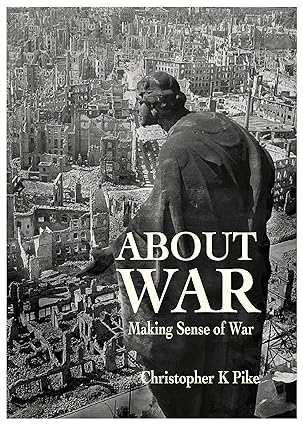
  • ABOUT WAR: Making Sense of War

    ABOUT WAR: Making Sense of War

    War is a paradox and a war is a scandal and regardless of what you think about War, how long or how often you pray or wish for world peace, the reality of the situation is that world peace is a fleeting thing, whereas War has been around since humans first walked this earth and is showing no signs at all of departing any time soon.

    In this fascinating look at War from Christopher K Pine, About War, he has, as have others before him, set down the interpretation of what is defined as War and what is also and perhaps more accurately, Warfare or the art of waging War.

    It is considered that war has no origin, it simply is a fact that men have waged war over almost anything, from land, to football, even stray dogs; in academic circles it is also considered as an activity that is ’mankind’s greatest experiment’.

    So why then do men wage warfare against one another? The Americans summed it up rather neatly by coining the description ’blood and treasure’, but surely there has to be politics and ego at the core of the matter, as well as in several instance a dash of madness, as could be viewed in The Football War between El Salvador and Honduras in 1961 with around 3,000 casualties.

    Pike traces the intriguing history of war to modern times with the establishment of NATO, the United Nations and various other government and non-government agencies, after the global devastation wrought during World War II, to try and prevent the outbreak of such wholesale devastation occurring again.

    But as history tells, war has continued and at the time of writing, war was being waged in Syria and the Ukraine, as well as parts Africa in the long, long list since the cessation of hostilities in 1946.

    Perhaps the release of About War is timely, as the re-election of Donald Trump for his second term in office sees the United States of America on a pathway to isolation, to withdrawing from all the established means of achieving what passes for peace in the modern world, and will help people understand the real issues that lie at the heart of waging warfare in the modern world.

    About War is a timely read that is both informative and fascinating as it paints an excellent picture of what motivates governments to spend millions to send men, women and machinery to war, with the winner, if there is one, taking all!

  • Out of the Woods

    Out of the Woods

    ‘Out of the Woods’ set in 2000, by highly regarded author Gretchen Shirm, takes the reader back to a terrible time in the history of Republika Srpska, Bosnia and Herzegovina; the trail of a former military man, charged with war crimes during the Genocide that occurred in the small mountain town Srebrenica in July 1995.

    Jess, a middle-aged Australian woman, while working as the secretary to an Australian judge during this trail of “K”, not only explores The Hague, and other Dutch cities in The Netherlands, but also her life as a child, mother and now as single divorced woman.

    As Jess sits through the evidence of mostly women, who have lost husbands, brothers and other family members, relating the horrors of the genocide, she has difficulty in associating them with the defendant in the dock.

    As a result of her friendship with Merjen, one of the women, who has suffered unbearable loss and who had given testimony at the trial, Jess’s compassion for the people of Srebrenica is complete. 

    As Jess’s knowledge and understanding of the extent of this Genocide grows, so does that of the readers, who will be continually asking themselves ‘How could this have been allowed to happen?’ They will be moved by the extracts of recorded testimonies, which have been placed at the beginning of each chapter.

    Readers will not be able to leave what they have read of this terrible event behind. This thought provoking novel will no doubt give them greater compassion for those who have endured suffering.

  • At the Going Down of the Sun

    At the Going Down of the Sun

    Inspired by her grandfather’s war service, Mary-Anne O’Connor has in “At The Going Down Of The Sun” successfully melded a family saga with the historical event surrounding World War I. Spanning from country Victoria to Europe and the Middle East, the author captivates the essence of life during the pre and war years. 

    When headstrong Molly James’ reputation was besmudged, she was exiled to live with her maiden aunt in rural Rainbow, Victoria. Here she not only involved herself in the work and social life of the town but she also made true friends with Joanie, and brothers Archie and Thom, who were soon captivated by her charm.

    Although Molly lost her heart to Archie, his brother Thom was also captivated by her charm and exquisite looks. However, the brothers’ passion for restoring a small biplane, lead them to join the flying corps, which would later result in their involvement in the Great War.
    Not to be deterred, Molly would follow her heart; she became a war nurse.  

    As a result of her meticulous research, the author has been able to construct a compelling story, which adheres to the facts surrounding this world event.

  • Wheel of Fortune (The Tarnished Crown)

    Wheel of Fortune (The Tarnished Crown)

    Set during the time of the War of Roses (1455-85) that raged between the Houses of Lancaster and York for the English throne, Book 1 in the Wheel of Fortune – The Tarnished Crown is a gripping read that has skilfully drawn the protagonists and set the scene for the following books.

    Isobel Fenton, only daughter of Sir Geoffrey Fenton has been bought up as an educated young woman, who is destined to inherit her father’s manor and lands of Beaumancote. Her father, injured in a conflict relies on her skills as an herbalist to help with his many ailments.

    She has been betrothed to Thomas Lacy but upon her father’s death she is sent to live with Earl Langton, a man who is powerful, damaged, emotionally hard and obsessed with Isobel. She believes she will be a safe from the turmoils of war surrounding her, but is soon to discover that her life will never be the same again. She may be safe from the war but she is not safe from the Earl, who rapes her and takes her to his bed.

    With her life in tatters, her betrothal cancelled, she flees to her beloved Beaumancote, only to be attacked on the way, rescued and returned to the Earls’ stronghold where life gets even more challenging; a woman with little ability to change the situation even though she is titled, wealthy and intelligent.

    Robert, the Earl’s brother recently widowed is considered as good match for Isobel, as it becomes politically necessary that she is soon wed. He is still grieving for his wife but becomes a friend of Isobel’s and offers to try and help her; become her protector.

    C.F. Dunn has captured the times of the terrible and bloody conflict that saw families, friends and political adversaries pitted against one another in the desire to claim the English throne. This was eventually thwarted by Henry VIIth :the unbridled and lawless activates of both the Houses of Lancaster and York were carried out without mercy and in a cold blooded, ruthless manner.

    What is to become of Isobel, a woman who holds the key to the political upheaval surrounding her is yet to be discovered and will no doubt be revealed a little more in Book 2 Sun Ascension.

    The Tarnish Crown is an excellent, if somewhat bloody read, which leaves a desire to discover that happens next!