Tag: Sydney

  • Woolloomooloo: A biography

    Woolloomooloo: A biography

     Once again Louis Nowra takes a loving look a suburb of Sydney where he has found, much to his surprise, a place where he belongs, a place that fits, a place that although it appears to be largely dysfunctional has a great sense of community, is crowded with history and the ghosts of times past and present.

    But perhaps most or more importantly, a place that has survived the best and the worst the various Governments of the day have managed to thrown at it ever since it was dubbed a suburb, and yet somehow always treated as the poor relation; a place where the lower levels of society lived and died, all overlooked by the residents of Potts Point perched high above.

    Woolloomooloo was created as a suburb of Sydney, way back in the early days as a docklands, becoming home to the seafarers and workers earning their living from the docks areas. Rubbing shoulders with the notorious Kings Cross, the suburb soon developed a fearsome reputation, one which until recently has held true.

    Nowra discovered, over time, there is far, far more to this much maligned area of Sydney than its reputation would have one believe and although colourful and violent at times, it has a heart, a soft side, a side that struggles to be seen and heard.

    Discovering the Old Fitzroy Hotel one afternoon, he arrived at the bar in his black suit and white shirt, with his Chihuahua Coco, who somehow seemed to know where she was going, ordering a gin and tonic. He admits he felt rather out of place surrounded by tradies, labourers, and locals.

    He again set out for his evening ramble through the streets the following day, only to once again find himself being led determinedly to the bar at the Old Fitzroy, which was to be the beginning of a long and seriously enjoyable association with not just the hotel, but the locals and the history of this much beleaguered part of Sydney town.

    As the months went on, Louis Nowra found he was beginning to settle in at the Old Fitzroy, becoming considered as a local, as one of the crew, a ‘regular’ to be exact. This is his story of what has become his beloved Woolloomooloo and in telling his story, he has entwined the present with the past in a narrative that is as fond and loving as it can be critical and almost scathing at times.

    As each of the characters unfolds, both past and present we are introduced to a world we generally know little about, a world where acceptance is the norm, change comes slowly and often with unexpected consequences. We see the charm, the degradation, the resilience and the very heart and soul which make up a community that is more like family, who, in spite of what can often be significant differences, look out and care for each other.

      By writing this loving look at Woolloomooloo, lumps, bumps and all, Nowra has definitely placed it and the Old Fitzroy on the map, a place where the ‘real theatre of life’ is played out, where you can get a cold beer on any given day and rub shoulders with the locals, enjoy a conversation or two with many and step back, just a little in time, to what is perhaps one of the last remaining icons of ‘old Sydney’ as inevitably, just like Kings Cross, it too will become trendy and expensive, morphing once again into its new identity.

    Unforgettable and absolutely enjoyable, Nowra’s words bring to life a place, which if you never, ever get to visit there, makes you feel like you already have been to that place with the almost unspellable name, the name that rolls off your tongue, Woolloomooloo!
  • Wayside

    Wayside

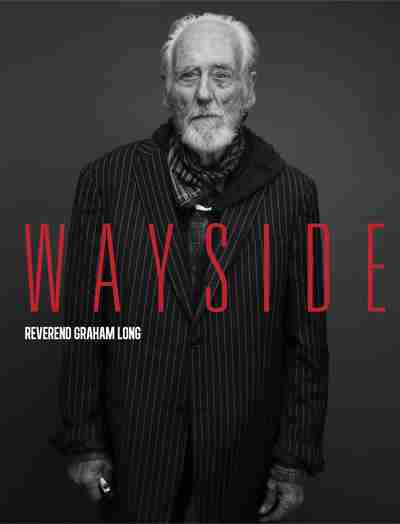
    The face on the cover tells a thousand stories without uttering a word: Love Over Hate just inside the cover, makes a statement from a man who has seen it all, it’s there in his eyes. He has seen the hate and then he has felt the love.

    Detailed throughout the book, captured in black and white so there can be no distraction when you view the photographs, are the people seen on the streets every day. The people who have been dealt a rough hand by life one way or the other, the people who, should things have been different would not perhaps be gracing the pages of this incredibly joyful book, that in a strange a way celebrates life; celebrates that there are people everywhere in all walks of life who are good, kind caring people who have come to, or through, or are a part of the amazing and loving work carried out daily by the Wayside Chapel in the Kings Cross area of Sydney.

    Established back in 1964 the Chapel began providing help for those in need. The care and love offered was unconditional. Over the years this unique Chapel has carved its place, not just in Sydney but into the history and folkloric of Australia.

    Many of the people who come to the Chapel seeking help have lived other lives, but discovered that the slide to the bottom, to life on the unforgiving streets, was not very far to fall at all. Their life span is not long and as is stated by Graham Long, everyone captured in this book is still alive, but many of the others in the previous two books have long since passed on.

    Looking at the magnificent pictures of both the visitors and volunteers who make up the family that is the Wayside Chapel, presents you with many emotions; sadness, love, hope and reflection, perhaps reflection being the most important aspect, in that ‘but by the grace of God, there to could be I.’

    Although the Chapel was created in 1964 it fell on hard times and when Graham Long accepted the challenge of Pastor, he had little idea of what he was taking on. A building which had seen better days, a few staff, a few ‘disconnected’ volunteers and the needs of a community people had forgotten. Against great odds, he and his staff of volunteers have gone on to rebuild, reconstruct and to continue to carry out the work of offering hope and unconditional love to all who come this way.

    Pages carry magnificent black and white photos of someone; a group or a family, occasionally a couple. Each of these photos comes with a story taken from the weekly note ‘Inner Circle’. Each of the stories paints yet another picture of life on the ‘other side’, life a so many know as their only existence, but also a life that offers hope to some, caring to others and companionship when times get tougher than usual.

    The stories are perhaps more powerful than the pictures, but then stop and take a really close look at the people portrayed and you will find what you discover comes with a humbleness that should be remembered.

    Be captured by the journey, stand in awe of the work being carried out, the people, the very many people, the haves, the have nots, the ordinary and the extraordinary, who have come together to create what has to be not just a shining light in Sydney, but an shining, living, daily example of Love Over Hate that is there every day, all year round.

  • The Worst Woman in Sydney: The Life and Crimes of Kate Leigh

    The Worst Woman in Sydney: The Life and Crimes of Kate Leigh

    Hero or villain, Kate Leigh, this is the question. How does a rebellious, recalcitrant teenager who was sent away to a reformatory become the wealthy ‘Sly Grog Queen’ in eastern Sydney’s male dominated world of petty crime? Read Leigh Straw’s book. She has written the first comprehensive biography of Kate Leigh, who was not only referred to as ‘The Worst Woman in Sydney’ by the police and newspapers of the time, but by others considered the benefactor of the poor. Local hero to some, scoundrel, brothel owner and cocaine dealer to others.

    Avid true crime readers will rejoice at the arrival of ‘The Worst Woman in Sydney: The Life and Crimes of Kate Leigh’ in the bookshops. Here is an informed account of a criminal, her exploits and her celebrity status – her home is now a popular café in Surry Hills.

    The author explores and dissects Kate’s complex life (personality and attributes) in the 1920’s and 1930’s Surry Hills environment. Kate Leigh’s criminal history (over 100 convictions) is put in context of existing laws and regulations, while anecdotal evidence is used to make the protagonist come alive. Including scenes from Kate’s life, which are told from her perspective, allow the reader to gain greater insight to the questions of ‘hero or villain’, ‘notorious crime boss or benevolent matriarch’, or ‘ruthless rogue or kindly patron of the poor’?    

    This engaging book is also a thoroughly researched social and criminal history of aspects of early twentieth century working class Sydney. It is comprehensively referenced and well documented without becoming overly academic and tedious. The reader is carried along the highways and byways of Kate’s life and times by the lively, highly readable text.

    It is a relaxing read for not only ‘true crime’ fans but also for readers interested in the seedy life of those in Sydney’s ‘underbelly’ in the early twentieth century.