Tag: culture

  • The Pacific Room

    The Pacific Room

    The Pacific Room is an interesting and clever novel. The author slowly unravels the tale, and involves the reader in the lives of the main characters, and the customs and culture that surrounds them. The writing is almost lyrical, and blends in beautifully with the swaying palms and the movement of the ocean. As with the ocean, there is an undercurrent, which is mesmerizing to hear, and slow to be revealed.

    The story uncovers the final years of “Tusitala, the teller of tales”, as Robert Louis Stevenson was known. He chose to live out his final years in Samoa with his wife and family, embracing the relief that the warmth gave him while he suffered from Tuberculosis. And yet, the focus of the story is on an art historian, Lewis Wakefield, who is doing his honours Thesis. He is trying to track down information about an Italian artist called Girolamo Nerli. Nerli wrote to Stevenson and said that he wanted to compose a portrait of the author in his home in Samoa. This was many years before Lewis knew of him. After the artist completed the portrait he vanished into obscurity.

    Lewis is curious about the painter, Stevenson and his American wife. The story then switches to follow Nerli, as he arrives at the house of the “Teller of Tales”. He meets the step children, one of whom informs him that the map in the story “Treasure Island,” was his work. He is also shown a portrait of Stevenson and his wife done by John Singer Seargent.

    At this point, we begin to meet some of the local people who are described softly and carefully. Their Island home has melded them into gentle characters living simple, almost spiritual lives. Lewis is invited to share in a festival which celebrated the courage of a man who was leading a peaceful protest and was shot down by police. Here we learn about sights, the sounds, the smells of this wonderful tropical island, and as Lewis says “His senses are too busy to worry.”

    The movement between Lewis’s accurate observations of the Island, its people, and the artist’s impression of the household and the model he is painting is smooth. It is not at all difficult to move from time past to time present, and the wonderful use of flowing language and linking of ideas aids this. Gradually as issues are revealed they merge seamlessly with what we already know.

    The delight in this story is following the main characters and understanding what motivates them. It almost seems that the portrait is secondary to the emergence of the written word. The controlled and stylish language moves us seamlessly between culture and history. This has been called “A love letter to Samoa,” and the delightful setting certainly adds to the story and the actions of the characters.



  • The Honest History Book

    The Honest History Book

    In this collection of 19 essays we are introduced to another, perhaps more intimate, and definitely factual look at the basis of what has become in Australia, one of the country’s most influential, widely celebrated cultural and historic events, that of Anzac Day and the legend, folkloric, the myth, the barbarism that has created the legend of Anzac and what is often referred to as ‘Anzackery’.

    But what is it that has created such a modern day juggernaut of an event, where actions both heroic and appalling, more than 100 years old are celebrated, are remembered, as are the men and women who gave their lives, their sanity, their all, to go to a foreign country and enter into a fight that claimed hundreds of thousands of lives, all in the name of King and Country, certainly not in the name of Australia!

    Each of the essays takes a very salient point from our Anzac history, dissecting the events, placing them into context and then aligning them with modern times. What is presented is extremely confrontational, certainly presents a far wider view of the issues which started the events in the first place and in many cases, explodes the myth, the legend, which has grown up around an event to gloss over, make far more palatable, the very unpalatable issues which many would say should be better left undisturbed.

    The words of Mustafa Kemal Ataturk, (1881-1938)recalled some 15 years after his death by Sükrü Kaya (1883-1959), which are now embedded in history, is one such case where politics far overrules reality and goes a long way to gloss over the very real tragedy that was Gallipoli.

    The central point to this collection though, is not to degrade what is a right and fitting remembrance of the wars Australia has been involved with right up to current commitments, the right to look back and remember and pay tribute, but to put into place that far more has gone into Australia’s history than just wars fought overseas on behalf of other countries.

    The reality is presented poignantly by Paul Daley in chapter 17, Our most important war: the legacy of the frontier, where he looks back to the beginning of the white settlement in Australia and the horrific events that took place over many years and almost succeeded in completely wiping out the indigenous people of Australia.

    So much more, goes into building a country that eventually came of age as Rebecca Jones presents in chapter 10, devoted to the harsh climate of Australia where year’s long droughts can wipe out communities, which are then often followed by rains that create massive flooding, then the devastation of bushfires takes its terrible toll; all these factors  and many more bring out the resilience which is what the Anzac legend, myth, folkloric is really all about : the mateship when the going gets tough, almost impossible, the strong resilience that allows the rebuilding, the faith and hope that tomorrow the sun will shine and things will begin to get better.

    There is definitely more, far more, to the tradition of Anzac than the involvement in wars far from our shores. As each chapter unfolds you will find that you have developed a fresher, far more balanced and informed understanding of exactly what it is that makes up the wonderful, glorious tradition of ANZAC, but you will also have a better understanding that there is considerably more to Australian history, to the Australia people and character, than one period in the timeline of modern Australia (1770 –   ), that of World War I, which most certainly set the standard, so very long ago.

  • We Come Apart

    We Come Apart

    These two authors have combined to produce an amazingly powerful work of young adult fiction.  The dual perspectives, given by two narrators, give authenticity to each of the characters. Jess is a young woman who has an extremely unhappy home life, and reacts in a belligerent and angry way. Nicu is a young man from Romania, who has come to England with his family. The authors have written separate chapters for each character, and each has very different voices.

     Nicu is learning the English language, and his broken English can be very insightful and beautiful.  …. 

    “She seem total tragic sad. And I want to rush to her……….. feelings show her my smile”

     Nicu is attracted to Jess and wants to form a friendship.

     The story is written in free verse which makes for fast and gripping reading. Words are used carefully and succinctly, drawing the reader instantly into the plot. There are themes which are troubling, but common. How people deal with such things as domestic violence, racism and bullying is shown on a personal level, and there is no easy solution. One does what one must at the time.

     The characters are portrayed so completely and simply that you cannot help but form opinions of them and their behaviour. Jess and Nicu meet because they are both in a Reparation scheme. Although the most unlikely people to get together, they have much in common. His family wants to earn and save money so they can find a bride for him, while he wants freedom to choose whom he marries and when. Being accepted in the English town they have arrived in seems impossible, despite his smiles and friendliness. School is also a nightmare.

     It would be sad to think that there is so little hope and help for people in this situation.  The solution for Jess, whose mother is a silent victim of domestic violence, and for Nicu, is to make radical changes to their lives. A plan is devised, not in a cool, practical way, but in the heat of a dramatic situation.

    There is no instant fix here, and one feels that both the characters have a long way to go to find happiness, and contentment in their lives.


  • Black British

    Black British

    Congratulations must go to the author on her first novel. It is a wonderful read. It tells the story of her family life set in the dramatic period (1958) in India after the withdrawal of the British. The descriptive writing is engrossing, while the humour and family antics make it enjoyable and hard to put down. Ms De Souza has been able to capture the characters in the novel in an intimate and careful way. You would be sure to know them if you met them in the street!

     The De Souza family consists of Mum, Dad, Lorraine, Lilly and Lucy. The story is narrated by Lucy as she returns to her home in Kanpur as an adult. Their family were descended from the Portuguese who originally lived much further south in Goa. The extended family settled further north, in Kanpur, and followed the British traditions. Then the British left. The family had no one to socialise with as the locals despised them, so they were a close knit family. Father managed the mill, and would have nothing to do with corruption or black money. They were always prepared for trouble, always very careful to take many precautions, both around their home and when going out.

     Due to these restrictions, the evenings were spent together, with much reading of stories, playing of games and the bickering that will always exist between three girls. Mother was a patient, resourceful woman, who worked incredibly hard to make life fun and rewarding for all. There were some hilarious moments when Lucy first arrived at the Catholic School. She couldn’t believe the Nuns wanted her to call them Sister. “But I have sisters”, she replied with shocked disbelief.

      After having three children in quick succession, Mother decided to take a holiday. This was explained to the girls, but Lucy, at about five years of age, didn’t quite understand the implications. On the day after her mother left, she went to school and was overwhelmed by the enormity of her mother’s absence. She screamed! Long and loud and red in the face until her uncle came to pick her up from school; but not before all of the other children in her class were screaming as well.

     Lucy was a very bright girl who caused her to question and speak up when she sensed injustice. She became aware of the fact that their extended family was surrounded by hostile people, and she was not accepted by the British either. As the girls grew, they realised that they would have to leave the home that they loved and the animals they had used as guards, Reg the dog, and the geese, and the turkeys. Older members of the family died, and the family safety  became paramount.                                                 

      Returning as an adult, Lucy realised “There is an inherent human need in each of us to know what went before us, and how we are related to it and therefore to each other. It is this knowledge that anchors us to our identity…” She stands before the Church where her family have been baptised for the last four hundred years, and looks around. The sense of belonging she has yearned for in England is here. Now she can explore it and move on.


  • I Knew You’d Have Brown Eyes

    I Knew You’d Have Brown Eyes

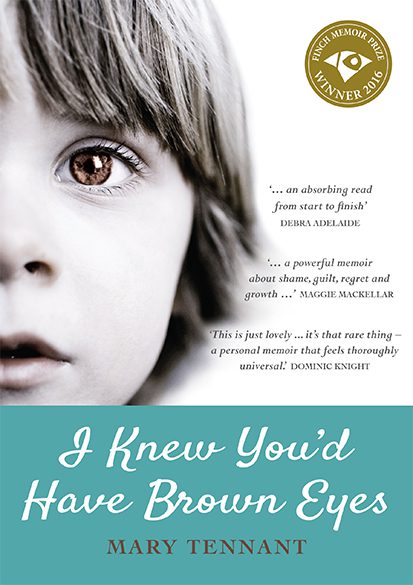
    The story Mary Tennant has chosen to tell is a personal memoir of her life which will resonate with so many people. In 1974, as a seventeen year old, Mary found herself pregnant. Her family was an ultra-conservative Catholic family, who lived in Queensland. Mary’s mother was authoritarian, and a very unforgiving and cold woman. Mary was hoping to gain entrance to University, but didn’t make the required mark because of constant sickness during the exam. This is her story, told in a factual, clear and truthful style, which immediately aligns the reader to her plight.

     Abortion was out of the question, because Mary feared her mother’s reaction, and also because she and her boyfriend didn’t know where to go, or how much money they would need. Eventually she resided in a home for pregnant girls, who were all advised to have their babies adopted out. The birth was easy, but when the nurses said it was better for her not to see or hold the baby, it was devastating. The Adoption laws at that time made it clear that she was not allowed to ever contact her son. Mary began the next phase of her life.

     Although she had wanted to study medicine, she trained as a nurse in a large hospital. From here, she moved to many positions, continuing her studies, never forgetting her son, celebrating each of his birthdays. Mary decided to work with Indigenous Communities in the Northern Territory and spent time on Groote Eylandt. Some of the stories she relates are amusing and all are fascinating. Aboriginal customs are well respected in this area, and when a man had his leg amputated, it was meant to be returned for burial and ceremony. Unfortunately the leg went missing, and a huge leg hunt was undertaken until the limb was found and returned.

     In the remote communities where she worked, Mary found friends who loved to water ski and camp, and she also went food gathering with the local women. Still, she never forgot the son she had given away, and seldom shared this information. It was her dream to meet someone and begin to build a family of her own. Eventually, she did meet the man that she could trust and confide in and eventually marry. Mary gave birth to two daughters, and still looked out for any changes to the Adoption laws to help her contact her son.

     Eventually, those changes came about and she was able to contact her son. We share in the wonder and amazement she felt as she related to him as a very familiar adult.

     The title of this book is touching, revealing the thoughts and longing that Mary carried with her for all those years. As well as a true story, which has not written as an emotional outpouring, but with dignity and truthfulness, Mary has many amazing stories to tell of her work and her family.

     The issues of abandonment, grief and loss are considered and shown to be so powerful in shaping people’s lives. As Mary says, about Abandonment, “For some it builds resilience, and yet for others  …it had spelled disaster.”

     The story is very deserving of the Finch Memoir Prize for 2016.

  • Turner Classic Movies: The Essentials: 52 Must-See Movies and Why They Matter

    Turner Classic Movies: The Essentials: 52 Must-See Movies and Why They Matter

    What a fantastic coffee table book this is. For all movie buffs and anyone who wonders why a movie is classed as a classic, this is the ultimate guide. One’s first thought about this book is, “How do you define what is an essential movie?” This is addressed in the beginning pages.  One of the answers is ….“Their fluid mix of comedy, drama, romance, and suspense – so satisfying for audiences because it engages multiple corners of their brain- is one of the most difficult results for film makers to achieve.”

     The list of films presented in this book, begins with “Metropolis” (1927)  and goes through to “This is Spinal Tap” (1984). Many of the films are widely known, such as “Gone with the Wind” and “Citizen Kane,” but some are not so well known, such as “The Bicycle Thief”. Each film has a page outlining the Directors, Producers, Screenplay Persons, and the Leading Characters. A short synopsis of the story is given, and then there is a half-page discussion about why this film is essential viewing. 

    In the film King Kong, Fay Wray “had to react convincingly to what in the reality of the film set, was nothing.” Her screams were convincing, and the musical score was magnificent. This was the first time distinct themes had been used for different characters. “King Kong laid the groundwork for all monster and disaster movies to follow.”

     After this information about each film, there is a segment called “What to look for.”  King Kong opened in an era where there was no production code. There are some graphic and suggestive scenes, which certainly would not be allowed today under the current rating systems.

     The Essential looks at the Western movies, and in particular, “Winchester 73.”  This is where the career of James Stewart began, and “incorporated a dark, psychological intensity that impacted the genre forever.”  Messages that” violence by the hero was not necessarily heroic …paved the way for later westerns.” The Director of this movie, Anthony Mann, was one of the first to make sure the audience was clear in its spatial understanding of where the hero and villain were during the final shoot out.

     Singing in The Rain is another movie discussed and explained, with Gene Kelly shown to have experimented with dance numbers to give them as much dimension as possible. He used “innovative choreography, camera placement, lighting and colour to imbue depth and dimension.”

     Each film examined is given thoughtful and precise reasons for being selected in this list of excellence. It is fascinating to read the little tit bits about actors and photography, and directors’ tricks. In films such as “Red Shoes,” camera speeds were changed to make newspaper spin and turn into a newspaper man.

      There are some  films that you may not have seen, but as winter approaches, sitting down with this book in hand and the film on the screen, could not but lead to a satisfying few hours. There are fifty two movies lovingly discussed and unwrapped for the curious reader.