Tag: WW2

  • Against the Rising Sun

    Against the Rising Sun

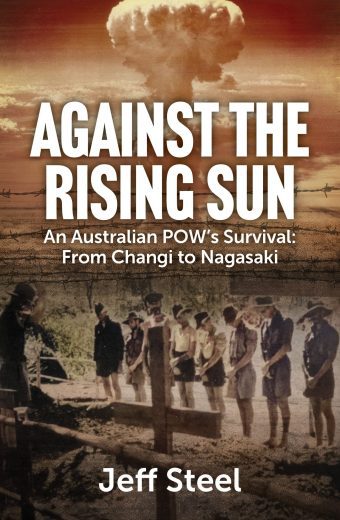
    An Australian POW’s Survival: From Changi to Nagasaki

    Volunteer Australian soldier Don Graham, part of the greatest military disaster in the British Empire’s history, like many returned soldiers, rarely talked about his wartime experience.  It has been left to others like Jeff Steel, successful Australian author of military history to ensure that this important time in Australia’s past is not lost to future generations.

    On 22nd March 1941, aged 19 years, Melbourne born Don Graham joined the Australian armed forces; too young to qualify for an overseas posting. Mysteriously, his date of birth was pushed back to 1920, so on the 2nd of November 1941, signalman Don Graham boarded the medium-sized vessel Zealander and headed for Singapore.  He was to fight valiantly as part of the ill-fated Australian 8th Division, firstly in Malaya and then to retreat to Singapore, where he courageously took part in street fighting.

    Taken captive, he was marched off initially to the notorious Changi prison and later to Japan, where he became part of the slave labour contingent to work in the Kawasaki shipyard in Kobe. Despite the brutal treatment, lack of food and being surrounded by death, Don with his magical card tricks endeavored to remain brave and to encourage his mates to be positive about their future.  When Kobe was obliterated by an American air raid, he became one of 300 men to be sent of a coalmine at Yoshikuma: a certain death trap.

    Readers will find this eye-opening detailed account of Don Graham’s ordeal in World War Two, both inspiring and confronting. Inspiring; despite imaginable horror, the human spirit survived.  Confronting; the details of the atrocities perpetrated by the Japanese on their captives is beyond comprehension.

    Definitely a must-read book not only for those with an interest in the war in the Pacific but also for those who want to obtain a greater understanding of Australia’s participation in this war; the excellent ‘Select Bibliography’ will help readers to further their understanding of this period in Australia’s history. 

  • No Heil Hitler

    No Heil Hitler

    A True Story of Faith, Courage, and Defiance in Nazi-Occupied Poland

    Award winning authors Paul Cieslar and Jeff Steel’s fascinating book ‘No Heil Hitler!’ is not only an inspirational memoir of the life of the remarkable Paul Cieslar, who lived in Poland during the harsh German and Russian occupations, but it is also a cultural history of the Adventist community in Wisla, Poland during that time. The authors have crafted a touching and insightful recount of life for the citizens, whose resilience and fortitude in this time of extreme hardship, was beyond extraordinary.

    Pawel (Paul) Cieslar grew up on a subsistence family farm in Wisla, a town located at the foot of Barania Mountain in the Beskid Mountains, Poland. In September 1939, when Pawel was 10 years old, his life changed dramatically; life under the regime of the Third Reich with its restrictions and abuses had arrived. Paul was robbed of his childhood, and he was to witness some of the worst crimes in the history of humanity. He attributes his family’s survival to their faith and the courage and inspiration provided by God.    

    I highly recommend this memoir to all readers, not only to those who have been fortunate never to have experience war but also those who have survived occupation.  Despite the harshness of the times, the author’s recount of events is never morbid as it remains overridingly uplifting.

     ‘No Heil Hitler!’ will captivate readers, giving them an understanding of the difficulties of life and the resourcefulness of ordinary people in times of extreme oppression; they will no doubt reflect on the situation of those currently living in war-torn countries.   

  • The Battle Within: POWs in postwar Australia

    The Battle Within: POWs in postwar Australia

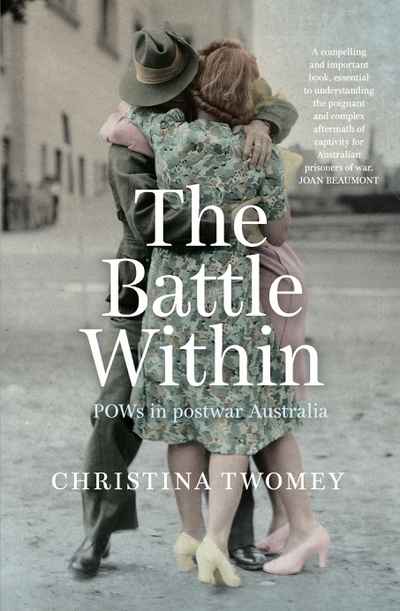
    The front cover of this book depicts the loving embrace of a soldier and his wife after his return from war. It would almost appear that the hardship and nightmare was over. The author has researched and presented a factual and powerful argument that this was not the case. Using Australian Government records, as well as many other sources, Christina has written this rather shocking and sad account of the reality for POW’s and their families.

    The attitude in Australia to POW’s was rather strange. They were seen as soldiers who had surrendered to the enemy, rather than fight on, like their compatriots in other regions. The reality of this was it was not their decision. The personal accounts in this book are taken from the men who applied for grants from the “War Trust Fund”; they were frank and honest about their struggles to reintegrate into society and family life. The Australian War Memorial in the 1990’s had only a small section devoted to POW’s, and this focused on objects like swords and ham radios. It seems unbelievable that this attitude was also reflected in the thinking of Generals such as Blamey.

    The chapter “A Broken Body Of Men” outlines the mental struggles and psychological disorders which was the lot of so many returned soldiers, but especially POW’s. The Red Cross insisted in their report in 1947, that “Very few POW’s made a permanent adjustment, and many were prone to personality problems.” A Government Committee was formed and ultimately decided that the “Psychological consequences of captivity had been exaggerated and that far too many pensions were being granted for anxiety.” It was also thought that many of the symptoms shown by these men could be caused by gastrointestinal worms. Sterility was also an issue for many of these returned soldiers, but again was not seen as specific to POW’s.

    Support for this group was delayed until a former POW became a Member of Parliament. Winton Turnbull launched the “Subsistence Allowance claim,” and continued to fight for it. The RSL requested that the government support this, acknowledging a degree of suffering for this group of men as a basis for the request.

    In 2001, the Government passed an act (Compensation for Japanese internment), and men were given a one off $25,000 payment. How sad that the ones who survived, and their families, had to wait so long.

    This is a breath taking, factual recount with many lessons to be learned for the future.