Tag: Words

  • Bookish Words & their Surprising Stories

    Bookish Words & their Surprising Stories

    If you are a lover of words, their origins and meanings, this small book with a big title, is for you. David Crystal is a professor of linguistics at Bangor University. The anthology that he has compiled shows the way words have shaped our writing and reading over the centuries.

    He tells the story behind these 100 words and idioms, and uncovers many surprises relating to how meanings have changed. Each entry shows the stages of influence and linguistic origins, and the development is traced over time.

     When Romeo first kisses Juliet, she says “You kiss by the’ book.”  She means he kisses expertly as if following a set of instructions. Today, we refer to things that have been done in a specific way as “By the Book.”  Someone who never does things by the book is considered a free spirit.

     Deadline. This word was used as a boundary line. Prisoners risked being shot if they crossed the boundary line. It was first used in the mid 1800’s to mean motionless, such as a fishing line.

    At the end of the fascinating wander through words and idioms, there is a section on further reading which mentions other books and authors who collect words and their usages. Following that there is an index of the words examined.

    Bookish Words & Their Surprising Meanings is a meticulously detailed compilation.

  • Temora and the Wordsnatcher

    Temora and the Wordsnatcher

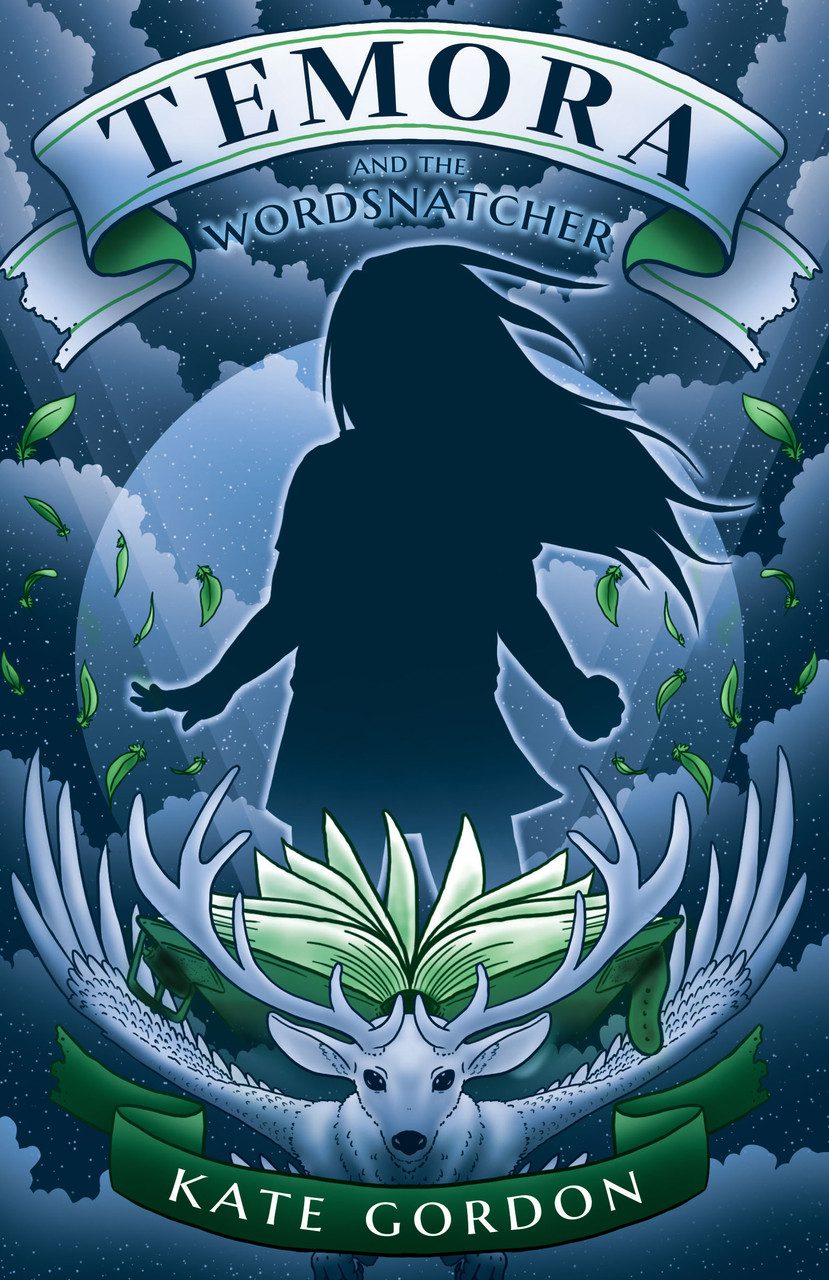
    Temora Murphy is the main character in this fantasy novel from Kate Gordon which is quite complex and has many twists and turns which gradually reveal some strange outcomes. Temora is eleven years old.

    Temora and the Wordsnatcher begins with Temora’s mother holding her baby and weeping as she has to part with the child. Temora is to be given to a “Safe keeper”, to protect her. The next few years for the babe will be lived in another story book with another mother, a mother not as kind nor caring has her real mother

    In fact, the girl lives in a kind of limbo as her carer mother really wants little to do with her. She lives a cold, sad, and lonely life until the age of eleven when she discovers that a wish on a birthday candle can make a difference. When she is aged twelve, she again wishes on her birthday candle and suddenly everything changes.

    She is transported to a different world where she learns that her presence has been long awaited. She is to become an apprentice and live in a community with other children. At last, she has company and friendship of others. So, a different life begins for her but all is not as it seems, for there are dangerous and evil people who have created magical diseases. It seems that her story must be to overcome these destructive forces.

    Temora and the Wordsnatcher is an imaginative and complex tale for good readers and is Book 1 in the Wordspinner series.

  • A Life in Words

    A Life in Words

    Collected writings from Gallipoli to the Melbourne Cup

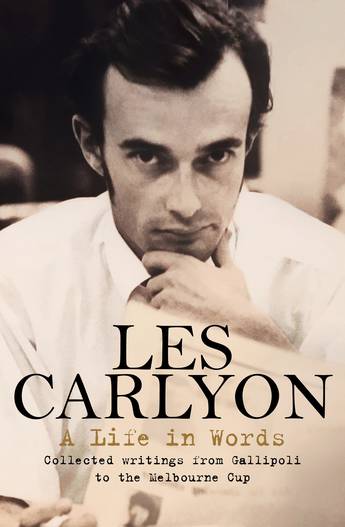
    The forward to A life in words is by Les Carlyon’s son, Patrick offers a very personal look into the life a man who became a legend in his time; a man known for his craftsmanship with words, and a definite flair for storytelling. It is a perfect way to commence visiting and revisiting some of the many stories he wrote over many years of reporting on just about everything of importance that made up the very diverse times of his long life.

    Carlyon’s career in the media was nothing less than stellar, winning two Walkley Award’s for his work before going on to be awarded the coveted Graham Perkin Journalist of the Year Ward. Over the many years of his career, he reported on everything from politics to horseracing, managing to be able to drill down to the very core of the matter under discussion with a care for accuracy, always mindful of being able to deliver a ‘good ’story, a story that the readers would accept as the truth and as credible news.

    A prolific writer the works gathered within the covers of A life in words capture the very essence of the man, his passion for news and this love of creating not just a news story, but a story that was redolent with the emotion of moment, captured on the page of news print for eternity. He was once asked if he ever wrote a bad story. His answer was no!

    Separated into nine sections, his many years of reporting on the news of the day offers a retrospective look the stories that have formed the history of modern Australia and in many instances, the world.

    He reflects on the almost magical, tragic life of Diana Princess of Wales in Goodnight, Princess, a small piece in which he ponders the legacy left, the tragedy that was her, as if he is trying to understand how her legacy has had the power to remain alive so many years on.

    Looking back, he writes of the history that is the second world war in Hirohito; each-way punter offering a very different take on Hirohito and his very deliberate double standards.

    A delightful section is Satire which is immensely enjoyable and shows a playful and yet very clear understanding of people in Illness thoughts, reflecting on a time when he was laid up in bed recovering from an illness; a time when one is drawn to reflecting on the nature of the cosmos and many other such weighty matters.

    Maggie Thatcher, Paul Keating, Bob Hawke, John Howard and many others rub shoulders in Politics, a section which allows a very interesting perspective of Australian and world politics, now retrospective, to be delivered. That this section is retrospective will no doubt to younger readers be food for thought, research and discussion, but for older readers it may help explain what once was considered unexplainable by the masses.

    Not a book to be devoured in a day, or even a week, the work of Les Carlyon deserves to be savored, enjoyed and treasured. Perhaps, in the modern world of ‘fast turnaround news gathering’, his work should be used as a yardstick for reporting on a story and always ensuring a good story is presented.

  • Strayan Dictionary

    Strayan Dictionary

    As one of the founders of the popular show The Chasers, Domenic Knight knows a good deal about the English language and of course how to speak ‘Oztrayan’ or Strayan, the new Aussie style of speak that somehow seems to have taken over from Strine, the old ‘Oztrayan’.

    To prove it, he has spent hours and hours researching words along with other things, to create the Strayan Dictionary for those who don’t get Strayan and the wonderfully colourful words that make up the lexicon of the Strayan person.

    Not only has he researched the words, but also some of the many quaint customs, err sorry history, that go with the vernacular such as, interestingly enough, the word A.AAARDVARK common as the first entry into all Yellow Pages phone books created before Google took over the marketplace making phone books almost obsolete.

    Moving right along though, the word Cobber, no longer in modern use, has been replaced by the word mate, which men use eloquently when out in male groups, but originally appears to have come the Yiddish word ‘chaber’ meaning comrade! Who says we are not a multicultural country?

    Nasho was word in common use during the Vietnam War, when men of 20 years old were drafted into National Service. It was a lottery where, if you won you went into Military Service for two years, while everyone else got on with the lives.

    A more modern addition is Seachange, based on a former television series, where the protagonist moves from a hectic city life, to what is meant to be a fresh, more peaceful life by the ocean. Treechange has derived from this terminology, but sadly the price of Seachange and Treechange lifestyles have gone up exponentially over the years in between, making this a not so desirable option for the everyday Strayan.

    Ugg boots or ‘Uggies’ to those initiates, are beautiful warm boots made from sheepskin and worn by bogans, which would be a point to be seriously disputed by owners of beloved ‘Uggies’, and possibly bogans!

    And believe it or not the Yidaki should not be confused with a Didgeridoo, or ‘Didge’ even though they look almost the same! A Zac was a sixpence back in the day, pre decimal currency and the Zuytdorp rose to fame by becoming wrecked off the West Australian Coast and now rises to fame once again as the very last, yep, very last, on the list of Australia Post’s alphabetical list of postcodes.

    In between A.AAARDVARK and Zuytdorp is a world of wonderful, glorious quirky facts which go to make up the background history of the everyday Strayan, and their colloquialisms. Perhaps the Strayan Dictionary should be given to, or included in every tourist pack, before they, tourists, come to this wonderful, idiosyncratic country known as Australia, or Oztraya, depending on your place of birth, so they totally get How Good is this Lucky Country of ours.

    Hooroo.

  • The Little Book of Lost Words

    The Little Book of Lost Words

    Language changes over the generations and centuries with so many wonderful, rich, and incredibly funny words, at least in the world of modern language, becoming obsolete or simply lost in the welter of new words, especially in the world of internet, mass abbreviations and changes of meaning.

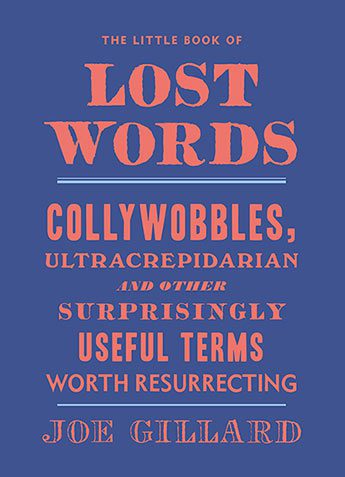
    But with Joe Gillard and his wonderfully funny, irreverent and quirky The Little Book of Lost Words, words that have long been discarded on the pile of ancient things, have still got influence, nuance even, and though dusty from lack of use, once rediscovered, along with the very cheeky illustrations served up with the modern vernacular of the word, make for some serious fun to be had, courtesy of the English language.

    As the book begins at A as all good books on words should do, how many of you have had to Absquatulate or run off with someone in a hurry; to abscond from a situation not always of your making.

    Water coolers at the office are often a place for Causerie, particularly when Doundrins are being planned or the issue of Fabulosity by a friend or workmate is under review!

    Gardyloo has thankfully long gone from everyday use, but maybe, in the case of the modern explanation of this word, should be reintroduced and used as due warning after a heavy night out.

    The world of politics can certainly benefit from the use of words such as Ninnyhammer, a perfect word for those who choose not to vote, or Mumpsimus, when the topic of climate change is discussed with politicians.

    Have you recently been invited to partake of a Prandicle, or a Quafftide or are you someone whom is already living their Quaintrelle, a life full of passion, leisure and enjoyment?

    Perhaps you know a Snool or an Ultracrepidarian or someone who will, whenever possible, indulge in Waggish behaviour, which has got absolutely nothing to do with WAGs. Or maybe it has!

    Enjoy entering the world of colourful language, a place when upon reading these long-forgotten words, could see them Mayhap, finding a permanent place once again in modern language.

    If you are a word nerd, a lover of history or simply enjoy a seriously quirky, irreverent read, this is the perfect book for you, or your friends, or your family, or anyone else who is Ramfeezled after a hard day and is need of a good laugh.

  • 101 Weird Words (and Three Fakes) From Ambidextrous to Zugzwang

    101 Weird Words (and Three Fakes) From Ambidextrous to Zugzwang

    Just in time for the summer silly season is the very fascinating 101 Weird Words (and three fakes) from the master of words, David Astle. He has dredged through the Dictionaries of the World to come up with an amazing collection of very real words, beginning with Ambidextrous and ending in Zugzwang, no kidding.

    But there are three fake words hidden somewhere within this alphabetized lunacy of language, which also in typical Astle style, is filled with puzzles, challenges and other exiting word games, just to see if you are awake. Perhaps Zugzwang is one of these fake words.

    Each of the selected words come with a complete set of instructions as to how they are pronounced, what they mean and how they can be used. Sometimes this is presented in the form of a riddle, or perhaps in the case of the Hobnob, how it came to be a word and how both the words that form Hobnob, came to join up with one another to make one word!

    A Quidnung is all about gossip, something we all know about, or do we, whereas Temploid is certainly not something from outer space or part of a video game! Bet ‘ya it’s not!

    Dotted throughout the pages are also some extremely Astle -like cartoons, created by Paul Tippet, to help illustrate a word or a point and to add a little comedy to words that really are already comical, amazing, and confounding, but most of all should be admired, as they hold their own amongst the more pedestrian words that also make up language.

    Of course, there is the challenge of discovering the three fake words amongst the 101 addictive words that you will definitely be trying to use in all of your conversations over the summer, simply to confound those around you.

    Happy word hunting as you track down the Triantiwontygong, or the outlandish Manticore, but make sure you don’t do it in your Juggernaut as you may well start something you can’t stop.

    Great summer word fun to be had for all, once again beautifully presented and created from David Astle, the Master of making language fun.

  • Linkee

    Linkee

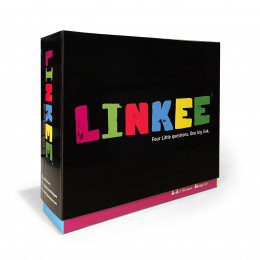
    Linkee is a party game played with teams and a question master. It is well presented in a sturdy box which is brightly coloured and appealing. On opening the box, we find a minimum of pieces consisting of three sets of cards, four pads and four pencils. There is a sheet explaining there are a very few rules, and the game is fun and simple to learn. It is a trivia and word association game, where you can have many players in teams.

    To begin, you need to select a question master who will ask all the teams the same four questions, which are on one card.  Once the answer to the questions has been written down, the trick for the team is to find the common link that all the answers have. When this is agreed upon, the team shouts out LINKEE, and gives their answer. If the answer is correct, the team wins that card which has a letter on the back.

    The object of the game is to spell the word LINKEE… If no one gets the link, a clue is on the card which the question master can read out. There is also a way in which you can trade letters with other teams to get the word LINKEE sooner.

    The game sounds simple enough, but actually it is a little trickier than it looks.  Once you begin to play the game, as a group of our friends did, answering (mostly) simple questions was good, but then the brain shift that was needed to find a link between the answers, took us a while to master. The fascinating thing was, that when you began to think laterally, it all became much easier, and suddenly, we were all shouting out answers rather than sitting quietly looking puzzled.

    The questions ranged widely and it has been suggested that it could be helpful if they were divided into easy, regular and hard groups. From pop culture, to history and geography, the questions are varied, but with a team, it becomes easier to bounce ideas around.

    We finished up having a lot of laughs, although the game is not designed to be played for a length of time. This is certainly one to involve the teenagers in, although all ages will have fun.


  • David Astle’s Gargantuan Book of Words

    David Astle’s Gargantuan Book of Words

    Well, here we go again, leaping into the unknown, the challenging and the downright incredible word of words as you have never ever known them before, or in some cases, with those really tricky words, never even realised they existed.

    Take the word Gargantuan for example – well perhaps you better read just how this word came about, which is of course right at the beginning of this book, as it not at all what you might think. In fact you could say it is a coined word from so very long ago, perhaps even before dinosaurs!

    In this latest mind exploding work from David Astle, he sets the challenge on every page, supposedly for children and young people, but this older person is challenged as well on some of the pages, well many of the pages to be exact, as one should be in this instance, which makes this book suitable for more than just the younger members of the family.  Note to parents and grandparents; don’t let the kids know this, but just sneak off with it while they are not looking!

    Each of the pages deals with a different word or set of words, disguised as puzzles, word games, quizzes and secret codes. There is even selfie slang!

    There are pack animals, Rare Creatures, a Bali Bain Game, a sort of Minecraft with words, and even jigsaw puzzles which will really get the brain working. And for those children of that particular age where everything is bottom related, there is plenty there to keep them amused with Poophemisms and Chunderdome to begin with as well as meeting a farty astronaut! Phew!

    You may well wonder What is the Point, but there is plenty of point, as each of the amazing pages in this fun workbook, teaches children to have fun with an incredibly complex language, creates hours of challenging undertakings which has absolutely nothing to do with computers, and is a huge and fantastic way to learn something that perhaps, maybe, you just never wanted to know, but now do anyway.

    So take a journey into the wild side of the English language and have a ball! Err, maybe there is a better word than that somewhere in the dictionary or even in this book, but whatever, have an entertaining, enjoyable, amusing, exciting and pleasingly, great time.  Oh, just simply have fun!

    Race you to the end page!

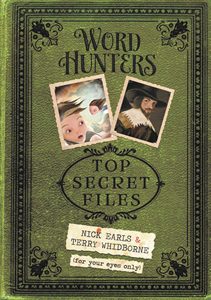
  • Word Hunters: Top Secret Files

    Word Hunters: Top Secret Files

    For those children who are fascinated by words, their origins, and meanings, this book is a must.  It is set as a mystery for children, who have to read each chapter, to understand the origins, of not only words, but sports, such as tennis, and language in general. This book has been placed in the readers hands by Caractacus, to protect and guard the secrets of the English language. Only a good reader will be able to manage the text or an interested parent or adult may help.

     The game of tennis comes under scrutiny, as do all the words which have evolved to describe it. We learn that the term volley “Came to English in the 1570s “, and it meant to discharge from guns, and also to hit the ball in mid-flight. Backhand is a word used just for a tennis shot, and came into being in the 1650s.

     The word busk provides a great deal of insight into just how our language has developed. A story is told about a modern day busker, but again we look at the origins of the word. It seemed to develop in the 1850s in California, during the Gold Rush. People who busked had something to sell, or trade, or use as entertainment. Quite often the goods to be traded were stolen.

     Using their backpacks, the two children, who are discovering the secrets of language, are able to travel back in time to observe and learn after immersing themselves in dragon armour. Instructions on how to make your own cardboard armour for the children are included. They can make Gauntlets, Sabatons, Greaves, and Tassets.

     In Egypt a piece of papyrus has been discovered. A note from a servant suggests that he will bring Cleopatra to the palace at night. If she is to be welcomed, there is a favorite recipe to be made up for her. It consists of flour, water, figs, dates, walnuts, sesame seeds, and honey. These are mixed together and rolled into balls; an interesting dish to explore.

     Each chapter in this book is so intense and interesting, that reading will be slow going. The information presented, has been collated through much research, and will link language and language development cleverly. Different cultures and languages are used to show the meshing of words from all over the world, to form English.