Tag: voyage

  • The Voyage

    The Voyage

    Pared back to a single word on an illustrated page The Voyage is a powerful story of immigration, of people forced to flee from their homes, their countries because of war and persecution; people who look at the challenges before them and take the most dangerous pathway of all, in the hope that they and their children will have a future free from war, destruction and devastation.

    Robert Vescio and Andrea Edmonds capture the huge challenge that a small family choose when they leave their home, board a small boat and cross the sea to what they hope, is a bright new future.

    Fear, calm, danger, memories and so many more emotions have been captured in the beautiful illustrations, which makes this a book suitable for a wide range of readers and ages, as in this instance, the picture is far more powerful than any word could ever be, at portraying the immensity of what people face when they feel this is their only choice in life.

    Over the past sixty years and more, Australia has taken in many refugees from a wide range of countries, as have many other countries of the world, adding a variety and diversity of culture to what back then was a very British country, still young, still growing, still adaptable to change.

    That there should be such a need in today’s world was something never foreseen, but is sadly still an ongoing issue, with people seeking a safe haven from the horror their country, their home, has become.

    The Voyage reaches out with compassion and understanding, offering a beautiful way to help educate people, regardless of their age, to the plight of these people from many different lands, as they try to make a new life for their families in a land that is very different to the land they left behind.

    As this is primarily aimed at children it will certainly make a very interesting topic for discussion, helping with understanding and forming the foundations of kindness towards those who may look and behave in a different manner to them.

    Beautifully done!

  • Journey For Mankind

    Journey For Mankind

    Anyone who has ever flown long haul, looking out into the endless blue sky as dawn is breaking or night is drawing in will relate to this latest, very peaceful album from the talented duo of Tom Moore and Sherry Finzer, as they have once again collaborated to create a tribute to Neil Armstrong and Buzz Aldrin and the Apollo Lunar Module Eagle landing on the moon.

    On 21 July 1969, history was made when Armstrong became the first person to set foot on the moon with Aldrin joining him a little later. Fifty years on the fascination with that incredible event is still palpable, with countries worldwide celebrating in so many ways, spending time reflecting back to a time when space travel was very, very, new, almost unbelievable to the man on the street. A time when new horizons were being discovered, challenged, in the race into space.

    So many people can remember to the very second where they were when this event was taking place, many still marvelling at the awe in which they held being able to view these men, doing something unimaginable, walking on the surface of the mood.

    In their significant style Moore and Finzer have, with the blending rich notes of the of flute and intimate electronic range, followed the journey from the dawn at Merritt Island to the eventual and safe return to earth of Armstrong and Aldrin, whose lives had been changed in so many ways, forever.

    There is a small booklet that accompanies the album which sets out the inspiration behind the pieces. Words from the men are also included which provided the inspiration for Shadow of the Moon and Blue Pearl in a Black Sky.

    Once again, Tom Moore and Sherry Finzer have simply merged their music into a seamless whole, allowing the evolution of an absolutely beautiful work full of peace, beauty, serenity, awe and reflection to be born.

    A Journey for Mankind is outstanding tribute to those who dared to venture forth and make history in the everchanging, mysterious, unknown universe, Space.

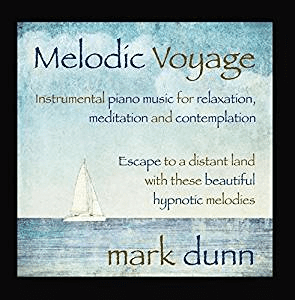
  • Melodic Voyage: Music for Relaxation, Meditation and Contemplation

    Melodic Voyage: Music for Relaxation, Meditation and Contemplation

    A lovely old fashioned aire Tegucigalpa introduces a voyage of charm and delight as Mark Dunn takes us for a journey around and about the world in each of the melodic, relaxing and beautifully crafted pieces, that make up his latest solo piano album, Melodic Voyages.

    A traveller and musician Dunn has performed to audiences’ worldwide, enjoying and embracing the changing pace of life and culture in each of the many places he has visited or lived. He estimates that he has been around the wold at least three times and considers this experience and the experiences he has been involved with have seeped into his music.

    Each of the pieces has been written with a person, a place or an event in mind and in many ways pays tribute to the emotions that have remained. Such a piece is Don’t Cry Paola, created after hearing a mother speak to her heart broken daughter in the aftermath of terrible ravaging storm and mudslides in Honduras.

    A deliciously measured piece is the Children’s Waltz, slow dreamy and thoughtful, Dunn looks at the feelings of a small bird learning to fly for the first time; a small child learning to ride without training wheels on their bike. A step into another form of freedom is offered in, The Truth, reflecting on the price so often paid for freedom in today’s world.

    Regardless of what order the tracks are enjoyed, each one is singularly well constructed with a definite feeling of grace entwined within the notes.

    The lovely little melody Fools’ Dance encourages some toe tapping, perhaps even a gentle jig, while the captivating piece The Moon Represents My Heart, based on a Mandarin melody, is pure enjoyment.

    The final track was written after bumping into an old girlfriend in Costa Rico which inspired Dunn to rewrite It’s You, formerly a single, with the melody now coming from a completely different, emotional perspective some ten years on.

    Written to encourage a peaceful interlude in a day or evening, this very different compilation of times, places and emotions touches the heart strings with a lovely sense of joy and peacefulness.

  • Stardust

    Stardust

    All encompassing, far reaching, rich and full barely begin to describe Kerani’s latest project of incredible majesty, beauty and strength.  As always she has based her compositions about one of the many aspects of the earth, this time predominantly space and all the various aspects of discovery, gravity, timelessness and infinity that still evolve as each mission to space is launched, bringing back fresh information, presenting almost on a daily basis the awe inspiring beauty that is space.

    She has also paid tribute to the incredible Leonardo da Vinci whose curiosity and intelligence knew no bounds in the piece Perpetuum Mobile, reflecting on the 13th century when the search for perpetual motion began, and still continues with the thought that perpetual motion can truly only exist in space. Tubular bells make an eerie, futurist sound before they are joined by strings and the body of the orchestra creating a sense of space and timelessness to the song. There are subtle overtones reminiscent of Çlannard interwoven with the rhythms which completely changes the dimensions once again.

    In the beginning there was ‘Stardust’ or more prosaically cosmic dust, which scientists believe are the building blocks of life as we know it. The song commences with what could almost be termed a hesitant piano note which builds into a richness as the structures begin to form, stars begin to shine, the earth begins to evolve and life begins to grow.

    Cosmic Sunrise was inspired by the moment when the sun first peeps over the horizon, heralding the beginning of a new day. Astronauts in space see this from a completely differing aspect, being presented with a stunning kaleidoscope of coloured layers changing every 92 seconds.

    Upbeat and funky The Next Step completely changes the pace, moving into the more edgy, modern style of composition, still maintaining the rich tones of space, discovery and anticipation which could almost be inspired by Mike Oldfield’s ground breaking compositions of the 1970s and ‘80’s.

    Almost by default Infinity follows with the voices of a choir filling in the background to create a feeling of endlessness, time without structure, form or void. Diana van der Zee’s voice rises effortlessly over the body of work to take a journey into that deep mysteriousness known only as ‘deep space’.

    Refreshingly beautiful, each of the ‘songs’, as Kerani likes to refer to the pieces takes a step closer to a completion which, as always with her works, comes with a message, that of respect of the planet we have been given as our home and to remind us that we need to respect each other, as we all are star children, coming from the stars and eventually to return to whence we once lived.

    Her work  simply goes from strength to strength as she uses the medium of music and her incredible talent, to reach out to all people reminding them of the wonders we have in our universe, that we as the current custodians of this planet need to be more gracious and caring.

    Stardust is also in tribute to all the men and women who go into space in the name of science and humankind.

    Gloriously wonderful and totally immersing!

  • Endeavouring Banks: Exploring collections from the Endeavour voyage

    Endeavouring Banks: Exploring collections from the Endeavour voyage

    Joseph Banks is a name synonymous with Botany, the mapping of Australia and New Zealand and voyaging far and wide with Captain James Cook during the years of 1768-1771 on the Endeavour. But it does make you wonder what it was that enticed a young man to set off on a voyage of discovery, at his own cost, other than the sense of adventure created by going to places that yet, remained largely either undiscovered or unexplored.

    Therefore, who was Joseph Banks and what exactly is the legacy he left so many years ago that is still as important today as it was in when he first recorded his findings on this legendary voyage.

    The purpose of this work, which is as informative as it is beautiful, brings Banks into Sharpe focus, highlights the incredible work carried out and perhaps even more importantly, brings his remarkable achievements back into the modern arena.

    As a young man of independent wealth, an intellect, a man with a strong a fascination for plants and nature which saw him voyage out with friend Constantine John Phipps to Newfoundland, on a collecting expedition while on a fisheries patrol, in 1766,. He was also elected to the Society of Antiquaries and then the Royal Society as his expertise in things Botanical was beginning to see him considered as somewhat of an authority in this area of natural Science.

    About this time there was a great interest in scientific findings and when the opportunity to go to the Pacific as a part of a collaborative international recording of the transit of Venus on 3 June 1769 was put forward by the Royal Society, it was far too good an opportunity to miss. King George III also gave his approval of the expedition and donated generously to the cost of the voyage.

    The Royal Navy were despatched to take astronomer Charles Green to Tahiti, the ship to be commanded by James Cook and called the Endeavour. Banks was well aware of this voyage and used his influence within the various Societies to talk his way into a role of supernumerary, paying for his own passage and that of his team of illustrators and collectors, along with their luggage and equipment. It was estimated that this voyage would cost in the vicinity of Ten Thousand Pounds; a vast sum, as his yearly income from his estates was only Six Thousand Pounds.

    When HM Bark Endeavour set sail on 25 August 1768, Cook and Banks did truly set of on a voyage of discovery, hardship and adventure, which was to last longer than expected, establishing a legacy that is a relevant today as it was in 1771.

    Each section of this work has been divided up into the various stages such as The Atlantic Stage, The Society Islands, New Zealand, The East Coast of Australia and Homeward Bound, tracing the route travelled and the work carried out while in these areas.   Using this method of presenting Banks and his work makes an interesting read, as well as a logical progression which is more than helpful for the non-scientific reader, simply interesting in the life and times of this man and the information and species he gathered and recorded.

    Each section contains masses of information, beautiful illustrations, pages from his note books, details on the many artefacts recorded and the collections gathered. Each artefact has a detailed description of the item, its usage, construction and current location if known.

    It is considered there were many, many more artefacts collected by Banks, which were considered a part of his personal collection that never made it into the various Museums and Societies. Many pieces were passed on to friends and other avid collectors and scientists.

    As a comprehensive wok, Endeavouring Banks has wide appeal, presenting to a new audience not just the work of a man, still widely respected for his contributions to Botany and Science, but a time in our history when to venture forth was a time of great adventure, a time when anything could and usually did happen, a time when life was so very different, governed by different rules and a very different society.

    Neil Chambers has not only presented the man, but the life and times of a world that was keen to know more, to discover the new, the untamed, the unclaimed and to claim that discovery for King and Country.