Tag: South

  • The Dirty South

    The Dirty South

    For John Connolly fans the series of Charlie Parker thrillers has seen many readers enthralled in the storyline of a crime fighter who will almost stop at nothing to find the killer or killers and bring some kind of justice to the victims’ families. But what was it made Charlie Parker, a former NYPD detective, become the fighter for justice he has become, a man determined to discover the truth?

    The Dirty South is a return to the beginning of the man who became Charlie Parke; a man reborn after the death of this wife and small child, a man who had been imprisoned in Arkansas  for pushing the boundaries a bit far in the search for their killer, a man who eventually agreed to join forces with the local police, in a Cargill, town that was as dissolute as it was poverty stricken, a town where young black women were being slaughtered, a town where new industry is trying to be established, but With the deaths mounting up, the salvation of  Cargill is looking less likely unless the killings stop.

    So, begins the beginning of Charlie Parker as he and the local Sherriff’s department learn to work together to peel back the layers of evil, greed and lust that stalk the streets of Cargill, as Parker seeks to right a terrible injustice in the Deep South.

    Portraying the elements of a young Charlie Parker the work is refreshing, filling in the many blank spots left over the previous nineteen Charlie Parker crusades, with a little less of the supernatural Connolly is noted for and a lot more of the everyday elements, which reflecting back on the dark history of many of the southern states of America, leaves plenty of history to be mined for works such as The Dirty South.

    As always the storyline is riveting, and by chapter 12 it is clearly understood that this book is a little different to many of the others in the series, by the careful and descriptive introduction of Charlie Parker,, ‘He seemed sad-  and angry, because the two often went together’ which immediately introduces you to a man in crisis, a smart man, a man who is looking for answers.

    Chapters are kept clean and short adding strength to both the storyline and the characters which offers options as either a standalone or the beginning of a walk on the dark side, courtesy of Charlie Parker and John Connolly.
  • Hillary’s Antarctica

    Hillary’s Antarctica

    Sir Edmund Hillary,as he eventually became, was a humble man born into a New Zealand family living in Auckland in 1919. He was a quiet, reserved child who discovered a love of climbing and snow on a school trip at the age of sixteen.

    His father was beekeeper as was he and his brother, a pursuit which allowed them to enjoy the winter months in New Zealand. Hillary climbed Mt Ollivier (1,933 m/6,342 ft) in the Southern Alps at the age of twenty in 1939.

    This love of the outdoors, striving to conquer the many challenges was to see this indomitable man go on to be the first man, along with Tenzting Norgay, to reach the summit of Mt Everest on May 29, 1953 at 11.30am. This, along with several other expeditions was to lead him into the New Zealand Antarctic Expedition of 1956/57 which is where this book Hillary’s Antarctic begins.

    Ed Hillary’s role turned out to be another Antarctic story that created legends, set the world agog and almost caused an International incident. The New Zealand commitment to what was the British Trans-Antarctic expedition to be led by Vivien Fuchs, was to establish a base at the Ross Sea area to be known as Scott Base and to act as support teams for the British Expedition.

    The Antarctic, lived up to its reputation of being dangerous, deadly and totally unpredictable over the months the British and New Zealand teams spent in the attempt to establish a safe crossing from Shackleton base, which Fuchs was to establish to the Ross Sea and Scott Base, but also the British were determined to also be the first to reach the South Geomagnetic Pole.

    As history now tells, this was not to be as Ed Hillary and his team, driving their Ferguson tractors, and in what was to be a desperate attempt to save their own lives made it there before Fucks and his team by several weeks. Fuchs was still one-month way from the original estimated time to meet at the Pole, and Hillary, in the outlying supply depot did not have the fuels nor supplies to it that long.

    Making sure there was to be extra fuel to be flown to the base known as D700, and that in an emergency fuel could supplied at the American base at the Pole, Hillary and his team, along with their tractors set out to complete what was to become the famous message from Hillary to Scott base, ‘We are heading hell-bent for the Pole, God willing and crevasses permitting.’

    January 4, 1958 saw them reach the South Pole and to be recorded into history as the first expedition to travel overland to the South Pole since Captain Scott and his men in 1912.

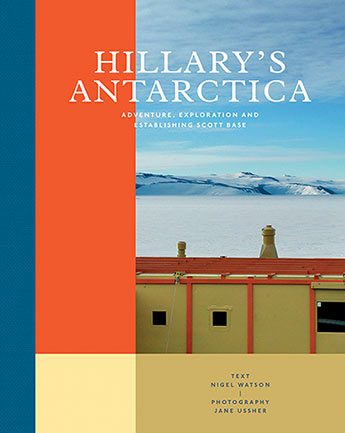
    This beautiful book created by Nigel Watson with stunning photography from Jane Ussher retells this amazing slice of history, bringing to life the medium of photography many of the items used by the men, the captivating and deadly majesty of the lands they traversed, and the eventual restoration of the original building stablished at Scott based back in 1957.

    A wonderful Biographies section at the conclusion of this work reads like a who’s who and also pays tribute to the many men who made up the New Zealand Expedition, without whom Hillary and his men would not have been able to accomplish what they did; arrive at the South Pole on Ferguson Tractors!

    For anyone with an interest in in the Antarctic, a place of awe-inspiring beauty, of great courage by early explorers and today a place of political debate, Hillary’s Antarctic pays tribute to a time when life was very different, but in so many ways, so very little changed!


  • The Crow Eaters: A journey through South Australia

    The Crow Eaters: A journey through South Australia

    All South Australians should read this book which is a big call, but the author has done what the best travel writers do, and that is, looked at familiar places, with different perspectives. He had no intention of writing a book but was inspired by a man who wrote about his bedroom. He found the most remote details and tiny observations to describe. Ben has done more than that.

    In an interesting style, he has looked at local places. He has included geology (South East), Aboriginal perspectives, and inciteful assumptions from his conversations. His intent was to cover only certain parts of the state, but, in depth.

    Some of the places he writes about are Coober Pedy, Maralinga, Mount Gambier, Port Lincoln and Kangaroo Island. In each place he visits, we are given a brief history of the interesting facts, and past times.

    On the way to Mount Gambier, Ben comes across Chinaman’s Well. It was here that thousands of Chinese landed to avoid the tax that the Victorian Government placed on those migrants wishing to work the goldfields. The number of Chinese passing through the town was staggering and there is really no acknowledgement of this massive migration.

    When Ben first moved into his house at Littlehampton in the Adelaide Hills, he found shards of clay in his garden. It was from a time when there was a brick works operating alongside Littlehampton bricks. This was another reason he felt that he had to unearth more stories of South Australia and give his stories in return.

    With his broad approach to a district, the writer would often refer to another author, so we find stories of Mark Twain visiting Goolwa. Yes, it’s true. The American had invested unwisely and so he travelled the colonies on a speaking tour to recoup his losses.

    After visiting many places on the South Australian map, the author decides that a suitable end for his book would be a closer look at the city of Adelaide and how the Kaurna people fitted into the history. He begins his trail at Victoria Drive where a memorial is built to honour those who served.

    In the first world War, 1000 Indigenous people enlisted. Only 1 received access to soldier settlement land later. He follows the trail and discovers art works and a visual history painted on tiles from the Kaurna people. Along the Torrens River bank there are also acknowledgements to the first people here and their lifestyle.

    This is terrific reading as a local and as a tourist or visitor each chapter could guide you to an intimate understanding of a region.