Tag: return

  • House on Endless Waters

    House on Endless Waters

    Why does Yoel Blum, famous Israeli writer, break his promise to his deceased mother never to visit Amsterdam? First he travels to The Netherlands to promote his latest book, but while there he visits the Jewish Historical Museum in Amsterdam where he accidentally sees a film clip featuring his mother, father, sister and an infant, whom he doesn’t recognise; this causes him to return immediately to uncover the story of the infant. In Emuna Elon’s powerful tale ‘House on Endless Waters’, the story of Yoel and his family during the difficult times of the late 1930’s until the mid-1940’s evolves.

    As well as being a family saga it is also an historical novel, which highlights life for the Jews in The Netherlands during the Holocaust.  This novel set in Amsterdam is a story within a story, as Yoel unravels his own early history, while exploring his Jewish mother’s life in the challenging times of the Holocaust; a time when Jewish parents had to make the most difficult choices of their life.  By blending the past with the present, fact with fiction, the author immerses the reader in the present-day beauty of Amsterdam and Dutch culture, while at the same time exposing the reader to the horrors of life for Yoel’s Jewish mother during earlier times.

    Originally published in Hebrew, I highly recommend this brilliantly translated booked, which is not only incredibly moving, bitter and brutal, but also hopeful and optimistic. Readers with a Dutch background will particularly appreciate Elon’s vivid picture of Amsterdam, both present day and during World War 2.
  • The Battle Within: POWs in postwar Australia

    The Battle Within: POWs in postwar Australia

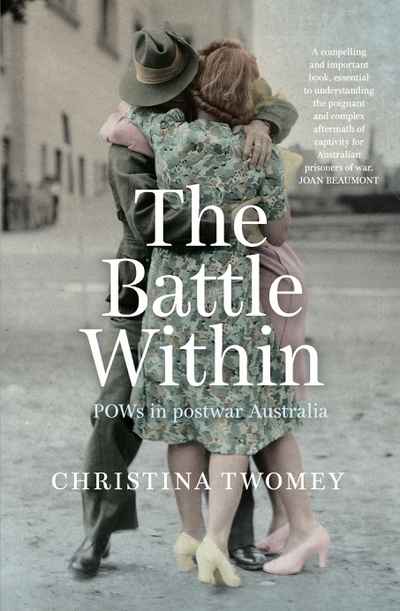
    The front cover of this book depicts the loving embrace of a soldier and his wife after his return from war. It would almost appear that the hardship and nightmare was over. The author has researched and presented a factual and powerful argument that this was not the case. Using Australian Government records, as well as many other sources, Christina has written this rather shocking and sad account of the reality for POW’s and their families.

    The attitude in Australia to POW’s was rather strange. They were seen as soldiers who had surrendered to the enemy, rather than fight on, like their compatriots in other regions. The reality of this was it was not their decision. The personal accounts in this book are taken from the men who applied for grants from the “War Trust Fund”; they were frank and honest about their struggles to reintegrate into society and family life. The Australian War Memorial in the 1990’s had only a small section devoted to POW’s, and this focused on objects like swords and ham radios. It seems unbelievable that this attitude was also reflected in the thinking of Generals such as Blamey.

    The chapter “A Broken Body Of Men” outlines the mental struggles and psychological disorders which was the lot of so many returned soldiers, but especially POW’s. The Red Cross insisted in their report in 1947, that “Very few POW’s made a permanent adjustment, and many were prone to personality problems.” A Government Committee was formed and ultimately decided that the “Psychological consequences of captivity had been exaggerated and that far too many pensions were being granted for anxiety.” It was also thought that many of the symptoms shown by these men could be caused by gastrointestinal worms. Sterility was also an issue for many of these returned soldiers, but again was not seen as specific to POW’s.

    Support for this group was delayed until a former POW became a Member of Parliament. Winton Turnbull launched the “Subsistence Allowance claim,” and continued to fight for it. The RSL requested that the government support this, acknowledging a degree of suffering for this group of men as a basis for the request.

    In 2001, the Government passed an act (Compensation for Japanese internment), and men were given a one off $25,000 payment. How sad that the ones who survived, and their families, had to wait so long.

    This is a breath taking, factual recount with many lessons to be learned for the future.