Tag: relationships

  • I Love Harriet Kippley 

    I Love Harriet Kippley 

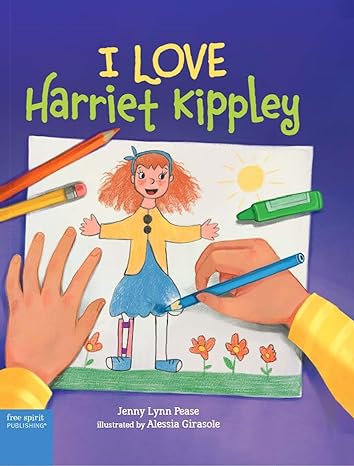
    Harriet Kippley’s art class was to have a party. They had to create a painting of something they loved for the event which was causing Harriet to become seriously worried. She simply did not know what to draw.

    All her bright ideas had already been taken and no matter what other ideas her family came up with, they were already taken or simply far too silly. What was she to do. After much thinking she went and asked her family what it was they loved the most and that is what she painted.

    Jenny Lynn Pearse has created a delightful story about loving yourself in this colourful and entertaining story of Harriet and her family, as they let Harriet know that she is the one who is special, that she is the one that they love.

    Bright and colourful the artwork from Alissia Girasole captures the worry when Harriet struggles to come up with something that is suitable and different, as well as the happiness and joy when Harriet discovers answers to her worries. It also presents in a very gentle style, the important issues of learning to ask questions to try and get answers to the problem and understanding that it is alright to love yourself.

    At the end of the story there is a lovely little section titled Questions and Ideas for You which helps understand the many facets of I Love Harriet Kippley while encouraging the reader to draw a picture of themselves and all the wonderful things they love about themselves.

  • Astrolations!

    Astrolations!

    Jill Carr like so many others, begun studying her Astrological star sign as a young teenager, wondering what the day, month or year ahead held for her. This fascination with Astrology continued on leading her to study both Western and Chinese astrology deeply and with an ongoing fascination as to people and their innate characteristics.

    Her fascination remains particularly in regard to the aspect of how people relate to one another and why. Why, when you meet someone for the first time do you feel like you are comfortable within their field of energy, or instantly discover hackles raised for no specific reason. 

    What particular combination of Astrology makes a relationship gel and work, while others fail makes fascinating reading, as she details how, over seven specific sections, getting it right, or understanding the pathway you are on with relationships, both on a personal and community level, is so important.

    Both the Western or Sun Sign and the Eastern or Moon Signs combine to shape your character and how by understanding these various influences, you can better understand yourself and those around you.

    Well set out and presented in easy to understand language, each of the sections provides a raft of fascinating AH HA moments, which are edifying to the novice or the more informed reader.

    Should this be your first journey into the fascinating world of Astrology, Astrolations will guide you gently towards discovering more about who you are, with a little bit of fun along the way, as you begin to establish what it is that makes you, well uniquely you!

  • Bridge Jumping

    Bridge Jumping

    Life is a leap of faith, a jump from a bridge railing.

    She is walking over the bridge; he is standing on the rails getting ready to jump. She stops and talks to the young man who she believes is about to end his life; he jumps.

    Poignant, thoughtful and fascinating Bridge Jumping tells the story of love, sorrow, regret, forgiveness and understanding through the diary of Paige Delainey, a young woman who considered herself a heretic, misfit and rebel over the course of what was to be her short life.

    Gabriel, the young man who jumped off the bridge became the love of her life, was bequeathed her diary and charged with the final distribution of her ashes. Twelve friends, all of whom had known Paige over many years were to be given a vial and asked to distribute them how and when they were ready.

    Somewhat unusual, Bridge Jumping looks at how one person is perceived by many, how they relate to that person as they each reflect on their friendship, their times together and how their lives interact with each other.

    Each of the family and friends story and their relationship to Paige is slowly revealed, as they in turn reflect and make the decision to take their vial to where they believe is her final resting place; a place they consider is deeply personal or was, to them both.

    Paige kept a diary, a journal, where she recorded her thoughts about her friends, her family and those that she loved dearly. These thoughts, beliefs and her understanding of their friendships and her sibling interaction is made known to the twelve people with intriguing results.

    One very relevant aspect of this beautiful story is that acceptance creates healing, that personal beliefs can change and be understood, that relationships can be healed with time, understanding, acceptance and love.

  • The Crying Room

    The Crying Room

    The Crying Room is a novel of many parts, all of which are complex but in an oblique manner come together to make a fascinating journey into the human psyche through the eyes of the feminine perspective.

    The Crying Room begins literally at ‘The Crying Room’ not far from Kings Cross Station, the week before Christmas. It is a specialised room established specifically for the purpose of crying; for letting your grief format into tears; a private place for letting go and refreshing.

    This is where we meet Suzie, who is working her way through a Medical Degree and is empathic to the tears and distress of the visitors to the room. In many ways this is her story which in the first instance appears to be one of a series of short stories.

    It is not until several chapters have been read the realization that this is only a small segment of a much longer and far more complex story becomes apparent, with Monica, Suzie’s niece joining the narrative as she begins a creative writing course. She is the writer of some of the chapters, but which is never quite clear. Is it Monica retelling a story or Suzie sharing her grief?

    Each of the female protagonists is a complex character; the mother, the daughters, the niece, each one trying to find the meaning or reason for their lives and the why of the repression they have each faced which appears to be inherent.   

    Various other threads are added to weave the complex narrative of the varying emotion of family and relationships: compassion, death, regret, remorse, control, loneliness and interestingly the concept of love; what it is and how fleeting it can be.

    Slow moving and delicate, the style allows each of the women to develop, with their innermost thoughts and feelings placed in a clear light. Even though they are not to any degree overly likeable, they are the people in our lives we meet and work with every day.

    The Crying Room is a novel of our times; careful, precise and yet complex. Throughout the narrative the destruction that can be caused by holding emotions at a distance is placed in plain view, analysed and eventually reflected upon, almost far too late.

  • It’s OK to Cry

    It’s OK to Cry

    It’s OK To Cry is one of the valuable books for children that can be read with an adult (allowing discussion) or read alone and thought about. So many children are unable to identify and name specific feelings that it is no wonder that they cannot solve issues that arise from these. Even the happiest children will feel disappointed, cranky, or cross at some time; to identify why and what they can do is hugely important.

    The hard-back picture book is immediately appealing because of the bright colours and intermittent illustrations. The Contents page talks about Boy’s and emotions, then lists different Feelings, with lastly “Things you can do to cope.”  The author suggests that society and things such as ads on TV and books can pass on messages to boys that they have to be tough. I think that there are equally damaging messages for girls, but the author does address this later.

    The next part of the book gets children to identify and name feelings they have “Dog poo on your shoe. Disgusting!”  When your pencil breaks all the time, you feel Irritated. When you are lost, you are feeling distressed.

    When the reader can identify emotions, there is a page on “Steps you can take to help you deal with uncomfortable feelings.” These recommend that the child talks to someone to explain how they feel, or if they are angry with another child explain why they are cross. To end this segment there is a page of notes for parents and carers.  The tips given here are worthwhile and solid. They are a good foundation for young children to build upon.