Tag: rebellion

  • Memoirs of a French Courtesan: Volume 1: Rebellion

    Memoirs of a French Courtesan: Volume 1: Rebellion

    In 1852 Celeste Mogador wrote her memoirs in self-defence. Speaking out about the lack of justice to be found in France during the dangerous years of her growing from childhood to adulthood, her life changing rapidly as she faced up to the reality of survival as a young and beautiful girl on her own, her story fills four volumes.

    Raised as a spoilt, beautiful child she was much loved and doted upon by her parents until her father died. Her mother, remarrying a man who turned out to be a vile and brutish man, saw Celeste and her mother leaving the familiarity of their home in Paris to take up work in a town far from this man and his brutality.

    Time passes and as Celeste grows into a captivating teen, her mother’s choice in men, always rather poor, sees Celeste forced to leave her home once again, but this time she discovers she is going to be on her own, as her mother has rejected her through a spate of jealous anger.

    Celeste, is remanded in the local Police station, before she eventually finds a friendship of sorts, which leads her into her new life as a prostitute; a situation not all that uncommon for women who had no means of support.

    As this is a Memoir published to outrage and acclaim in 1858 France, it presents a detailed and real story of life for those of a lower or middle class existence at the time of political upheaval, where marriage made women the property of the man, their lives considered of little account.

    Not an overly long read, this is the first of four books translated from the French which for those interested in history makes a most informative read. Celeste transitioned from indulged child, to homelessness, prostitution, discovering fame as a Hippodrome performer who eventually met, fell in love with and married a Nobleman.

    Translation, wording and time make a difference but Memoirs of a French Courtesan Vol 1: Rebellion also highlights that even though this was written more than150 years ago, in many instances little has really changed in the world of women who are unfortunate enough to fall on hard and difficult times.

  • The Book of Longings

    The Book of Longings

    Reading this incredible story from a male perspective was far more than interesting, it was amazing, and informative reflecting on a small segment of history not already contemplated.  Although I have no fixed ideas of Christianity, and therefore read it as a work set in the times of an ever more powerful Rome, The Book of Longings, which while it took some time to read, was evocative and informative, looking at the life of women in a time when to sell them off was considered the right of the father, regardless of their standing in society.

    It is considered there was a time when Jesus was just an ordinary person going about his craft as a carpenter and stone mason; one of a number of children in the family of Joseph of Arimathea and his wife Mary.

    The Book of Longings is a love story based on the premises, which some scholars consider was Jesus’ life before he became a powerful, charismatic leader of the people. Some consider Jesus did indeed marry and may have had children, therefore this story told by Ana, the wife of Jesus, could have some serious historical merits, but otherwise is simply a formidable, fictitious, historic love affair.

    Ana, born into a wealthy family was soon to discover that her sheltered life was little different to many other daughters, in that she was to be married to a man much her senior for her father’s ambition. A chance meeting with a young carpenter called Jesus and his passionate ideas are intoxicating to the protected young girl.

    A simple love story, or maybe the lament of a young woman much in love with a man who was on a powerful course with destiny, a man who was to change the beliefs of so many with his ideas, Ana comes across as a power in her own right, and although it may seem that her character could be  little to modern for the times, who is say this may be incorrect, as those long gone days are not well recorded through history from a  female perspective, as women were considered more as chattles, rather than people in their own right; there, but not there.

    Perhaps, to thoroughly enjoy this book it is best to park pre-conceived ideas firmly to one side, before beginning a journey that just may have been as incredible as Sue Monk Kidd has portrayed

  • Islands

    Islands

    The style of writing in Islands is unusual and charming. The story begins with a repetitive few lines, being built up to create a picture. Gradually the reader sees the young girl, the house on the hill and the happy family which then began to fall apart. The style of writing means that the reader has to work to piece together the chunks of story. Sometimes the chunk is in the present, sometimes in the past. Each block of story gives us more of an idea as to why a person would behave that way.

    We are presented with characters who all meld together as a happy family, until one of them cannot stay any longer. This character seems heartless, but later we learn how she spent her childhood, and why she feels the way she does. The reactions to this family breakup are different for each family member. The story is told from different points of view, and the distress and dismay felt by all is almost overwhelming.

    Each character is unravelled as they move from childhood to adolescence. Then we see how they emerge from their parenting disaster to form their own relationships and parenting styles. It is a rather gloomy prospect to contemplate, but the writing style of the author challenges the reader to understand the consequences of the mother’s family who ignore her most of the time. There is one section of the story where an older person has a stroke. The reader is confronted by words which are made up, but you quickly realise what is happening and share the frustration of the character.

    The setting for some of this story is an Island of the coast of Melbourne. Some of the descriptive passages which tell of tunnels of bush leading down to the beach are vibrant and memorable, as “the ti-tree crouched, humpbacked, on the dunes”. A family disintegration is not a comfortable plot for a story, but the past and the future looks at those same people reveal how things may be different in the future.

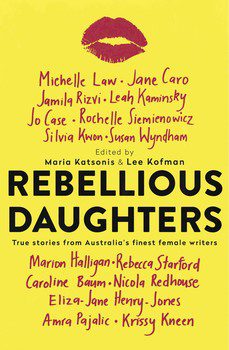
  • Rebellious Daughters

    Rebellious Daughters

    To be a Writer and write either fact or fiction is one thing, but to decide to contribute to such a work as Rebellious Daughters, exposing a small, but incredibly important aspect of your family life and coming of age, is a completely different story.

    That seventeen of Australia’s much love and respected female authors have chosen to do this, shows remarkable bravery as, each of the people in these stories are still very much a component of their lives, their families and as such, can either be deeply offended by what is written or finally enlightened as to what that ‘rebellious’ phase was all about.

    Each of the stories is poignant, occasionally sad, many times well worthy of a chuckle as you recognise yourself in the words, and in each case confronting, as we each had to grow up, face the challenge of breaking out of the patterns or expectations established by our parents, which were begun when were all small children.

    Jane Caro, in Where Mothers Stop and Daughters Start, shares from a mothers perspective the rebelliousness of her daughters, one moody and introspective, the other full of rage and fury and the angst she and her husband faced as they came to terms with the ‘difficult years’ of their precious children learning to grow up into adults.

    Susan Wyndham shares the tumultuous pathway she travelled looking for ‘A Man of One’s Own” as she grew from a good girl into a confused teen who considered she was ‘obsessed by sex, emotions, etc’, an emotion most young people can relate to as they enter the next phase of their life.

    The Good Girl is the story Jamila Rizvi uses to illustrate just what happens when you are always seen as the good girl who does as she is told and likes or tries to like everyone. But what happens when the new baby sister is full of cheek, does not do what anyone wants and always, even when she has done something so naughty, seems to get away with it!

    Deeply poignant is the story offered by Eliza-Jane Henry-Jones about her grandmother in “Just be Kind’ and is a lesson to us all about kindness and the issues raised when caring for a sufferer of Alzheimer’s.

    Maria Katsonis comes from a Greek background that has strict expectations about the daughter’s role and place within the family structure, so when it comes to challenging the expected norm, tempers fly with deeply hurtful and unforgivable things said, creating lasting scars. She couches this tale in the story of learning to make kafe in the traditional manner and by doing so eventually learns she does have a choice; to either obey or disobey.

    Each of the stories reaches out and in by doing so reassures that you are not the only one coping with rebellion and rage from your teenagers, you were not the only one crashing through the barriers as you grew into adulthood and that whatever you experienced, no matter how dreadful you thought it was, and in some cases it was and is, in hindsight, there was and always will be someone else out there making the same mistakes, creating the same uproar, trying out their fledgling ability to create change and in most cases managing to survive into adulthood, a little wiser and definitely a little older.