Tag: play

  • Superheroes in the Park

    Superheroes in the Park

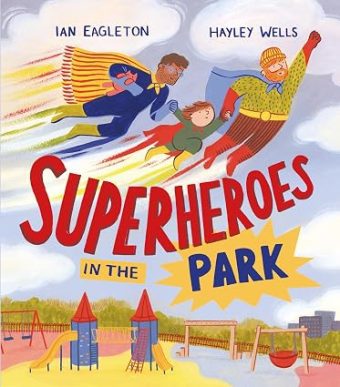
    It is a very wintery day when a young girl goes to the park with her Dad and Daddy. The path is slippery and she dreams of sliding across the frost like a skater. This is where her parents learn a huge lesson. They stop her from sliding. When they reach the park, they stop her from climbing the ropes, saying the dreaded words, “Be careful, stop, you might get hurt.” She wants to play badly, but her parents feel everything is “Too high, too fast, or too slippery or too big.” Hugely frustrated, the girl stomps away, crying.

    Her parents sit down with her and say, “This is new for all of us.”  This is when the girl has an idea. She decides to show her family how to play and suggests they all do it together. First of all, they climb up the ropes and ladders which in turn become a ship on the high seas. There are pirates and terrifying sea monsters to contend with.

     Next are the swings, where she sits on Dad’s lap and soars high into the sky passing birds as they swing. Then the monkey bars become a bridge to cross over a river with crocodiles snapping at their feet. Luckily, they get across safely. On the roundabout, they become superheroes, flying through the air. There are so many great things to do. The family climb trees, roll down the hill and walk with dinosaurs. No one is hurt!

    Superheroes in the Park cleverly shows how a child might encourage parents who are “Careful,” to join in their game, rather than warn them about being safe. The illustrations are colourful and show the imaginary adventures with crocodiles and dinosaurs.

  • Shadow Play

    Shadow Play

    The dark front cover and pages of Shadow Play alert us to a worrying time. Sure enough, the first page depicts a small girl sitting in a very grey garden and we are told that this is Minnie May, and she is afraid of her shadow and of many other things.  Minnie May knows that her shadow is attached to her and follows her every move. It follows her on the swing, under the bed, in the streets and in the water.

    One day Minnie May meets another boy when she sees his shadow. His name is Ziggy, and he shows Minnie May how his shadow follows him when he cartwheels. He teaches Minnie May how to tell the time by shadow and how to makes shapes on the wall with a hand shadow. Gradually Minnie has a sense of belonging to her own shadow.

    The Text in Shadow Play is large, brief and easy to read against the dark background. The illustrations add to the text and the reader has to look carefully to see the shapes of the shadow. As Minnie May’s confidence increases so also does the colour in the pages become lighter and more detailed; then we see the girl stretching out to embrace her play, and her new friendship.

  • Turning Cartwheels

    Turning Cartwheels

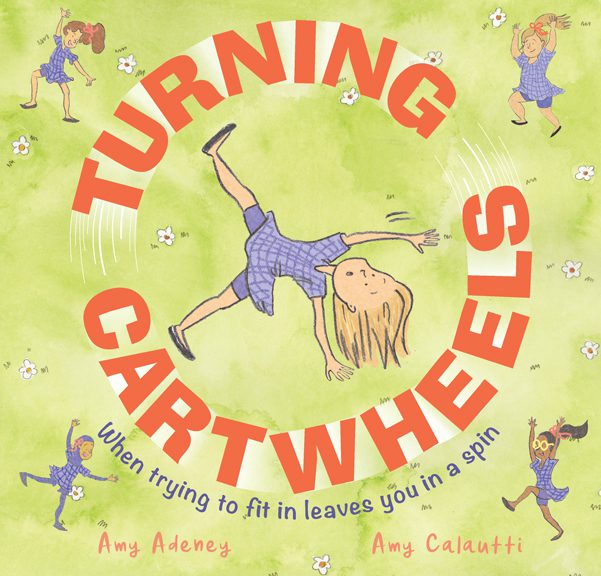
    The expectations for many children when they start school, is that things will be like their home experiences. Most children have learned about rights and responsibilities and respectful treatment of others at home. When Emma tries to join the Cartwheel Club at school however, she realises that other children do not recognise the “Fair Play” rules.

    When she is refused entry to the Club because her legs are not straight enough, Emma goes home and practices until they are. Then she is told that her landing is messy, so she goes home and practices for a week until it is perfect. At last, she is accepted in the club, but the rules do not stop there. By Friday Emma is exhausted and she knows that she will have to come up with an alternative solution for those twitchy times at lunch when exercise is foremost in children’s minds.

    Turning Cartwheels a wonderful way of showing children alternative ways to solve problems. To be resilient in today’s world, Emma must find a solution to her problem. She does this in a way that is inclusive of other students, including those with special needs.

    This picture book is splendidly illustrated. Most pages feature double page spreads of grassy green colours, with the girls all dressed in purple. The artwork shows basic features and easy to read attitudes from the characters. Turning Cartwheels is another great way to talk about resilience to children.

  • Black is the New White

    Black is the New White

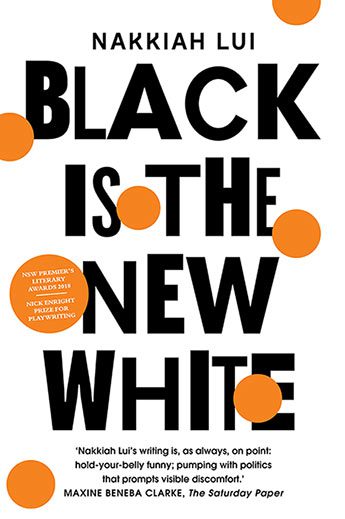
    Nakkiah Lui’s play, BLACK IS THE NEW WHITE has been performed in Sydney, Melbourne and will be in Queensland soon. There have been accolades given to this new young playwright for her sharp wit, her clever insights and her promotion of the huge issues of racial inequality. The author is a Gamillaroi and Torres Strait Islander woman from Mt Druit. She developed a love of reading from her grandmother and wanted to write for a purpose. She found it empowering that people found a value in her voice, and this is shown in her play.

    Reading this play is comfortable, as it is well explained and set out. The humour in situations and speech is sometimes subtle and sometimes overt. When the young couple get caught out in the nude by their family at Christmas time, the horror and hilarity are evident. The title of the play suggests that nothing is either black or white, which is especially so at Christmas time with extended families gathering together.

    However, this is no lightweight skit. There are many references to politics and past times. Aboriginal affairs are brought to the fore, with questions asked about a recent law passed, which will disadvantage Aboriginal people more.

    The first character we meet is Charlotte, an Aboriginal woman who has become a lawyer with a brilliant career ahead of her. She has fallen in love with a white man, Francis, who is a modern composer of music, without a job. Her sister feels that it is the duty of the sisters to maintain their race and marry a man from their culture. Rose, Charlotte’s sister, is avoiding pregnancy for as long as she can. The girls’ parents are horrified when they find out that Francis’s parents are coming for Christmas Day. They are on opposite sides of politics with many a harsh word between them.

    The dialogue and fast repartee are witty, as the two adversaries lock horns around the table. Many issues are raised, and some solutions are posed. For a while, everyone is involved in the melee, but then some step back and thoughtfully put forward suggestions. This is an educational, funny and insightful play to read. Hopefully, we look forward to more humorous, thought-provoking writings from this young author.

    This idea for the play came about when Nakkiah was reading the Census and found that the Aboriginal community has the highest percentage of interracial marriages. It is indeed thought provoking.

  • Play This Book

    Play This Book

    Following on from “Pet this book”, “Play this book”, has all the same wonderful qualities. It is a really sturdy book, with a strong board cover and board pages. It is most suitable for the smallest hands and will survive being sat on, chewed and slept with.

    The story tells about various musical instruments, and how they can be played together to make a band. The author shows how a guitar can be strummed, and a drum can be tapped, a piano can be played by touching the keys, and maracas can be shaken. Of course the cymbals need to be heard as well.

    The text is in rhyme and enhances the beat of the music. There are some instruments which are less common (such as the saxophone) which are introduced. The noises made by the musical instruments in in a very large font encouraging chanting along and jumping up and down is encouraged.

    Each instrument is looked at individually and given its own sound. Then all of the instruments are combined to produce a song…. Of sorts. The primary colours used in the illustrations attract attention and provide a great back ground for this noisy book. It is not a bedtime book, but one that encourages noise and movement and is a great way to introduce children to music and instruments using imagination, noise and fun.

  • We’re Going to be Friends

    We’re Going to be Friends

    Friendship is such an important area of understanding for young children, that any discussion and impetus is welcome. This is a great opportunity to share this concept with a delightful, brightly coloured children’s picture book. Not only do we have the story, but also the option to download the video clip and song which is the same as the text.

    Rhyming text is used and really designed to be sung, but works well to read out loud. It tells the story of a young boy and girl starting out for school. They walk together and together, they discover bugs, and many things of interest along the way. When they arrive at school, they need to clean up, and prepare for all the new and interesting things they will be doing and learning. There are “numbers, letters, learn to spell, nouns and books and show and tell.” So many interesting things to do together!

    Then there is playtime. Being set in America, the chosen sport is baseball, and the children tackle the game with relish. After lunch it is back to the classroom, where the teacher measures each child’s height and records it. Next comes singing and one child is pictured as singing like a bird, the other is rather flat, and out of tune. But we are all different.

    The illustrations are creative and combine a selection of photographs and images superimposed on them. The people who sing this story are shown in photos as well. The colour red is used predominantly throughout the book to give it a cheerful and stand out feel. The characters are drawn in cartoon style which suits the nature of the art work.

    The text is a good size for following along with the song. It is either red, or black or white, so that it stands out from the page. This is quite a visual feast with the differing styles of art, and realistic sketches of bugs work well with enormous red and white lollipops, used as seats. The happiness engendered by this book is a lovely way to start a school day.

  • Lovable Lottie and the Lost Toy

    Lovable Lottie and the Lost Toy

    Full of fun and hide and seek this beautifully present book, Lovable Lottie and the Lost Toy is  aimed at ages 3-5 years, with the story built around a lovely new puppy and his forever home.

    Like all small puppies he loses his toy, absolutely everywhere he goes, causing mayhem trying to find it. He loses his beloved toy at his welcome party, in the apple orchard of his new home, and of all places in the bedroom.  Actually, he loses it everywhere he goes!

    Of course everyone is required to help find the lost toy, which means you of course! As each of the pages is built around beautiful photography, with somewhere in the picture the ‘lost’ toy, it will be a huge amount of fun with little one to see who can find it.

    Each day of the week, Loveable Lottie loses her precious toy somewhere different, which adds to the colour and enjoyment of the story.

    Engagement and enjoyment are the themes of the book, with each of the scenes presenting so many objects and many, many places the lost toy could be, along with many items for discussion as to what is in the bedroom, what is out on the farm and what items are in the shop.

    The photography is beautifully presented with the text suitable for beginner readers. A gloriously colourful book, picturing real places about the house and farm, the cutest little Maremma puppy and tons and tons of adventure for everyone to enjoy

    Do you think Loveable Lottie really has lost her toy, or is she doing this so you will join her in her play?