Tag: planets

  • Meet the Planets

    Meet the Planets

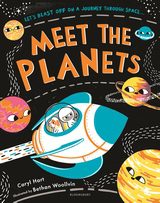
    What better way to take journey into space than to put on your space suit, jump into your rocket and set off to Meet the Planets one by one then have them tell you who they are, what they are made of, who is nice and who is really naughty, just so you know what those glowing, twinkling lights in the night skies are all about.

    In this well constructed journey into space, young readers will have a huge amount of fun zooming around from planet to planet, as they get to know so much about the night skies which has been presented in rhyming text, with large, bright, easily understood illustrations, perfect for a wide age range and reading ability.

    The first planet met is of course the Sun, who tells about being so hot you may frizzle and fry of you get to close, but also tells of all the good done with its warmth and light.  Venus looks beautiful, but is really one of those not so nice planets. Do you know why?

    Moon: silver, mysterious and glorious, explains why you often see her during the daytime in her ghostly shape and why she often changes shapes and colours.

    Saturn has so many sparkly rings she is can almost be considered as the planet of ‘bling’ and believes she is the Queen of the skies as she is so beautiful. But as you go further and further away from the sun you meet the two coldest planets of the lot, Uranus and Neptune, perfect in their worlds but sometimes they too, just like you, get a little lonely.

    Meet the Planets is the perfect way to introduce young readers to the world of science with fun, read aloud text and of course, with the planets all dressed to impress, they are out to ensure that what they tell you about themselves is also pretty impressive.
  • Cosmic Chronicles: A user’s guide to the Universe

    Cosmic Chronicles: A user’s guide to the Universe

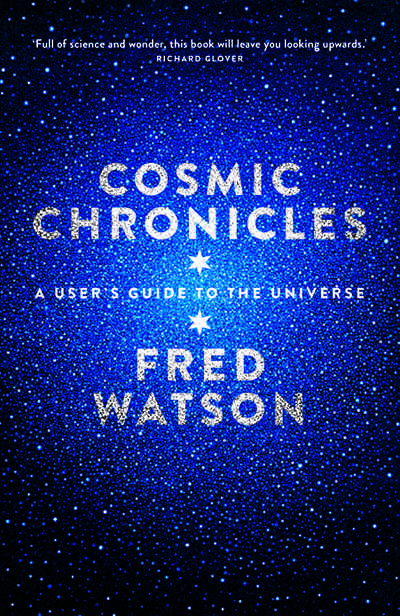
    Readers who are familiar with the likes of Douglas Adam or H.P Lovecraft will have some idea of how truly small we humans are. Well, Fred Watson, asks you to please disregard your previous ideas, so he can explain to you truly, how small and insignificant we actually are.

    Or rather, how incomprehensibly huge the universe is.

    Watson, current astronomer and former pioneer, is more than qualified to talk to us on the subject of the universe, though he never relies on the reader having a scientific background and incorporates explanations, where necessary, well throughout the pages. Cosmic Chronicles never crosses the threshold where leisure reading turns into a lecture session and remains as it claims; a user’s guide.

    And guidance is a good word to use for this book, as the writing style is that of a friendly and charismatic tour guide who takes you through space at light speed, making various pit-stops to point out one or another notable feature. Though the universe may be incomprehensibly big and empty, you certainly don’t feel alone while reading this book.

    Astrology, geology and biology might not be everyone’s cup of tea, but Watson seems to understand this, and it feels like the material has been through a few ‘enjoyment’ filters. As the majority of the content inspires ‘wow that’s cool’ moments instead of making your eyes glass over. Topics range from everyday ideas like meteors, stars and nightfall, while the more obscure sections go over interstellar property and space bugs (yes, space-bugs).

    Fred Watson has an asteroid named after him, but he explicitly claims no responsibility if it ever hits the earth. Overall, I’d recommend this book to anyone outer-space minded, and any age from young adult upwards. The chapters make it easy to learn and become familiar with a new idea in one sitting. Be prepared to look up and see the sky in a whole new way.