Tag: pictures

  • Making Picture Books

    Making Picture Books

    This small book, Making Picture Books is a treasure for anyone wanting to create a picture book. It is also very interesting for readers to unpack the process of making a picture book, either for teaching purposes or for sharing ideas with young readers, or for guidance for budding authors.

    Libby Gleeson generously gives her time and thoughts on this subject, along with other authors who contributed to this book, giving it a serious and wide-ranging feel. We learn that a Picture Book is a story told in words and pictures. The balance between the illustrations and the words to successfully convey the meaning is crucial.

    The author begins by telling us that “there are no rules.” The early chapters deal with Writing the story. How to get ideas, and what different authors do to make sure they have a collection of ideas at the ready.  

    In “Getting Started”, Libby asks many questions to make the audience think through their process. Things such as “What is this story about, Who are my characters, who is telling this story, where is it set?” There are more questions for the budding author to contemplate but the sense of being able to answer these questions and begin to write is strong.

    “After the first draft”; asks us to look at plot, structure, language and characters for a start. It is a great way of going back to analyse your work and assess its precision. When this is completed, there is advice given on finding a publisher and an illustrator, and how best to work with them. Making Picture Books is a marvellous and generous little book, easily read and referenced, with practical up to date, local advice.

  • The Hidden Book

    The Hidden Book

    It is always exciting when a new book is presented by Kirsty Manning. She has an amazing talent for finding little known subjects and writing about them.  Her books are based on facts and a story is built around the initial truth and how the future may have unfolded.

    In the past, we have learned about the Cheapside Hoard, found in the basement of an old building in London. We also have read about an Indian boy at the Golconda diamond mine. The thing that Kirsty excels at is her detailed information of the social and political times as backgrounds to her stories.

    Mauthausen Prison of War Camp in Austria during World War 2 is one of the settings in this story. The facts are that a photographer at the camp managed to take many photographs which were secretly hidden and at the end of the war, used to convict Nazi criminals. With help from locals, the photos were smuggled out of the camp and kept hidden until the Allies arrived.

    Surprisingly, an album of these photos was found in Australia, and this is where Kirsty has woven a credible tale. No one is quite sure how they arrived on Australian soil but eventually, the album was handed over to the Sydney Jewish Museum for all to see.

    The story Kirsty weaves around the photos is seeped in the fear and constant terror of the people living in Austria near the camp. Later, in Australia, the author shows how “Trauma bleeds through generations.”  The Austrian Mother refuses to let her student daughter see the album, saying that it is too horrible for eyes to see.

    Kirsty Manning has an extensive list of resources she has used from which to gain the intimate knowledge required to craft The Hidden Book.  Thanks Kirsty for enhancing our understanding once again.

  • The Covers of My Book Are Too Far Apart! (and other grumbles)

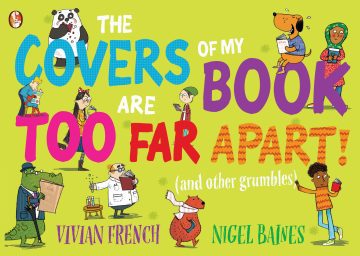
    The Covers of My Book Are Too Far Apart! (and other grumbles)

    This colourful Picture Book begins with a rather startling statement! “Huh! Reading is rubbish!” So says a young man sitting on a park bench. Another young man flying a plane says that he loves stories because you feel like you are there. Other advice from a youngster suggests choosing books more carefully, and a Librarian offers help to find a book the boy will enjoy. More suggestions include Superman’s offer to read comics, and a dog who loves joke books. This is not a story book, but a book about choosing a storybook.

     Cleverly, Vivian French has given a negative point of view, such as “I’m too busy to read”, and countered it with suggestions such as “I read in bed before I go to sleep”, and “read when you are supposed to be working”. The comic preference is reinforced many times by Superman himself. Books that are for girls are not out of bounds either, as some boys read a few pages to see if they will enjoy the storyline, and likewise many girls enjoy boy type adventure books.

     Issues are discussed such as “Reading is hard…” and complicated too. Kids with Dyslexia explain how they find reading difficult and some children wear special glasses to help them decode. A wolf with headphones is thoroughly enjoying a story and happy about hearing it, while Picture Books are enjoyed by all ages. After all, you watch TV and that’s pictures. Bedtime reading is shown to be a warm and sharing time for all. The idea of having to finish a book you don’t enjoy is discussed, and most people say that if you have given it a few pages then still don’t like it then choose another.

     This is a great book to introduce to children who have become jaded with reading. Every excuse for not reading is looked at and answered (especially by Superman) who loves comics. Children and families often feel that there is no one in a story who looks like them, and suggest that authors take up the challenge of varying their characters.

      The clever illustrations by Nigel Baines certainly add to the text, and in very creative ways. The Librarian is a horse, and Darth Vader suggests reading about a favourite film.

      The text is on a cream background to assist those children with visual issues, and many concerns children have are addressed in a stimulating and humorous way.