Tag: philosophy

  • A Theory of Happiness

    A Theory of Happiness

    Lessons from a 100 year old Korean Philosopher 

    Professor Kim Hyung Seok speaks to us of happiness from the perspective of an elderly and sharp mind. He has designed A Theory of Happiness so he can tell stories which outline the point he is making.

    He recalls a time when he was at school and the Japanese had invaded Korea; his Headmaster was allowed to give a farewell speech. He was being removed because he hadn’t changed the curriculum. The headmaster stood on the stage, raised his fist and shouted, “ACT.” The boys were stunned but later became aware of the significance of his defiance.

    Kim also believes that happiness is in the present. He suggests we don’t look for happiness in the future, or the past, but enjoy the moments we have day to day. He tells the story of a factory worker and his wife. The man loved art and so each weekend he and his wife would go to a park where he could paint, and she could read her books. The children played and moved between the parents. His point is that wealth is not necessary for a happy life.

    Love is also a focus of Kim’s work. He says, “Where there is no love, happiness cannot dwell.” Initially Kim felt that Justice was the most important factor for world harmony but later he believed that it was love that was the epicentre of all happiness and peace.

    Reading the stories that Kim has written, we see examples of how his explanations can be used to enhance his case. He insists that a cultural awareness is necessary for an understanding of life and we should all take the time to read and explore uplifting activities.

    Footnote: Professor Hyung-Seok Kim is a 105-year-old first-generation Korean philosopher. A former Harvard research professor, he has found true happiness in life, having overcome adversity from a young age, and is committed to spreading joy and helping others through his work. He was born in and grew up in the North Korean province of South Pyongan before leaving to study philosophy at Choson University in Japan. From 1954, he served as a professor of philosophy at Yonsei University, South Korea, for 31 years, laying the foundations of contemporary Korean philosophy as we know it today. He was a research professor at Harvard University and the University of Chicago and, to this day, remains engaged with lecturing, broadcast and writing.

  • Understanding Animals: Philosophy for Dog and Cat Lovers

    Understanding Animals: Philosophy for Dog and Cat Lovers

    The Art of Philosophy is an interesting Art, as it is understood that no philosopher can ever be considered as wrong, perhaps because the many permutation of their pondering, observation and research are generally diverse, open to interpretation and always, further discussion.

    So, when a Philosopher such as Lars Svendsen takes up the challenge to understanding the Philosophy of not just Cats and Dogs, but the very humans that love and adore them, as well as their specific relationships, the subject matter makes seriously interesting, fascinating and astonishing reading.

    Does it help to better understand your Cat or Dog, what exactly they are conveying to you, as they twist you and your emotions around their very paw with childlike ease? Yes, perhaps it does, but then as with all things based in emotion, maybe not. Svendsen also looks at the bond that is often unbreakable between animal and human.

    Svendsen peals back the intriguing layers of communication between pets and their humans, looking at what certain types of behaviours, such as a cat purring, the volume used, the tone and times and situation, as verses dogs and their many varied ways of expressing their emotion means.

    Delving into the sensitive issue of changing animals’ behaviours, such as that of chimpanzee’s, once they learn to communicate with humans in the medium of drawing, a type of almost ‘Pidgin’ chatter and specific patterns of learned behave, how does this then change the perception of that chimpanzee. As a chimpanzee as it no longer fits into the traditional behavioural patterns of that species, nor does it fit into the full concept of human behaviour, so where does this leave the chimpanzee?

    He also investigates in some length the bonds that form between animal communication, intelligence and awareness and how all these, along with many other aspects of behaviour, form the basis of lifelong friendships that build a very emotional component of daily life for so many people.

    Thought provoking, particularly in relation to the aspect that because animals can look at us, see us, make us feel embarrassed, guilty or ashamed, even transferring emotions though a mere look, does than then, make them one of us!

    As with all things philosophical, Understanding Animals Philosophy for Dog and Cat Lovers, answers so many questions, and yet leaves many more areas open for further discussion and research, but in the final wash-up, animals and humans are each unique unto themselves, each coming with special gifts and talents.

    A very quirky sense of humour is strategically placed thought-out the book, lest everything written be taken far more seriously than was ever considered.

    Understanding Animals Philosophy for Dog and Cat Lovers is one of life’s more intriguing reads. Enjoy!

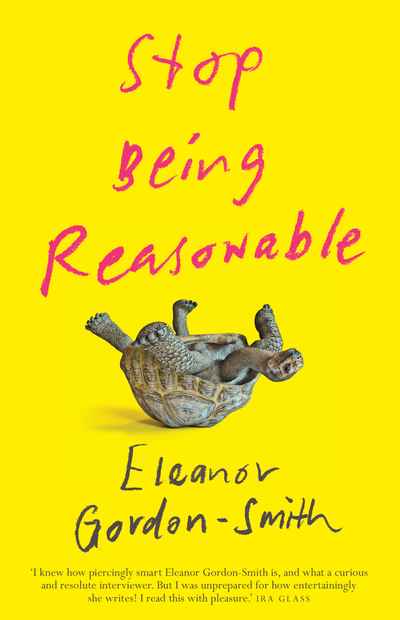
  • Stop Being Reasonable

    Stop Being Reasonable

    How best to describe a book that will stand all your preconceived ideas about who you are on their collective heads, and pose the question ‘What if you are not who you think you are?’, the reasonable, human being you have always thought you were!

    The answer to that is, read the book and then make a serious life decision as to who you are and who are the people that are close to you: You may be very surprised at the answers.

    Philosopher Eleanor Gordon-Smith brings her vast array of talent to this wonderful, fresh look at life and who we really think we are in ‘Stop being reasonable’, a rather wry, but very truthful look at how we form and become the person we are, the influences which over the course of childhood set the boundaries for what we think, the people we mix with, the beliefs we hold dear.

    Often these ideals remain unchallenged until something causes them to be challenged, causes a rethink, a change of direction, lifestyle or belief. The catalyst may be large or small.

    The Introduction is thought provoking as one would expect from a Philosopher, the following chapters, or rather excerpts from life are more than that; they are enlightening, enjoyable, revealing and fascinating, as the layers are pealed back on lives of six people as they discover that who they thought they were, was not really who they are and would eventually become.

    Some of the content could be considered as offensive, inflammatory or controversial, but the reality is, this is life in its raw state, life that is considered as ‘normal’. Life that when change is required to be made, can come with cataclysmic results for those who are brave enough to face up to wanting to be who they really are.

    Wading through what is termed as the ‘murky place where philosophy and real life meet, this is not a book for the faint hearted, but rather a book that is an entirely fascinating read from cover to cover, and one that can be read, slightly tongue-in-cheek or from a serious perspective of making change and accepting the reality of setting yourself free!

  • The Buddhist Way  A Brief Introduction to Buddhism

    The Buddhist Way A Brief Introduction to Buddhism

    Buddhism is a science, or some may say a religion, or at the very least a way of life which in the busy, challenging world of today, is becoming popular for the basis of the belief that is stepped in a wide range of factors; those of tradition, culture, teaching and practices from many countries, that have been collectively formed into what was once simply known as the Dharma (truth or teaching) but has now become known as Buddhism or Buddha-dharma.

    This practice or tradition has existed for many centuries and therefor it begs the question, why now in the 21 Century has it become popular, ‘highly visible to the modern gaze’? The answer to that question is probably as varied as the style of Buddhism practiced with a no ‘none size, fits all’ answer to be found.

    Nagapriya takes the novice or the seeker through a basic understanding of the philosophy which underpins all the various teaching and practices, beginning with an Introduction pointing the way forward and then leading into Part 1: The Three Jewels: The Buddha, The Dharma and then the Sanga, the beginning, the middle and the finale that looks at who and what is the Buddha, the Four Noble Truths and the Sangha; pathways which can be a source of support and inspiration.

    Part 2: the Threefold Way looks at the Ethics, Meditation of which many are familiar, and the Wisdom of what is considered as the three elements of the spiritual path of which the seeker travels.

    Concluding the book is an edifying look at Buddhism Today, a short history of modern Buddhism and its challenges as well what is considered as the Buddhist revolution, known as the Dharma Revolution which has been taking place in some of the poorest parts of India since 1950.

    For anyone who is seeking enlightenment, has an interest in perhaps following the Buddhist way, or looking for some additional meaning in their life, this easy to understand, ‘brief sketch’ of the main teachings or underpinnings of this fascinating way of life is the prefect answer.

    It is pointed out by Nagapriya, that reading about something is perhaps the easy way to understand a new concept as many of the personal challenges have been removed. The correct way, once the reading is complete, is to join a ‘living spirit’ community to meaningfully explore the pathway to what could be a deeper and more meaningful life.

  • PUG: How to be the Best You

    PUG: How to be the Best You

    Everyone needs this book in their life. It is a wonderful, simple guide to a happy, healthy way of peaceful living. It’s a book that almost needs a hug. The author is to be congratulated on the messages she has to share and the way she has presented it.

     PUG, standing for PHILOSOPHICAL UNIVERSAL GUIDANCE, is a series of short passages under such headings as “The Journey, Wonder, Sing, Compassion,” and many others. Most of the messages are only three or four lines, but each word has been chosen with great care to reflect how you can become a better person, and more content with life. For example, the message under “Confidence” says, “To explore new ground, you need to have faith in yourself. When following another, make sure you pick the right leader.”

     The illustrations which accompany this gathering of wisdom are simply delightful. They explain the text admirably, and are quite lovely to examine. There is such a variety of expressions on the pug’s face that each page is a pleasure to scan. As you read the text and the pictures, one cannot help but smile, as the pug makes a point of emphasizing the text. Each double page includes a full page illustration, and the opposite page contains the text. The author must love pugs very much, as her introduction describes the breed of dog that has travelled the world, lived with Chinese Emperors, Tibetan Monks and European Royalty.

     At first glance the hard back picture book seems like a child’s book; perhaps this is because it is suitable for all ages and stages of life. A child would delight in the illustrations and listen to text, while an adult would get a very different message from the wisdom that is passed on.

      “Trying to be your best self “, is not an aim exclusively for adults, but for all of us who do need reminding about the joy that is to be had in a life. As Pug says, “The world abounds with creatures who can point the way.”