Tag: personal development

  • How To Be Happy

    How To Be Happy

    Happiness is a fleeting thing or is it, is a question that has been pondered down through the ages, with many arriving at the conclusion that happiness is achievable if certain things take place within your life. But what those things are seem to differ from generation to generation, century to century.

    Enter Declan Edwards, a man who has devoted many years to the study of happiness, what it is and how it can be achieved, now offering his findings, philosophy and a clear pathway to understanding and achieving this illusive state called happiness in How To Be Happy.

    How to be Happy is a gentle journey into understanding what is happiness, which for everyone is different; the birth of a child, facing the fear and doing it anyway, the joy of appreciating the simple things of life such as a hot coffee on a cold morning, or a sunset at night. To each person that happiness is personal, enjoyable and happy.

    So why then do we labour the issue about being happy; are we programmed to believe that unless we do something specific, we will not be happy; buy a new car, new dress, climb the corporate ladder or keep on winning and if we don’t, we won’t be happy, which in many instances achieves the polar opposite.

    Over his many years as a happiness coach and drawing on the wisdom of the Ancients such as Aristotle and Epicurus, along with the vastness of the religious texts, he has come up with five basic skills we all possess, but need to apply, to be able to improve our happiness quota on a permanent basis.

    Not an overly long book How To Be Happy holds life changing information that asks you to ‘show up for yourself’. Once you have, you are asked to spread the word that happiness can be achieved and once it is it can be contagious.

    Enjoy your journey towards happiness; it is a great place from which to observe the world and enjoy every happy, joyful and well-earned moment.

     .

  • Break Through

    Break Through

    Stereotyping is something that is as old as the hills, and when it comes of women in business this is something that is hard to change as it is as entrenched as ‘the old boys’ network.

    This attitude is slowly but surely changing, thanks to women like Marina Go who set their course then work hard, effectively and efficiently to achieve their target.

    In Marina’s case she was born into a multicultural family of refugees; her mother the daughter of a single parent Italian woman, her father a Chinese’s student escaping a violent and unhappy family life; both people hoping for a chance to make a fresh start in the ‘land of opportunity’.

    The family grew up with hard work as a basis for achievement which has stood Marina in good stead as she has slowly but surely carved a pathway to the very top over the past 30 years.

    As a young girl she has dreams of becoming the editor of Dolly magazine, commencing  her career in media as a cadet reporter with the Daily Mirror in 1987, becoming the editor of Dolly at 23, moving on to become the general manager of the elite glossies, Harper’s Bazaar, ELLE, and Cosmopolitan.

    She moved on into the emerging market of foodie magazines, establishing Australian Good Taste, followed by digital media and then took on the seriously male dominated NRL to become the first female Chair of the Wests Tigers Club.

    This has not come without hardship; the challenge of combining motherhood and family with a career that is both exciting, challenging and demanding, as well as learning the hard way, how to handle the many and varied ego’s that tend to populate the magazine and print industries, as well as the world of business.

    In this work, she shares many of the tips and pointers that have helped her meet the challenges, carve out a successful career and raise, with the help of her beloved father and husband, two boys.

    Each chapter focuses on one of what she refers to as the 20 most important points in business, all based on her personal experiences and all bringing with them irony, laughter, frustration and learning. Several chapters have dot point highlighting important areas such as Nine pieces of advice I would give my 20-something self, which is something we should all reflect back on, Chapter 10 deals with Act on Your Gut Instinct which is very important component when making  difficult business decisions and as she points out, takes a lot of courage. Her pointers here are invaluable as are her Ten characteristics of a leader.

    Five bits of advice I like to impart to the next generation of female leaders is reflective as well as motivational and should be noted down by any woman heading for the top of her career.

    As a must read, it is both enjoyable and entertaining while imparting years of heard learned wisdom to anyone woman who wants to challenge the stereotypes, become a successful leader and most importantly, enjoy their journey to the top!

  • Transformation: Turning Tragedy into Triumph

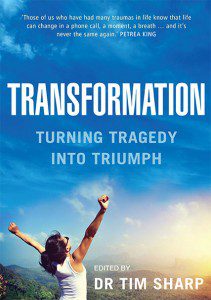
    Transformation: Turning Tragedy into Triumph

    There is so much tragedy in the world it is only fair for every individual to experience some in their own lives.  Spike Milligan is thought to have said that and there’s no doubt that learning about others tragedies can help one to manage one’s own experience. We read that ‘pain is inevitable – misery is optional’.

    Dr Tim Sharp gathered together a group of people who have each experienced a life changing tragedy.  They wrote about both what happened to them and then explained their reactions, what they did, how they learnt to absorb the tragedy and to cope with the rest of their lives.   At the end of each chapter Tim Sharp summarises their experience and discusses their various coping mechanisms

     In a number of cases the people involved move from being the victim to being able to assist others – both perpetrators with their actions and victims with their traumas. It’s one thing to live through abuse, rape, murder or other trauma; many of the participants in the book are now authors and speakers who have moved on to help people recognise and deal with their life’s traumas and difficulties.

    This is not an easy book.  Some of the stories are hard to read, let alone to live through and one is left with amazed admiration for the resilience of the participants. The importance of listening to our friends – really listening and being there for them when they need help – is one message I took from one of the stories. Suicide is a scourge in Australia – it has been said that a third of single person car crashes may be suicides. And while the loss of any life in this way is terrible, the effects on the families and friends who are left behind can be an ongoing ordeal.

    This is a useful book to keep close – you will be inspired by the stories and reminded that humans can rebound from even the most appalling travesties; not only recover but move on to help others.


  • Talking Baby

    Talking Baby

    ‘Talking Baby is required reading for every parent, grandparent, educator, student, or anyone working with children,’ says Elisabeth Duursma, Senior Lecturer in Early Childhood Education at the University of Wollongong.

    The book is set out in a very reader friendly way, with explanations and charts; blocks of writing are placed in different sized boxes and there are photos to show examples of the author’s meaning. Historically, when there were larger families, new parents watched how others in the family dealt with language. Now, people find reading easier and are given reasons why certain strategies work well.

    In the early pages, the authors explain that Chapters 1-6 describe the baby’s language development in relationship to their physical development. Before two years of age however, there is an explosion of knowledge of words, and in the following chapters of the book, areas of language are dealt with. For example, there is a chapter on play, another chapter on early words and how they use them, and then how children put words together. We see the development of the sounds of English, patterns of errors, and the progress that children show. Later in the book, the chapters cover language outside the home, and look at special topics, such as colours and numbers.

    To begin with, we have a chart, talking about Speech and Language milestones. It covers from birth to four years. It outlines how babies respond, what they say, and how you can help. This alone is a valuable asset for anyone dealing with children. There is a segment after each chapter which says, “What does Science tell us?” that outlines latest research and guidelines. For those first- time parents or grandparents, there is a guide of things to say to your baby, how to talk, leaving a time for them to respond.

    Chapters cover play and language, sound development, and one chapter deals with the three ‘Terrible Questions’ stage. When children are more advanced, they begin to give reasons, and this usually happens once they can join words together. Sometimes the reasons like ‘Not tired’ when they are rubbing their eyes and yawning, express an opposite feeling, to avoid bed.

    The topics and breadth of this book are huge. Any new parents and grandparents would learn so much from reading this, that it would quickly take a prominent place in the home. Schools and Kindies would find this a valuable refresher and ideas promoter, while Child Care Centre workers would also benefit from reading this. It is easy to read and segmented, so that the reader is not faced with slabs of text. The latest research is addressed here which adds hugely to the authenticity of the book.