Tag: perfection

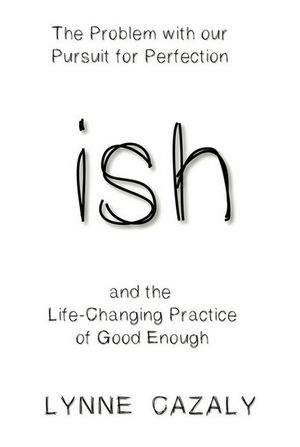
  • ish:  The Problem with our Pursuit for Perfection and the Life-Changing Practice of Good Enough

    ish: The Problem with our Pursuit for Perfection and the Life-Changing Practice of Good Enough


    At last, a book devoted to common sense as it applies to the world of ‘perfection’ created by the so very imperfect people, whom, in their pursuit of the unattainable God ‘perfection’, lose sight of life, reality and the very real concept of ‘ISH’.

    In ISH, international keynote speaker, author and a master facilitator Lynne Cazaly, introduces the concept of near enough to the world of business and everyday life, showing how to achieve much more, by caring less, but still being able to deliver a high standard of work.

    She addresses the very real and debilitating effects of ‘perfection’, a state of mind which is now considered as a mental condition, one which is on the rise and one that can have some serious consequences as to how we as people, view ourselves and our input to everyday life and work.

    Perfection is a state which has been created to dangerous levels over the past twenty years, which ultimately does not achieve all that it may be considered to achieve, generally ends up in a total state of inertia and fails to get very much done, because by always trying to make everything ‘perfect’, nothing is ever complete.

    Everyone has been caught up in the situation of ‘if I just did…..’ whether it is on the home front, writing a book, involved in a project or simply trying to fulfil the rather unreal expectations of a senior staff member or manager.

    But what to be done and how to find the way to being able to achieve more, accept that there is no such thing as perfection and be able to enjoy and accept that good enough, or Ish can make life so much more worthwhile, productive and enjoyable.

    Cazaly says that excellence at work, home or play should be the standard to achieve, but excellence is something very different to perfection. Excellence can be achieved whereas perfection cannot!

    She looks at all aspects of ‘pursuing perfectionism’ and why we are driven to try and discover it, or achieve it, how we get trapped like flies on sticky flypaper, and then offers nine ways of alternative thought patterns to discover a life based on the interesting state of mind you will come to know as Ish.

    It is so terribly easy to get caught up in the pursuit of perfectionism, especially in the aggressive world of today, but the reality is encapsulated in the single word coined by Nobel Prize-winning economist Herbert Simon from satisfactory and suffice, ‘satisficing’, which means, ‘That’s satisfactory. That will suffice’.

    There are some great quotes throughout the book which is full of those wonderful ‘light bulb’ moments; moments that create wholesome change.

    Ish is all about caring less about more. Brilliant and a great mantra to carry into and forward for a healthy, happy, productive life.


  • The White Book

    The White Book

    Stark and pristine in its beauty, the words are there to be devoured, to be revered, to enjoy, allowed to envelop the mind, the very soul of the reader, as Han Kang creates, with her succinct use of language, a time and place in the here and now.

    Describing all the many fascinating things in life to her older sister, born only to live a very short time, the many aspects of a life pristine in its perfection, a blank sheet of pure white still to be written upon, is  almost a meditation, a form of deep grieving for a soul unknown and yet loved as a family member.

    She describes her reason for commencing this book in the spring: the list she wrote and the process that would be cathartic, transformative and in so being, become a thing of pure beauty.

    Moving to a new city, a place of strange shapes and different language, the colours of the morning and the night has been described so well the vision is created, as if painted on a canvas: a sofa bed made up in the corner of the room is evocative of settling for the night; allowing a time of reflection of the day, the time passed.

    Located on page 83, in the second section of this three section work, there is a delicate passage titled ‘handkerchief’ inspired by the simple task of a woman hanging out her washing in the afternoon light: perfection. Sand is a piece which could, as could many others pieces, stand alone as a delicately encapsulated moment to capture a scene, a thought;  to simply sit and consider, to meditate upon; to spend time with each word used so delicately, so descriptively. These are only two of the many pieces which reach out to tell with pure simplicity of the city which is discovered through fresh eyes.

    There are longer passages. Some in a the form of a letter, others, thoughts written down, considerations of subject, time and place to be reflected over, to be discussed mentally, to be shared with her vision of siblings, always to remain unmet.

    In the telling of her families’ loss and final acceptance of the fragility of life, easily given and equally easily taken away on what would almost appear to be a whim, the last segment completes the circle of life in stunning simplicity

    Profound, deeply haunting and beautiful The White Book, the words broken only with the occasional black and white photograph, is a masterpiece in its simplicity, its beauty, is poignant style and the absolute beauty described that is and can be found everywhere we choose to look.

    South Korean master Han Kang’s previous book The Vegetarian  won  the 2016 Man Booker International Prize.

  • Atlantic Black

    Atlantic Black

    This story takes place over a whole day and night aboard the ship RMS Aquitania. It is on the 31st of December, 1938, that Katerina Kova finds she is alone, unchaperoned, on board the ship. Her every thought and action is described as she roams the ship, meeting and observing people who are crossing the Atlantic Ocean with her.

     Katerina is an Ambassador’s daughter, and she and her mother are travelling together on one of their frequent moves around the world. Anna, the mother, has a psychotic episode where she pulls out her eye, and so she has to be restrained in the hospital by the ship’s doctor. The daughter sits by her sedated mother for a while, but then begins to roam the ship. She helps to feed her father’s dogs, and gets bitten. Then she wanders around the deck, and sees a man she believes is contemplating suicide. They talk for a while and she realizes he is seriously unhappy.

     Next the girl goes down to the lower deck, but on the way sees a young sailor standing outside a cabin. He has been set to guard the room, as the male passenger, who occupied the room has died, and is surrounded by pornographic books. The sailor and the girl chat about how unfair it is that he has been left there, and joke that he should order a lunch to be sent down. Many of the meetings and conversations that she has are strange, as is an occurrence, where a page of the bible has been pushed under her door.

     Katerina is thinking of her mother, and her father who is Russian. She also has a brother who has joined the army but is being bullied mercilessly by those who don’t understand his poetry. As she meanders through the ship, meeting people at random and visiting various rooms, having sex in one, she becomes more introspective. Each of the characters she meets has an antisocial flaw, and a certain sadistic quality. There is no doubt, Katerina is trapped.

     The cover of this book is black. The contents show the blackest of human nature and thought. The ending is black, and as filled with mystery as the rest of the tale. Noir literature which is as challenging as the subject matter from which the author has derived the plot.