Tag: obsession

  • Death of a Bookseller

    Death of a Bookseller

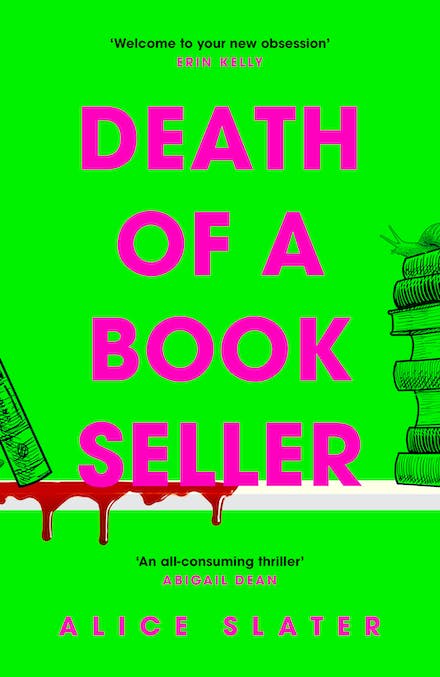
    Infatuation of one colleague for another can be both distressing and annoying, but when it escalates to stalking it is not only disconcerting but alarming. Alice Slater’s debut book “Death of a Book Seller’s narrative is driven by the personalities of two quite different characters, who are thrown together in Spines, a struggling bookshop in Walthamstow. 

    Goth loner Roach’s comfortable life as a bookseller is thrown into turmoil, with the arrival of bright, perky Laura, who joins the staff of the rundown bookshop with the aim to rejuvenate it. When true crime fanatic Roach notices that her new co-worker also reads about serial killers and writes poetry with dark themes, she believes that she has met a true kindred spirit; she fantasizes about a mutual friendship.

    Although from the title of this slow paced, easy to read book, it would appear to be a murder thriller, however it is more a tale of obsession, crime, and fixation, with the main protagonists eliciting both sympathy and disgust.

    As boundaries are crossed the deceptive story unfolds in the run-up to Christmas.  

  • An Ungrateful Instrument

    An Ungrateful Instrument

    Delicate, sensitive, brutal and unforgettable, as is a classical suite of music, An Ungrateful Instrument from Michael Meehan is a brilliant novel set in 18th century France, in the years before the Revolution, when to be considered a member of the Court of Louis XIV was the epitome of Society.

    The powerful voice of the mute Charlotte-Elizabeth Forqueray, sister to Jean-Baptiste and daughter to the genius, if demonic composer Antoine, himself a child prodigy at the Court, tells the story of love, abuse, decadence and strength, that was the everyday life of the Forqueray family as their father forced his children to become what he once was, a Prodigy to the Court of Louis XIV.

    In his obsession he believes that violence will achieve the desired conclusion, but in his doing so his brutality sees Charlotte Elizabeth choosing to remain mute, refusing to play the viola, Jean-Baptiste taking the force of the obsession, trying to live up to unimaginable expectations.

    Their mother, Henriette-Angélique Houssou, once a talented musician who accompanied her husband on the harpsichord, is now a dreadfully unhappy, broken woman who filled their childhood with wild stories associated with the Greek Gods and other ramblings.

    It is in this setting the powerful voice of the narrator tells of the tragedy, decadence and obsessive hatred of the father for the son, who even at a young age is a fine and rich talent, who takes punishment after punishment in the hope that he will be able to live up to his father’s demands. Eventually n his madness, the father, along with a group of Court lawyers sees the son exiled from France for many years, jailed and left destitute on the streets.

     Threaded through the sad story is the beautiful balance of a woodsman, a craftsman, who crafts a beautiful Viola out of treasured pieces of wood for the young Jean-Baptiste. He is tutored in the fine art of viola construction, each segment explained in detail, each singular piece gifted with its importance to the whole instrument. This in itself is an eloquent tale of beauty in the depth of horror, a light to be held in the darkness.

    Antione Forqueray was considered a genius in his compositions but he considered each piece so unique it should never be repeated, that the work should never be written down, that the piece should only ever be performed by either himself or his son.

    Harpsichord was the only instrument to accompany these works and to this end Antoine in his later years, lusted after the brilliant second wife of Jean Baptiste, a harpsichordist of prodigious talent.

    In a supreme irony, two years after his death Jean-Baptiste published 32 of this works; apparently more than 300 pieces had been composed over Antoine’s lifetime. His work was considered as extremely difficult if not challenging to play, so much so that after his death Jean-Philippe Rameau, Francois Couperin and Jacques Duphly composed works as a tribute to the complex and violent man.

    Michael Meehan has out of tragedy, crafted a work that is exquisite, that sings, as do the strings of a Viola da gamba, voicing brilliance, tragedy, love and lust to tell a story; the words placed on the page with care and precision, so much so, the emotion has been neutralised in the retelling. The voice of Charlotte-Elizabeth more powerful for the precision.

    It is perhaps a necessary conclusion to the work, to listen to one or more of Antoine Forqueray’s compositions, even if you don’t enjoy classical music, to appreciate the magnificent obsession that created such complex compositions. 
  • Storm and Grace

    Storm and Grace

    What a magnificent story. For those who love the sea, have dreamed of breathing underwater and are satisfied with nothing less than full immersion, reading this has a magical quality: A story of a powerful attraction between a man and a woman; a story of passion and dangerous relationships. It also involves the art of free diving, where one breath is all you are allowed before sinking as deep as you can in the ocean.

     Grace is studying Marine Biology and is also a journalist for a dive magazine. She is asked to interview a man, Storm, who holds the record for the deepest dive on a single breath. She is mesmerized by his powerful appearance and personality. Similarly, he devours Grace with touch, and whispers, and promises. He promises to send an airline ticket for her to join him at his home on an island. It is here we meet the ghost- like chorus. They whisper and float around the plot always, almost like a Greek chorus. Their whispers and rustlings give warnings and enlarge the understanding of what seems to be an amazing sequence of events.

     Grace goes to the Island, and obsessed, Storm controls her mind, body and breath. He suggests she try free diving, and when she has a successful first dive, the champion diver declares that he can make her “The World’s Deepest Woman”. For Grace, who grew up moving from country to country with her family, never making lasting friends, never being quite sure of herself and always shy, it is as if she is catapulted into stardom. She is Storm’s star! And so the training begins. Storm oversees her weight training, her breathing training, and her yoga. They go out diving often, as Storm continues to challenge his own records.

     Gradually Grace is weaned away from friends at home, her mother, and other people on the island. It is here we hear the voices, gently warning, checking on her need to please.  The reader is almost holding her own breath by now. The descriptions of how to fill your body with air, and how to overcome the weight of water, slowing of your heart, and the mind control, are vivid.

     The style of writing of this novel is almost poetic, it is beautiful and moving. Katherine has used words from the play, Medea, for her ethereal wisps that float around the plot. The reader is drawn in to an understanding of how this story will unfold, and how Grace’s destiny was always following a path.

     A book to treasure.

  • Capital

    Capital

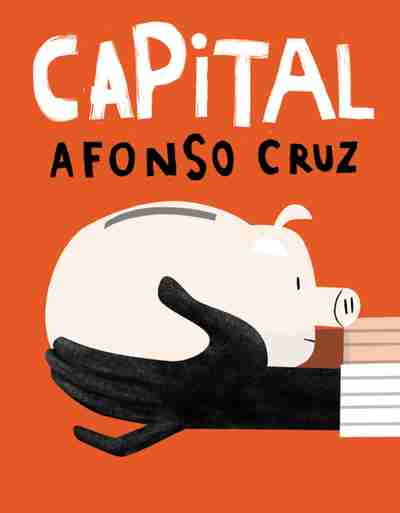
    Stories without words are always fascinating, as they leave the imagination free to move about to interpret the message being promoted as it will. In Capital this is totally the case, as the illustrations are simplistic, vivid and bold, allowing the message to come through loud and clear.

    A man gives a small child a piggy bank. The man is obviously someone of wealth and importance and the message is already there; money is important. As the pages turn the child grows from a child into a teen and then into manhood, all the while looking after his piggy bank, adding to the contents and almost seeming to make this piggy bank the most important aspect of his world.

    As the years roll along, the young man becomes a man of means, a man of money; whatever he does money is most important aspect of his life. Leisure, friendship, love and marriage take a backseat to money.

    His greed to have more and more becomes out of control, destroying all he has created in his desire to use every means possible to become stupendously, insanely, immensely, wealthy.

    There is a moral to this cautionary tale which will be different to everyone who takes the time to sit and really enjoy what this award winning author, Alfonso Cruz, has created.

    Suitable for a wide range of ages, the tale can be viewed from many differing perspectives. Children’s interpretation of the artwork and tale would be interesting indeed, as they tend to be able to see things as they are, unclouded by preconception. Teens would have an alternative viewpoint, which would also be equally interesting and adults should use this to reflect on what is truly important in their lives.

    A book which has a multitude of uses, interpretations and aspects to be pondered and one that should be considered as an addition to any library.