Tag: New York

  • Spillage

    Spillage

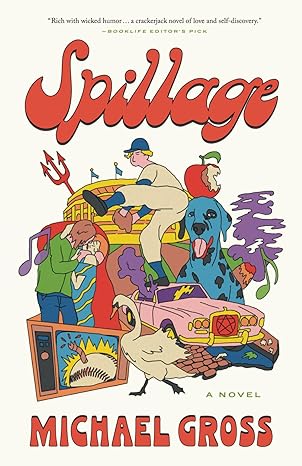
    It’s the 1970’s, a tumultuous time of change and anyone who live through the era of the ‘Big Apple’, hedonistic lifestyle of those days, hippy culture, drugs and what could be considered as a cultural revolution in societal values, will relate to this wide ranging, witty and fast paced look back down the years, captured by Michael Gross in Spillage.

    New York or the ‘Big Apple’ is beginning to crumble at the edges, the gloss slowly but surely being removed, the Nixon Administration is in full swing and the only bright spot in the chaos is the Yankee’s possibly making a major come-back, thanks to their new pitcher Nick ‘The Swan’ Spillage.

    But all this is put in jeopardy when Joan, a depressed young woman, develops a major crush on Spillage and is prepared to go to any length to gain his attention in bed and out. So metaphorically, while New York burns, Eliot, Joan’s long-time partner is prepared to do what it takes to get her back: to put his world and that of many others, back where it should be, Nixon and local politics not-with-standing.

    Spillage is not a book for everyone, but certainly is reflective of a time when the traditional was rapidly being undermined, rules changed consistently and corruption was on an upward trend.

    Somewhat cynical, often fractious and definitely a novel of the 1970’s, when Michael Gross wrote the first draft, Spillage will be a walk back down memory lane, when life was often exactly the way Gross portrays it – chaotic!

  • Mrs Harris Goes to Paris & Mrs Harris Goes to New York

    Mrs Harris Goes to Paris & Mrs Harris Goes to New York

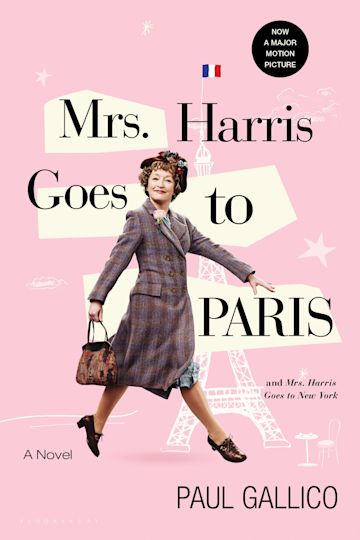
    Initially written in 1958, Mrs Harris Goes To Paris is being released as a major film in 2022. It is difficult when reading the book to relate to the photos of Mrs Harris on the front cover, but as with all book-to movie transfers, there must be some adjustments made.

    The story is charming and reflects the values of the times. Mrs Harris is an incurable optimist who believes the very best about everyone She is not daunted by a haughty demeanour, an impeccable accent, or immense wealth. Her innate goodness is what she sees in everyone else, and she treats people accordingly. Although Mrs Harris is a cleaning lady she still dreams, and one day when a client shows her a dress designed by Christian Dior, something dramatic happens.

    Owning a Dior dress of her own, becomes a goal for this determined lady. In per suing her dream, Mrs Harris has to face many challenges. In her own pragmatic way, she influences people in France and England, always with the best of intentions. And if coincidence plays a part in her success, we can only be grateful for it.

    When the Mrs Harris series was originally written the books became beloved of many as during the 1950’s in Britain the effects of World War II were still impacting on daily life and anything that lifted the spirits was more than welcome.

    Perhaps in today’s world of considerable uncertainly a little of Mrs Harris and her eternal optimism will go a very long way.

  • Finding Hannah

    Finding Hannah

    In Finding Hannah, Fiona McCallum takes the issue of tragedy and grieving, weaving a heartfelt and yet healing story around Hannah Ainsley. For anyone who has suffered the tragic loss of a family member or friend they will immediately relate to Hannah’s story of love, loss and the eventual healing which takes place.

    Hannah has always loved Christmas, to her and her family it has always been a special time of the year: presents are searched for wrapped, placed under the tree with great reverence and excitement. Traditional foods are prepared and enjoyed with her family and friends on Christmas Day.

    Tristan goes to collect her parents while Hannah puts ticks the final items of her too do list, but he is away far longer than the usual 20 minutes it takes. Friends who have been invited to lunch begin to arrive and when a knock on the door is heard, it brings with it the most terribly horrific news possible: Tristan and her parents have been killed in an accident. Hannah’s life splinters in that single devastating moment.

    She eventually comes to the place where she realises that her parents and Tristan would expect her to be strong, to cope, to go on in life and to rebuild; but that, while great in thought and principle, Hannah decides, is not so easy to accomplish in real life.

    As the months go by she draws on her friends love and support  to help her through the tough stuff, eventually taking the first small step to beginning again, learning to understand and manage her feelings and arrive at the understanding that the people around her simply want to help.

    Christmas begins to loom once again, and she is faced with the issue of what to do, stay home of go away. She decides to unwrap the presents left from that fateful Christmas Day and discovers a clue to a surprise trip to New York as the final gift from her parents. Does she take one more huge step or not and will it help Hannah begin to look towards a positive future once again?

    Beautifully written, McCallum has gone from strength to strength in her writing and in doing so takes the almost taboo subject of grief and grieving out of the dark and into the healing light.

  • The Spider and the Fly

    The Spider and the Fly

    Why would an author want to initiate a four year correspondence with a serial killer behind bars, who hid the eight bodies of his victims in the loft of his house in which he and his family continued to live? In September 1998, young reporter Claudia Rowe, while working for the ‘New York Times’ in Poughkeepsie, New York became obsessed with the story of Kendall Francois, a seemingly ordinary community college student who abducted and strangled eight women. What was the killer’s motive in taking these lives!

    ‘The Spider and the Fly’ chronicles her correspondence with the serial killer, Kendall Francois and in the process Claudia Rowe takes the reader along on her journey of self-discovery. The correspondence between the two is also a tedious power struggle as to who has control of the resultant ‘relationship’; the book explores this provocative and dangerous relationship. Meanwhile, those near and dear to the author found her involvement with the serial killer through the letters which later lead to phone calls and eventually to prison visits, difficult to understand and even bizarre. 

    In order to find an answer to the ‘why’ the author interviewed several people; a few teachers and some acquaintances but none had any useful perspective on the question. She was no closer to establishing whether Kendall is just a monster or worthy of some empathy.

    In ‘The Spider and the Fly’ Claudia Rowe generally combines the true crime and memoir genres successfully. The author also provides the reader with some insight into the cultural and political history of upstate New York. However, topics tend to be a little random, which makes it difficult for the reader to make the connection between one event to the next.

    If you enjoy discovering what the killers did, what drove them to do it, and some gruesome details of the crime they perpetrated in some chronological order, this probably isn’t the book for you. However, if you are interested in exploring this relationship between a journalist and a killer, you will find it a worthwhile read.

  • Golden Hill

    Golden Hill

    This story is a tapestry of stories and themes,woven so tightly together that it calls for reading and re-reading. It is an Historical Fiction about the early days of New York; it is a romance, it deals with African slaves, the ending of the English era and the beginning of the Dutch golden age. The characters are given great depth and understanding while the language leads you into the very streets of New York in 1746. The plot is not revealed until the very end and is impossible to unravel beforehand, keeping the reader guessing as to motivation and plans.

     Richard Smith arrives in the small city of New York (“where cows can be seen at the end of the street”) He has arrived with a bank order for one thousand pounds, a huge amount of money. The locals are bemused, not knowing if he is genuine, or if the note is a fake. The only way to make sure is to wait for confirmation from the bank in London, which will take a month. Meanwhile, they do not wish to alienate a potentially wealthy man, and so invite him into their homes, and to their parties; any questioning on the townsfolk’s part result in polite digressions from Richard.

     n one of the homes, Richard encounters a young woman, Tabitha, who attracts him with her bravery, daring and spirit. She has an incredibly sharp tongue, can behave outrageously at times, is heartily disliked by most of her family and friends, therefor it is surprising Richard enjoys sparing with her, and begins to understand her form of rebellion and expression. Their developing relationship weaves through the story again, leaving the reader to wonder where it will end.

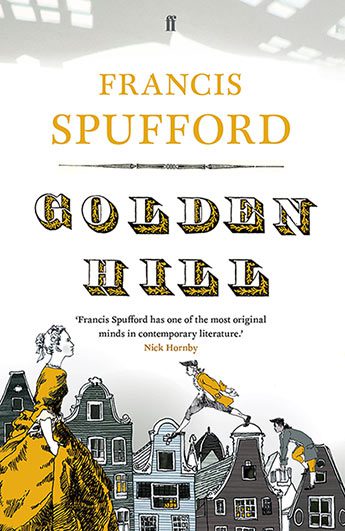
     One night Mr Smith decided to watch the celebrations that were being prepared for Guy Fawkes Night. He finished up in a seriously compromised position, the local butcher wanting to strangle him and throw him in the river. Luckily Septimus Oakeshott came to his rescue and they had to run from the hostile crowd. It is this chase that is featured on the front cover, edged in gold and depicting the narrow Dutch houses clumped together. The whole town was aware of the escapade next day. This emphasized to Richard the smallness of the town as compared to London. It also provided him with a true friend, as he and Septimus shared many values and ideas.

     We still have a few weeks before we know if Richard is a wealthy man or a fraud and for him to avoid the questions and suggestions made to him. We know he is a scholarly man, as he is invited to take part in a play and does so with great skill and knowledge. Unfortunately the part he has been offered was originally given to Tabitha, but he was not aware of this. The feisty woman is not amused, and ignores both the play and the stars.

     As a tapestry, this story has so many wonderful aspects to it. The characters are rich and alive, the language propels you into the time and street, the plot unravels slowly, with Richard, the narrator saying “I do not want to write this part of the story,” leaving us wondering. The fascination of New York in its raw and early days, and the horror of an accident keep us reading. There are glimpses of what the future holds for this era, a generation before the American Revolution. Marvelous!