Book 2 The Bookfinder Series
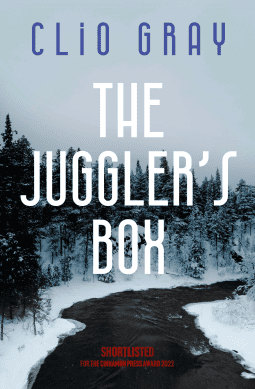
Three stands which frequently seem like more, are woven skilfully together by Clio Grey in The Jugglers Box, book 2 in the Bookfinder series, as she selects a slice of European history in which to craft a fascinating, challenging adventure with risk faced on every side.
Napoleon is moving through Europe taking all he can capture, living the life of a conquering Emperor, his rhetoric beginning to wear thin. The British, sent to route him have fallen to disease in Heligoland and are vainly trying to recover any men that can, sending them back to Britain.
Set at the beginning of the 1800’s a body is found frozen in time in a Salt Hedge, a crate of books with him. Who is he and what was he doing there is the question that no one can answer in the town of Bad Salzbaum.
Ruan Peat has been tasked with the job of looking at the books in the crate to identify if there is anything valuable within the books, that would mean someone has had to hide themselves and the books in a salt hedge undergoing repairs. There is more to Ruan than just a book finder, he is a very good detective who enjoys getting to the bottom of puzzles that are created when he is tasked with finding and classifying old and rare books.
Greta Finnerty is a rebel still fighting for a lost cause, that of the Irish Rebellion of 1798. She is the love of Ruan Peats’ life, and he hers. She regrets refusing his offer to live with him, turning once again to fight the just fight. This time, she is smuggling an English Officer across enemy lines to get an urgent message through. This goes against her inner belief to help the British, but for once she can eventually see the bigger picture.
A somewhat mysterious woman Hela, from Vettie’s Giel, an almost mythical valley in Norway, appears in town, looking for an old friend of her mothers. She is very careful in what she is doing, who she is talking to and why. She believes if she finds a song written some years before, a song of mythical portions, that helped people rise up against the Russian Army and win, she will be a hero, remembered for all times. She is ruthless in her quest.
Each and every character, of which there are many, each intricately involved in the wider story have been beautiful crafted, coming alive on the pages of the story, each one doing what they are destined to do, with each one eventually forced to face the reality of who they are and what they want in life.
The language used in this multilayered story is a joy to read, the description of the places, the times and the people springing off the pages, full of vitality and realism.
The Jugglers Box is a story that needs to be read with time to spare as the plot is complex, the main strands having many smaller strands allowing them to be able to twist together in a fascinating conclusion.