Tag: Mystique

  • Saga

    Saga

    The final in the Systir trilogy laced around  Astrid, Mercy and Mia, Saga rates up there for passion, fascination and emotion as the lives and times of three very different women from vastly differing times in history draws to a final time in today’s world, a world which is very different but very much the same.

    1066: Astrid is in Norway – She is destined to become a high priestess at the last remaining temple. She realises the learning must be recorded for history and must be protected from the Roman Church and Norway’s kings. She records all of her learning and the last days of the old religion then hides the books, hoping they will eventually be found and kept safe.

    Mercy is in Glasgow in 1813, an orphan girl who had a parcel of clothes and a book she had inherited when she first entered the Orphanage. She grows too old to remain there; she was sold off to an undertaker to follow the hearse. She eventually escapes to London where she meets Anne Ratcliffe, author of Gothic horrors novels and is coached into becoming a society lady. Mercy discovers she has only been a challenge to Mrs Ratcliffe, a Pygmalion situation, and decides to return to Glasgow to collect her parcel left behind at the Orphanage.

    Mia lives in present day Australia. She is given a very old book at her cousin’s funeral which refers to another book somewhere in Scotland, possibly the Orkney’s. She decides to go to Scotland to find out what her ancestry is and connections to the book. But first she needs to track down a second book, which may hold many of the answers to so many of the questions she has about her cousin’s death and family history.

    Based around the concept of the story lifting the emotion, and used as a vehicle to bring into the modern world so much of history and spirituality forgotten or seldom viewed, these three women who form a sisterhood down through the centuries have much to tell, to offer, as well as present for inspection and acceptance through the modern and yet ever changing scope of a generation seeking.
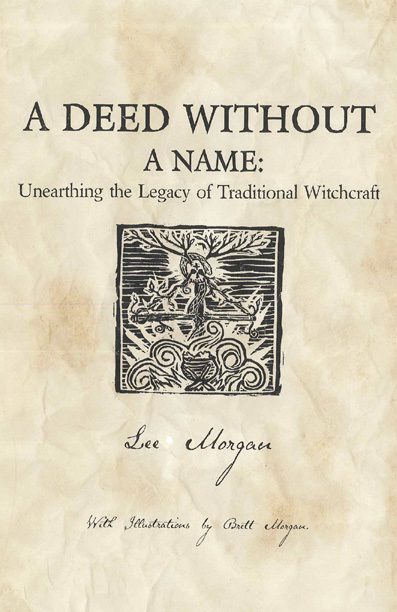

  • A Deed Without a Name, Unearthing the Legacy of Traditional Witchcraft

    A Deed Without a Name, Unearthing the Legacy of Traditional Witchcraft

     A Deed Without A Name: Unearthing the Legacy of Traditional Witchcraft is a fascinating work that seeks to combine academic research on traditional witchcraft with practical knowledge and insider information which will close the gap between scholarly knowledge and the practical applications of Traditional Witchcraft. Drawing from decades of their own experiences in core-shamanism and witchcraft and combining with information from modern testimonials, folklore and trial records, the author desires to deepen the audiences understanding of the ‘ecstatic and visionary substrata of Traditional Witchcraft’ (Morgan 2013).

    The book is filled with fascinating content throughout all twenty-three chapters, ranging in subject from mythical creatures to exorcisms, which makes for interesting reading, particularly to those of us not as attune with the other realm. Each chapter clearly and concisely defines the subjects they discuss. Academic sources, poetry as well as other practitioners of magic are regularly referenced or directly quoted throughout the chapters, making for an informative and educating read. This is one of the few works of non-fiction that is either tedious or dull, rather the style of writing, while academic, flows and feels casual with the tone of language and not weighed down with jargon.

    Though this book intends to shed light on the often dark and murky subject of Traditional Witchcraft and enlighten its audience, but by no means does it dull or take away the wonder or intrigue of its subject nature.

    For those of us who are not in touch with the other-world, this book may seem like it is purely for those who practice or take an interest in witchcraft. However, this book is a fascinating read for anyone.

    Overall, A Deed Without A Name: Unearthing the Legacy of Traditional Witchcraft is an interesting read that successfully combines academia and witchcraft.

  • Guitare Mystique

    Guitare Mystique

    Solo guitarist Jim Stubblefield has gathered his many talents, added his love of fantasy, collected a group of like-minded musicians and created a wonderful voyage of musical styles which range across a broad spectrum, each piece holding its own originality but complementing the entirety.

    As always with Stubblefields’ works the music has a flair and verve that is all encompassing, combining many ‘flavours’ to be found throughout what could be easily referred to as world music, as the tempos take a little from here, a lot from there and a dash of something else from some other place.

    All things mystical and based in fantasy are the underlying basis for this album with enjoyment to be found in many ways. Each of the pieces, beginning with the very gentle Saint-Tropez softly lulls you into the mood to simply enjoy what is to come. The piece based in the ambience that is the French Riviera, draws inspiration from the glorious relaxed mood of simple pleasure and enjoyment.

    Azure changes the pace entirely as Novi Novog takes centre stage with his violin: the addition of guitars and a touch of synth make this almost an otherworldly piece, which is definitely a different style for Stubblefield. It certainly invokes the fantasy and mystery to be discovered on any voyage through life!

    In Café Café he and Eric Hansen share the solo roles in this rhumba influenced piece adding a wonderful touch of colour and flamboyance to the work. A little further along there is the wonderfully tempestuous Oculus Tempestatis . The wordless vocals of Moksha Sommer combined with Stubblefield on electric guitar and Stephen Duros on acoustic guitar to create that deep mysteriousness that enhances a campfire at night, a dancer moving ever faster and faster, a storm brewing on the horizon, the elements and emotions building to reach the ultimate, explosive, peak descending into the aftermath of calm.

    After the emotion of the previous pieces the lovely Sueno Pacifico creates a delightfully light finish to what is a varied, up-tempo album filled with mystique, change, style and panache.

    Stubblefield set out to create an album of difference and in Guitare Mystique he has truly succeeded.