Tag: issues

  • What to Say When You Don’t Know What to Say

    What to Say When You Don’t Know What to Say

    The picture book ‘What to Say’ is just the book for parents, when helping their youngster to come to terms with those tricky every day challenging little moments. Life isn’t always easy for a young child. Author Davina Bell has selected more than twenty of the most common situations which give rise to anxiety in preschoolers and preteens. Each beautifully illustrated page aids parents to talk to their child about the perceived difficult situation which has arisen; be it being left out, having feelings hurt, or being different and many more.

    Children generally are more willing to express their feelings in the terms of a third person. This book’s charming illustrations give both the parent and child an opportunity to discuss the incident portrayed in a secure loving environment and hence help the child to resolve his/her own problem. 

    I highly recommend both parents and teachers to keep this hard backed book as a handy resource in their own personal library.

  • It’s OK to Cry

    It’s OK to Cry

    It’s OK To Cry is one of the valuable books for children that can be read with an adult (allowing discussion) or read alone and thought about. So many children are unable to identify and name specific feelings that it is no wonder that they cannot solve issues that arise from these. Even the happiest children will feel disappointed, cranky, or cross at some time; to identify why and what they can do is hugely important.

    The hard-back picture book is immediately appealing because of the bright colours and intermittent illustrations. The Contents page talks about Boy’s and emotions, then lists different Feelings, with lastly “Things you can do to cope.”  The author suggests that society and things such as ads on TV and books can pass on messages to boys that they have to be tough. I think that there are equally damaging messages for girls, but the author does address this later.

    The next part of the book gets children to identify and name feelings they have “Dog poo on your shoe. Disgusting!”  When your pencil breaks all the time, you feel Irritated. When you are lost, you are feeling distressed.

    When the reader can identify emotions, there is a page on “Steps you can take to help you deal with uncomfortable feelings.” These recommend that the child talks to someone to explain how they feel, or if they are angry with another child explain why they are cross. To end this segment there is a page of notes for parents and carers.  The tips given here are worthwhile and solid. They are a good foundation for young children to build upon.

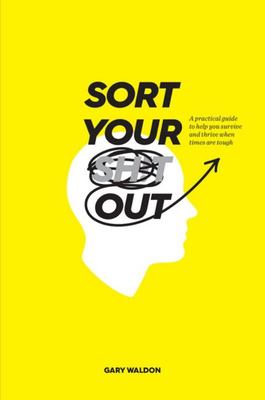
  • Sort Your Sh!t Out

    Sort Your Sh!t Out

    There are many, many self-help books available but not often is there one more or less directly written for the men who struggle with self-esteem, self-doubt and a sense of overall inability to cope with life and emotion.

    Gary Waldon a transformation change specialist has recognised this, trawling back through years of working with people learning how to cope with their own particular pile of shit, as well as his own pile, to bring together all the important points that need to be recognised to Sort Your Sh!t Out.

    Bob is the main character in this story and as he largely charges or attempts to charge through his life issues, and his own often deep and dense pile of shit, looking for the magic bullet one stop fix it all shop, much is revealed about what is classified as shit, and how best to deal with the resultant pile.

    In the introduction Highway to Hell, Waldon sets out in no nonsense language how this book was born and why it was written:  helping a young man he had known for many years begin to seriously face up to life, facing his fears and realising that he was not the only one on what he considered as his particular pathway to hell, proved to be an ah-ha moment. He realised that much of what he was sharing with Dan were many of his own hard learned lessons and  perhaps it was time he created a book he wished he had read when he too was desperately trying to understand his own often destructive behaviour patterns.

    Well set out in plain no-bullshit language, the book can be used as a workbook, as in most of the sections there is a very blunt self-analysis area that should be complete to help you understand your behaviours and allow yourself to be vulnerable, or simply as an excellent read towards better understanding and accepting what is considered as human or shit behaviour; behaviour everyone has to face or deal with at some time in their lives.

    Waldron uses a quote from the Dalai Lama, a man who also has to short his own shit out from time to time, ‘We can never obtain peace in the outer world until we make peace with ourselves’, which is the perfect place to begin on your roadway to sorting out your own shit!

    Sort Your Shit Out is a transformational read for anyone who is facing their own pile of shit; Gary Waldon has just offered you your own shovel.

  • The Space Between

    The Space Between

    For her first novel, Rachel writes with great understanding and intensity. Her portrayal of young adult passions and emotions are credible and realistic. Their world is filled with issues that cannot help but scar the heart, such as a brother dying of cancer and a family divorce. Coping with these problems forces life to become a day by day journey; sorting out thoughts and feelings, while also developing a new relationship, draws upon every ounce of the main character, Erica’s strength and courage.

     The story begins with Erica, the narrator, going on a camping trip with Daina, her best friend, Daina’s brother, Alex and Erica, another girl from school. The night is long and Erica doesn’t go back to the tent that she was sharing with Daina. In the morning Daina is missing and after a time the police are called and a search is mounted. Everyone is frantic and it is here we get to know the characters intimately. Their reactions and the devastation and guilt they each feel is truthfully portrayed.

     The writing evokes a sense of recognition in the reader that draws one into the story, and you read it with heart and head. Gradually pieces of the puzzle emerge. When Daina’s diary is found, Erica unashamedly takes it as she needs to know and understand what has happened to her friend.  Relationships between Erica and her parents, the families of Daina, Alex and Erica, are explored again with feeling; so many issues and yet so little to be done.

     It is great to read a book set in South Australia. For many  the area is familiar and makes sense of the story. Rachel also has a wonderful sense of being in the water, describing Erica’s feelings as she enters a pool and swims, holding her breath. “This is how I have taught myself what it is to breathe.” It is almost a cleansing ritual for her, which unfortunately doesn’t help her inner thoughts.

     The twist at the end of the novel is startling and brings many threads of the story together. It will allow the characters to move on, although they will never forget the girl, the love, or the lesson.  Life today is tough for many young adults, and following the thoughts and inner feelings of the characters helps us to understand and empathize with them.

    Shortlisted for the 2016 Ampersand Prize**