Tag: greed

  • Dogboy v Catfish

    Dogboy v Catfish

    Dogboy v Catfish is a most intriguing novel set in Melbourne which commences at the end of Melbourne Universities’ annual rowing regatta, where a group of friends are completing their day with a Pub crawl. A somewhat disturbing incident occurs and Lindsay Kramer, or Dogboy to his friends, uses his uncanny ability to work with dogs to save his friends from a vicious attack.

    Time passes, everyone moves on and Lindsay, always the outsider, meets and marries Katherine “Catfish” Fisher, an influencer, fashionista and former Miss Australia entrant. They have been married for eighteen months, when Cat decides she wants a divorce and the money.

    She approaches one of the top Divorce lawyers, a woman known for her success rate: she is well prepared, has already worked out what she wants and will stop at very little to get her own way. There is one problem, Lindsay has gone missing, possibly committed suicide, but whatever has happened he is gone and there is no body yet discovered.

    So begins what is a fascinating tale of greed, corruption, deceit, obsession and the value of friendship, which ranges across the world of money laundering, drug smuggling and counterfeit designer goods with links to several crime syndicates.

    Written in a clear, concise, almost report like style the mystery unfolds in carefully constructed sections which, in an almost clinical manner holds a fascination as to what happens next. In a wry twist, justice is seen to be done, but at what cost.

    The conclusion while not completely unexpected, ties up many loose ends, but also delivers a moment for reflection on friendship, how we treat others and how the impact of a kind word at the right time, can make a very large difference.

    Based on a true story, Luke Gracias has created an intriguing story that looks at the many aspects of humanity and the results of what could be considered as the ruthless narcissism prevalent in the world of today.

  • Max Champion and the Great Race Car Robbery

    Max Champion and the Great Race Car Robbery

    Written in his wonderfully measured style of words, Alexander McCall Smith has created a gentle story about courage, goodness and honesty which will delight the hearts of younger readers.

    Max, his Mother and his grandfather are very poor. Max and his Mum live in a very small house and grandfather lives in the shed at the bottom of the garden.

    Max has to help Grandfather Gus in his garage, as well as helping his Mother and when he is not at school doing his part-time job mowing lawns. In their village lives a family of very wealthy people, The Grabbers, who like to win. They are not very nice, are very boastful and certainly not very honest.

    When Mr Grabber brings his car to Grandfather Gus’s garage to have it cleaned, Max offers to wash the car, something at which he is very good. While he is washing the mud off the car, he finds a badge on the old fashioned racing style car that has his family name on it, Champion, and wonders why this is so: how could this be.

    From then on so very much happens between the greedy Grabbers, and Max and his family that the entire book takes on feeling of riotous adventure which could simply end up anywhere at all: maybe the Grabbers will win the day or maybe Max and his grandfather, with a little bit of help from their friends will emerge the winners.

    Kate Hindley, with her accompanying illustrations has captured the spirit of the book perfectly, which compliments McCall Smiths slight zany style of writing perfectly.

    Bound in a hard cover, with dust jacket, the entire book, from cover to final page is a great big, old fashioned story, one of which Grandparents will enjoy reading to their grandchildren and children will enjoy reading to themselves.

  • Capital

    Capital

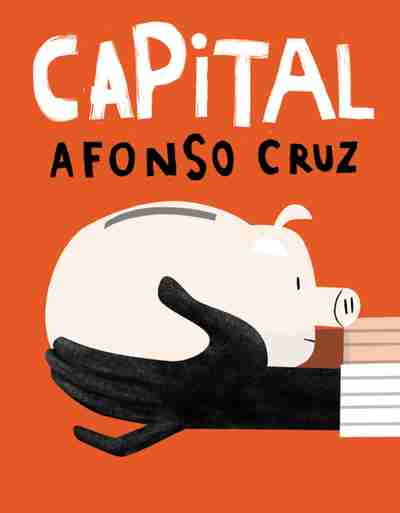
    Stories without words are always fascinating, as they leave the imagination free to move about to interpret the message being promoted as it will. In Capital this is totally the case, as the illustrations are simplistic, vivid and bold, allowing the message to come through loud and clear.

    A man gives a small child a piggy bank. The man is obviously someone of wealth and importance and the message is already there; money is important. As the pages turn the child grows from a child into a teen and then into manhood, all the while looking after his piggy bank, adding to the contents and almost seeming to make this piggy bank the most important aspect of his world.

    As the years roll along, the young man becomes a man of means, a man of money; whatever he does money is most important aspect of his life. Leisure, friendship, love and marriage take a backseat to money.

    His greed to have more and more becomes out of control, destroying all he has created in his desire to use every means possible to become stupendously, insanely, immensely, wealthy.

    There is a moral to this cautionary tale which will be different to everyone who takes the time to sit and really enjoy what this award winning author, Alfonso Cruz, has created.

    Suitable for a wide range of ages, the tale can be viewed from many differing perspectives. Children’s interpretation of the artwork and tale would be interesting indeed, as they tend to be able to see things as they are, unclouded by preconception. Teens would have an alternative viewpoint, which would also be equally interesting and adults should use this to reflect on what is truly important in their lives.

    A book which has a multitude of uses, interpretations and aspects to be pondered and one that should be considered as an addition to any library.