Tag: gods

  • Punch Me Up to the Gods

    Punch Me Up to the Gods

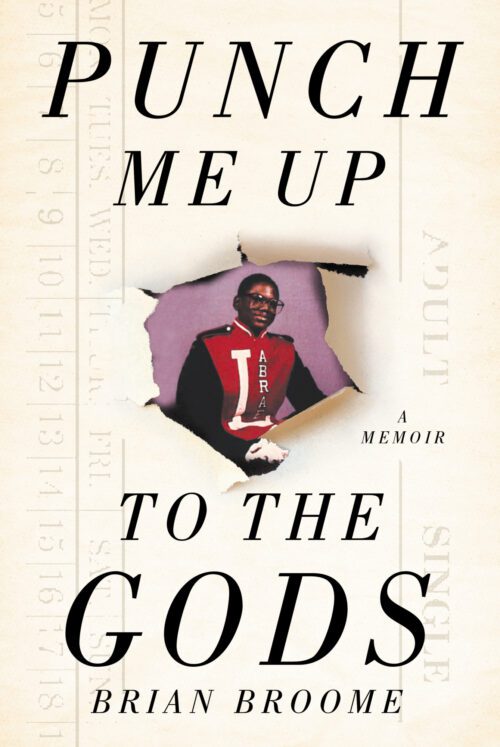
    In a stunningly heartfelt, quirky, often funny but unbearably sad memoir, Brian Broome shares what it is really like to be black, gay and an American, in his ‘coming of age’ work Punch Me Up to The Gods.

    Born into a family where to be black and male meant you had to be tough, strong, able to stand your ground in a range of adverse conditions and social prejudice in a black neighbourhood, Brian Broome was born a gentle soul, who always like to play with his sister’s dolls, rather than rough it with the other neighbourhood boys.

    His father, in a misguided attempt to ‘toughen him up’ bullied him, his friends at school did the same. He learned at a young age to be something other than what he was simply to survive. He invented a person that was him, but stood him up to ridicule once again.

    The pathway to drugs called and he cheerfully walked down it still trying to understand who he was, what he was and why his life was such a tragedy.  His pathway is reflective of so many disenfranchised young people as they try to find who they are.

    It was not until he realised there was more to life than a drug saturated world, he began to really discover life as a man, a gay man and an intelligent black, gay man; to begin to accept who he was.

    Eventually journeying overseas, he learns that racism is not just a prerogative of the American lifestyle, but is a world-wide concept that will judge you by your race, nationality and so many other pre-ordained concepts that are all too easy to accept. This was a very sobering moment and also a turning point in his life.

    Brian Broomes’ words are gracious, sashaying backwards and forwards in time to offer a delicately balanced, very personal perspective of growing up in a world full of prejudice and managing, against many so odds to become a man of words, a man who has earned his respect, a man who has in his middle years, discovered who he is, learning along the way the art of understanding, forgiveness and acceptance.

    Punch Me Up to The Gods is a memoir that is a must read for everyone who wants, or is trying to understand who they are, and how to succeed against what often appears to be insurmountable odds.

  • Heroines of Olympus

    Heroines of Olympus

    The Women of Greek Mythology

    In the world of the ancient Greeks designed for men, women were expected to “Blend into the fabric of the city,” (according to Pericles); the Goddesses and Nymphs were the exception. Their behaviours were far more extreme and accepted, as was their power and their irrational actions. If we look at the purpose of Mythology as both a moral compass and entertainment, we understand why these behaviours were so accepted by women of the time.

    The contents page of Heroines of Olympus shows us there are fifty Goddesses and Nymphs whose stories are briefly told here. Ariadne has a page of introduction, together with her image. Following that is two pages of her story, which tells how her fortune changed from being discarded by Theseus, to being happily married to Dionysus. Each goddess is described, and her story outlined in the same way.

    The Heroines of Olympus is a wonderful book for Ancient History enthusiasts. The reader can pick and choose a favourite or start from the beginning. Much enjoyment comes from tying in relationships of the deities, and their feelings for each other.

    Satisfaction for suitable punishments of bad behaviours by men causes as much pleasure today, as it would for the women of ancient times. The power that was at the fingertips of many of these deities would be dreamed of by many young women. Ellie Macklin Roberts has created such an interesting read which takes a slightly different look at the life and times of Ancient Greece.

  • Pomegranate: A Global History

    Pomegranate: A Global History

    The Pomegranate you may say is little more than a fruit, strange though it may be, that plays a prominent role in Middle Eastern cookery. A fruit that had almost disappeared into obscurity, at least in Western diets, over the past decades, until more recent times when cuisine of the finest, most unusual and from all corners of the earth, became something that was written about, created and slaved over by chefs and presented in many forms directly into your living room via modern media.

    But there is more to this strange fruit, a fruit which should be treated as royalty in the world of  fruits, as it has been revered by all major religions of the world at some point in their history; it has been found as far back as Neolithic times, when it was deliberately cultivated from the wild. Pomegranate seeds have been found in carbonised form at the Middle Eastern sites of Jericho, Arad and Nimrud and dated archeologically to the start of the third millennium BC.

    It has had poetry written to it, been a temptress of the Gods and Goddesses, used in rituals and been placed into history inscribed on wall paintings and wall hangings, silver and pottery vessels are adorned with its likeness, with ornaments worn by Kings and Queens throughout history crafted in its form.

    Great masters of their art such as Picasso, Matisse, William Morris and Dali have created woks about and around this glorious fruit, while the Buddha gets offered a single pomegranate by an old beggar woman then uses this gift, freely given, to illustrate the true meaning of sacrifice to a wealthy Maharaja.

    So no matter where you look, be it in Buddhism, Islam, Judaism, Catholicism or Christianity the pomegranate is there for all to see.

    Fertility is another area where the pomegranate features prominently, used by the Gods to tempt and also to illustrate the nature of life and death. The links to fertility are and were extremely strong. It was used as a medicine by the ancient Greeks to help with menstrual problems and considered as a symbol of great sexual ability. Each of the ancient civilisations has a considerable mythology woven around this remarkable fruit.

    In today world it is still used in certain cultural celebrations, still considered a god amongst the fruits and is becoming more and more popular for its health benefits and wonderful flavours when added to foods.

    As you reach the end of the book you may wonder why someone would have taken the time to research and present a wonderful work, with magnificent illustrations about a fruit, and if so you have completely missed the point.

    The pomegranate, as it has meandered down the corridors of history, brings with it a language of its own, telling a tale or two about who we as a civilisation are, where our roots return to, or if you like where all the folkloric, myth and legend that is very much a component of our world came to be created around one simple, in its original form bitter, little fruit with its royal looks and colour.

    As one final thought on a subject that is as fascinating as it is remarkable, it is considered by historians that the forbidden fruit referred to in the Garden of Eden, may have been the seductress of all fruits, the Pomegranate, not an apple!