Tag: Germans

  • Dunkirk

    Dunkirk

    There was a mass evacuation of 340,000 British, Allied, French and Belgium troops from the beaches of Dunkirk in France, during the days of May 26 to June 4, 1942; an heroic feat by any standard and particularly so when it was carried out by a flotilla of assorted craft, some captained and crewed by amateurs and others by seasoned leisure time sailors, some military craft, basically anything that could float, cross the English channel and return, was a called into service.

    All this was done under repeated attacks by the Germans, from land, air and sea, who thought that they had managed to contain the British Expeditionary Forces (BEF)  into a small area of Dunkirk, with the ocean, that had until now proven to be the one fixed escape route for fleeing armies for centuries, at their back but unable to be used in any tangible way, as to this stage in the invasion of the Low Countries of Europe, the Germans has a far superior force in numbers and equipment, blocking all routes via land and sea.

    In an ironic twist of fate, put into motion by Hitler, who gave the order to have Panzer troops called back from an attack on the Somme-Aisne Line, which in the three days it took for the German chain of Command to change the orders, was enough time to get support for the stranded BEF troops into place.

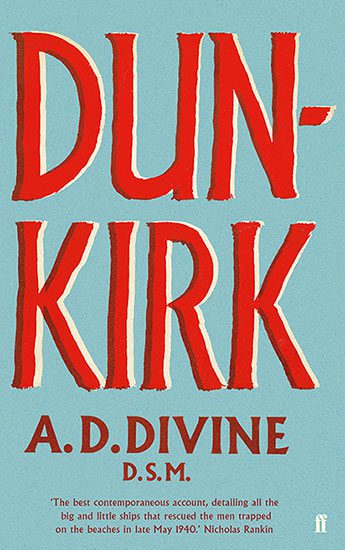
    AD Devine was one of the men called into service to help in the evacuation. As a war correspondent he had direct experience of war reporting on Operation Dynamo, becoming wounded and latterly receiving a medal. He was amongst a group of journalist who stood on the White Cliffs of Dover in 1940, watching from afar, the shelling of Boulogne. He like many others had done sailing in peace time; through his contacts at the Ministry of Information and the Admiralty he had acquired papers that put him in the navy for 30 days.

    Devine had already begun to look for a small boat that would make it to Dunkirk and back, rapidly getting her ready with the help of another man, setting sail as a member of the flotilla. Little Ann, became stranded on a sandbar and was abandoned. A second vessel, White Wing, was acquired and so began his journey into hell, as he, along with Rear Admiral AH Taylor, the man in charge of operation Dynamo small boat fleet, set out to cross the Channel to organise the evacuation of the last of the troops off Malo-les-Bains.

    From his hospital bed, Devine began compiling the book, Dunkirk, as he feared the history of Dunkirk would only be reflected through the Admiralty logs, kept in a somewhat haphazard manner, due to the situation as it unfolded,  understanding from first-hand experience, the event was so significant that it deserved a far better treatment .

    Churchill, on June 4, 1940,described in a speech to Parliament the evacuation of Dunkirk as, ‘ a colossal military disaster’ as well as ‘a miracle of deliverance, achieved by valour, by perseverance, by perfect discipline, by faultless service, by resource, by skill, by unconquerable fidelity’.  Such was Dunkirk; both a tragedy and a triumph.

    Over the years, Dunkirk as softly merged into the history of the world during World War II, never perhaps receiving full recognition for the valour and bravery of the men and women who were involved in all aspects of the rescue mission; the troops, the sailors and the public and the boat owners who gave everything they could to support such a daring undertaking.

    Released in original format, the wording is formal English which in many ways adds to the overall significance of the book, which is history recorded through the eyes of a man who was there; perhaps some aspects may have been left out, wittingly or otherwise, none-the –less Dunkirk offers to a new generation, the facts behind a war which are not glorious, just basic, raw and in the end words that go down in recorded history, as detailing just another event!


  • Escape Artist: The incredible Second World War of Johnny Peck

    Escape Artist: The incredible Second World War of Johnny Peck

    Johnny Peck was obviously born to be different, to accept that nothing sent to him to could not be overcome with a little thought, unswerving courage, a bit of good luck  and sheer determination. Peck grew up in a family that was struggling to cope with the after effects of the First World War, a father who was aggressive, often away on Navel duties. Growing up in Woollahra in Sydney’s east, close to the Garden Island Navy Base, life, in young Johnny’s eyes was not going to get better any time soon.

    His father remarried after the death of Johnny’s mother, but family life did not improve all that much. He planned his first escape at the age of 13 years, from his then home at Crib Point on the Mornington Peninsula, stealing his neighbour’s bike early one morning and riding the 80 kilometres to Melbourne. There he slept under a fire escape until a Policeman discovered him, gave him some fatherly advice, two shillings and sent him on his way.

    Four years later and considerably wiser, he enlisted in the Australian Infantry Services (AIF) becoming a member of the 2nd AIF and able to be sent overseas. He was just 17 years old but had given his date of birth as 16 February 1919, which would have made him legally able to serve.

    He fought with valour as a member of the 2/7th but first, after being sent to Jerusalem, his true age was discovered. He had to serve as a batman to General Thomas Blamey, until he had reached a suitable age of maturity for infantryman duties. Once he returned to his beloved regiment he fought in Bardia against the Italians, saw service in the Western Dessert towards the Libyan boarder, Tripoli and finally Crete, where he was captured.

    Crete was where he would begin the first of his many escapes which would eventually see him cover many thousands of kilometres across borders, torrid, inhospitable terrain and face almost certain death on many occasions. He depended on his wits and the endless courage and kindness of villagers on Crete, then later in Italy, to help him survive and on many occasions escape from the Germans.

    He, along with many others who placed their lives and those of their families at risk, helped him establish what could almost be considered as a highway to freedom for so many men escaping captivity or internment in Germany; or if Jewish certain death in the infamous German ‘camps’. His story is remarkable in that he survived at all, but that through cunning, skill and determination made a positive difference to the war efforts in Europe as a subversive element.

    Eventually though, his luck ran out and he was evacuated by the British to sit out the final years of the war in Britain.

    His story almost reads like a Boys Own of derring-do, and yes, to an extent is it; the major and overriding difference is that this story is absolutely true, as are the stories of the other servicemen whose names appear on the pages of a life lived on the edge.

    It is said that the greatest adventure known to modern man is to go off to War, perhaps this is the case, but in Johnny Peck’s case, as in so many other men of the time, it was also a chance to escape from the endless drudgery of trying to eke out an existence in the depression years leading up to the commencement of the Second World War.

    His story remained largely untold until after his death in 2002, but thanks to the efforts of Peter Monteath this remarkable story about a young man of great determination and courage, lives on to become one of the many that go to make up the remarkable history, of not just Australian fighting forces overseas, but also reminds us of the caring and courage displayed by ordinary people when faced with extraordinary events in their lives.