Tag: games

  • The Backyard Games 

    The Backyard Games 

    With the excitement and build up for the Olympic Games this year, it is only natural that children become inspired to follow in their heroes’ footsteps. The front end pages of The Backyard Games show some sporting equipment and give snippets of information. We read that John Landy stopped in a race to help an opponent who had fallen, then went on to win the race.

    The story begins with children getting ready to present their own games. They have planned and have their own venue. Then each competitor selects a country to represent. The parade is around the clothesline, but luckily the sausage sizzle has been set up and soon the quest for gold will begin. Weightlifting, archery, bike racing and javelin throwing are some of the events attempted.

    These are the happiest, tiredest children who have had immense fun. They have handed out medals, played anthems and are ready for home until “Yumi cries out, How “bout my place tomorrow?” The drawings add details to the text and cause many pauses to examine the activities and the equipment. The text is in rhyme and adds to the spirit of the fun.  This surely promotes an interest in participating in sport, and shows the many areas children could excel in.
  • Game On: Shrinkle

    Game On: Shrinkle

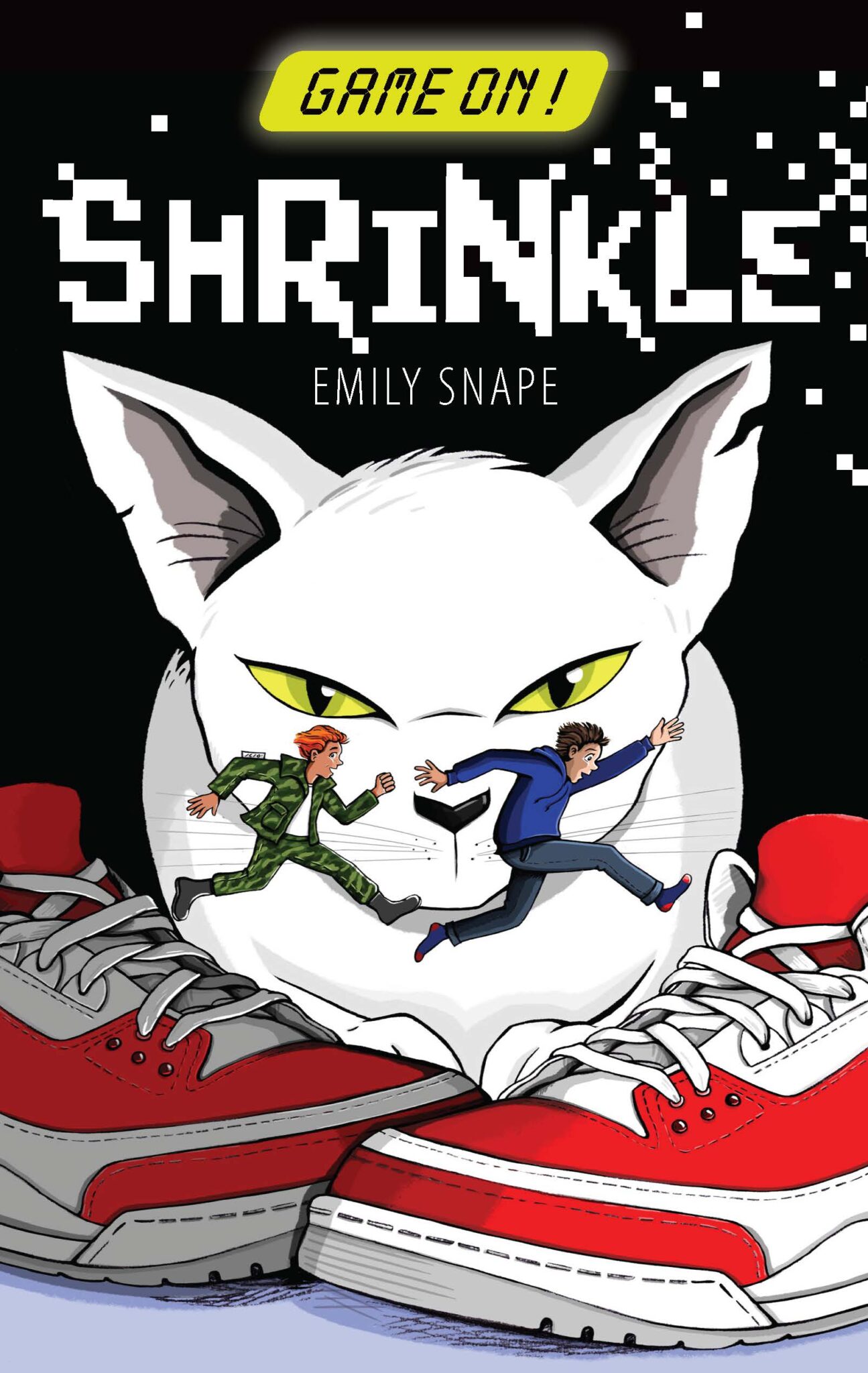
    Game On: Shrinkle, is a story for the children who love adventure of the gaming kind. The brothers who are known as “Pranks,” and “Pants” have just come home from school. Their Mum is in a raging mood because her job has been cancelled and she must go to another place.

    The boys are both in trouble; one for hacking into the school computer system, the other because his brother filled his backpack with underpants and, they have been given a strange babysitter, who they are told, used to work for NASA.

    The babysitter falls asleep with the baby and the boys borrow her phone to amuse themselves, as Mum has taken their computers in the car. Suddenly they are the size of small mice.

    Their home has become a challenge and their family cat a deadly enemy. It will take all their resourcefulness and courage to evade being eaten or squashed. The game on the babysitter’s phone has certainly changed their world. They need to cooperate now or perish.

    Young readers will enjoy the creative and spontaneous problem solving that the brothers must use to succeed.

  • Wahu Skim N Hoop  Pool Game

    Wahu Skim N Hoop Pool Game

    If you are looking for a game to keep your children occupied in the pool this summer, this is it. Skim n Hoop is a colourful, inflatable, sturdy toy with the ability to be converted into many activities. The dimensions are 150 cm long 144cm high and 86 cm wide. Once the plastic has been inflated it serves as a focal point for throwing the ball.

    There are two basketball hoops, three circular targets, and a detachable net on the back. A ball is included. The structure floats on the water and the aim is to get the ball into the hoops or into the targets. On the back side, the net is placed so the balls can be thrown over it. A small repair kit is also included.

    We tested this game at a public pool for a pool party. It seemed that younger children were less interested, but 5 year old’s and up enjoyed the challenge. The older children soon mastered the whole idea and it seems that playing in teams was the popular way to go. At this time, we only had the one ball supplied, and several lighter balls. The heavier ball was more easily thrown and aimed. Having the game as a focal point in the pool was popular.

    An air pump is needed to inflate this device, and a selection of balls would be helpful for all children to participate. There was a great deal of interest by the children when the toy arrived, and the older children stayed the longest.

  • Rubik’s Revolution

    Rubik’s Revolution

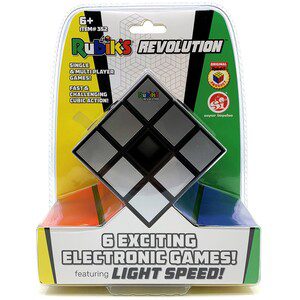
    Rubik’s Cube look – alike lights up and makes a noise; this cube is rigid with no movable parts. The centre square of each of the six faces contains a recessed light which illuminates when firmly pressed. Unlike the original Rubik’s Cube which took the world by storm in the late 1970’s (early 1980’s), the Rubik’s Revolution is not a challenging puzzle to be solved but consists of a series of six addictive games. Although it received the 2008 TOTY Game of the Year award, it lost popularity; however in 2018 there was a revival and since then record numbers have been sold.

    Each of the six games – Light Speed, Pattern Panic, Light Speed Trainer, Sound Out, Multiplayer Madness and Full Charge – requires dexterity and coordination. After the on/off switch has been activated a loud female robotic voice reminds the player of the games and their matching colours.  At the conclusion of the game the player is informed of her/his score. Each activity becomes progressively more difficult, so in order to improve one’s score, the player is required to increase the speed with which she/he presses the light button; this involves swift movement of both hands.

    This game can be enjoyed by the whole family and keep boredom at bay during ‘lockdown’; delay playing Multiplayer Madness (Red Light) until after social distancing! Unlike the earlier Rubik’s Cube, there is little educational value in undertaking each game, however becoming engaged with this cube does improve one’s reflexes and can provided endless fun for the participant.

    It is packaged in a hard clear plastic and includes batteries and instructions, which fully explains each of the games. If however you are a visual learner, there are several tutorials on YouTube which clearly demonstrate each activity.

  • Rubik’s 3×3 Cube

    Rubik’s 3×3 Cube

    More than forty years after the Rubik’s Cube, a simple, or what appeared to be simple, puzzle cube took the world by storm, back in the days before computers were a part of everyday life, the Cube  is making a come-back; once again pitting the skills of the mind against the dexterity of the fingers to scramble a six-sided cube, consisting of nine squares of six colours and then put them back as single panel colours.

    Ah, simple you say; well, one would beg to differ. Invented in 1974 by Hungarian Sculptor Erno Rubik as a teaching aid to help his students understand 3D objects, he did not realise he had deigned a puzzle, until he dismantled the coloured cube and tried to restore it; inadvertently he had created a very hands-on version of a mathematical Algorithm.

    During the 1980’s at the Cube’s zenith, competitions and challenges were held to see who could reassemble the Cube in the shortest possible time, with some phenomenal results being achieved. Many of these competitions have being reinstated today.

    A complete side industry developed in an attempt to solve the puzzle in entirety, as it was discovered most people could only get one or two sides back in the correct order, therefor, masses of books were written on the subject of how to solve the puzzle.  During the period of 1980-1983 more than 200million Rubik’s Cube were sold worldwide.

    Popularity waned and it was not until the 2000’s that it began to become popular once again, when it was ‘re-discovered’ and it became ‘cool to own a Cube’ once again. It is only 3 x 3 x 3inches or for the younger generation, 55mm x 55mm x 55mm, can create immense satisfaction and frustration, it is really, really difficult to cheat at, as the sections are now plastic not a series of stickers as in the original design and immense fun.

    If you are brave enough to want to take on a serious, non-electronic challenge, go grab a Cube, or rather in these changing times, buy one on-line and have a go: it is the perfect challenge for pitting your wits against the almost impossible!

    Bet you can’t do it!

  • Princess Snowbelle and the Snow Games

    Princess Snowbelle and the Snow Games

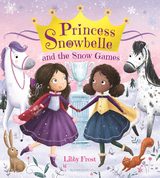
    The sparkling cover of this book gives us an idea that the story inside will be full of glitter and princesses, and snow. The soft covered paperback Picture Book, has cartoon type illustrations and plenty of colour. Set in Frostovia, the Princess is waiting with her brothers for the Snow Games to begin. The children are very excited and quite sure they will win their events. After all, they have been practising very hard.

    The Royal families gather together for the beginning of the games and the children all line up, sure of their own strengths and success to come. Oh Dear!  Noel, who has developed a super-fast sledge is tipped off. As the games progress each family wins an event, then loses one. The children are very competitive, but also aware of the importance of friendship and fair play.

    When tragedy strikes, the game is forgotten and rescuing a friend is the most important thing on everyone’s mind. A great solution is agreed to by the children and they have a great deal of fun helping each other. The chilling games are finished off with buttered crumpets and hot chocolate.

    The children are encouraged by their parents to be competitive, but to embrace the idea of fairness and friendship. The text is quite lengthy, but suitable for reading aloud, with colourful illustrations full of wonder. An enjoyable book for the early reader.

  • Shit Happens

    Shit Happens

    This latest release onto the Australian market from Crown and Andrews is definitely for the young or young at heart, more like the 18 to 25/30 age range, and best played with more than six players. The object of the game is to consider where a certain situation would rate on a Misery scale, should it happen to you.

    A few bevies would not go amiss either, as it is definitely a party game with a lot of laughs and some interesting graphics on the cards.  As it has been created in America, by a panel of highly qualified professionals, some of whom wish to remain anonymous, the American scale of what is considered as Misery is somewhat different to the Australian scale or perhaps even British scale of Misery in relation to some of the subject matter to be rated.

    Simple but effective instructions are easily translated and after the second round, the ease of the game becomes apparent, but holds the interest as it is entertaining to relate to where stepping on a Lego block fits on a scale of 1-100, when compared to loosing your left arm or dropping your phone in the toilet or worse. Is there anything worse!

    After some discussion the friends who volunteered to trial this game, decided it was created from the Likelihood and Consequences scale of probabilities, with a very intriguing mind creating the graphics featured on the cards, which were considered hilarious in a good many of the 300 cards which make up the game.

    Overall and after some discussion, the consensus was that it is a great way to spend a wet afternoon or evening or even a hot summer’s day with friends, but would have a short lifespan in terms of being around for years and years and years.

    So if you want to know all about Shit Happening, and you are definitely over 18 years old, this game is for you.

  • Linkee

    Linkee

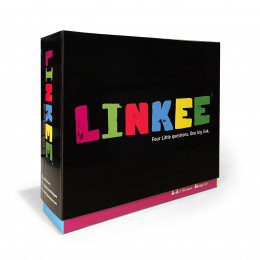
    Linkee is a party game played with teams and a question master. It is well presented in a sturdy box which is brightly coloured and appealing. On opening the box, we find a minimum of pieces consisting of three sets of cards, four pads and four pencils. There is a sheet explaining there are a very few rules, and the game is fun and simple to learn. It is a trivia and word association game, where you can have many players in teams.

    To begin, you need to select a question master who will ask all the teams the same four questions, which are on one card.  Once the answer to the questions has been written down, the trick for the team is to find the common link that all the answers have. When this is agreed upon, the team shouts out LINKEE, and gives their answer. If the answer is correct, the team wins that card which has a letter on the back.

    The object of the game is to spell the word LINKEE… If no one gets the link, a clue is on the card which the question master can read out. There is also a way in which you can trade letters with other teams to get the word LINKEE sooner.

    The game sounds simple enough, but actually it is a little trickier than it looks.  Once you begin to play the game, as a group of our friends did, answering (mostly) simple questions was good, but then the brain shift that was needed to find a link between the answers, took us a while to master. The fascinating thing was, that when you began to think laterally, it all became much easier, and suddenly, we were all shouting out answers rather than sitting quietly looking puzzled.

    The questions ranged widely and it has been suggested that it could be helpful if they were divided into easy, regular and hard groups. From pop culture, to history and geography, the questions are varied, but with a team, it becomes easier to bounce ideas around.

    We finished up having a lot of laughs, although the game is not designed to be played for a length of time. This is certainly one to involve the teenagers in, although all ages will have fun.