Tag: feelings

  • Growing Feelings

    Growing Feelings

    A Kids’ Guide to Dealing with Emotions about Friends and Other Kids

    Growing up can be tough, and in today’s world it is perhaps tougher than ever before, with the massive influence electronic media has on children and their parents.

    Child psychologist Dr Eileen Kennedy-Moore and health writer Christine McLaughlin, have combined their many years of working with feelings and emotions to create the perfect book for parents and children, to help them understand and deal with their feelings of anxiety, sadness and anger with their friends.

    Breaking the book into sections, contained within each area of emotion are several subheadings, each one presented in the form of a lovely little story with solutions to encourage thinking, accepting and understanding why children feel the way they do with their friends.

    Some of the wording is complex, which is where parents need to sit and talk with their children and not just help them to understand, but let them work out the solutions to the issues. Along the way there is a very cheeky cat and dog, who while the best of friends, do see the world through different lenses which adds a whole lot of fun, and helps introduce differing points of view in an informal manner.

    Growing Feelings also helps children accept that perhaps their friends have tough times as well and are also feeling upset, sad or just plain in need of time to themselves.

    Any parent who finds themselves struggling to help their children ‘fit in’, learn to cope with their developing feelings or simply wants to understand a great deal more about feelings in general, should consider this a must read book.

    In all truth, the information is not just for young children and adolescent youth, but for everyone as there is some very informative subject matter contained within the various topics which many an adult need to read and understand.

    Perfect for a wide range of children and adults from the age of 10 years, Growing Feelings should be in school libraries everywhere.
  • Feelings Are Wild

    Feelings Are Wild

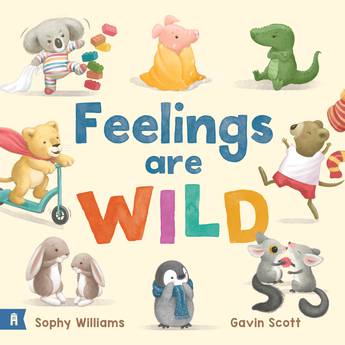
    This colourful hardback Picture Book Feelings Are Wild is a delight to the eye. The many animal characters are all different and encourage scrutiny of the details. The main storyline is about feelings, what they look like and how they can be managed.

    The story begins with one baby koala who has not had enough sleep. He is tearful and kicking over his blocks. The next page shows two nervous bunnies followed by three lion cubs then four crocs who are feeling frustrated. The numbers continue until we have seen ten quokkas feeling excited. Each page demonstrates how a feeling might look. Then the counting goes down from ten.

    Feelings change on each page. The nine frightened kittens are feeling surprised instead of afraid. The “Eight penguins feel reassured, but still rather glum.” Each page shows a positive outcome until we get to the one baby Koala who was grumpy. He is shown tucked up on his mum fast asleep.

    This is a well-crafted story particularly useful for enabling children to speak of WHAT they are feeling. The words in italics such as “Cheerful, Peaceful, Reassured, “show animals experiencing that feeling. Feelings Are Wild is a counting book, an animal story, and a clever look at feelings for the young. The art work enhances the text greatly.

  • The A to Z of Feelings

    The A to Z of Feelings

    Feelings and emotions, what are they? Do you really know who you are, emotionally? Can you differentiate between the good guys in life or otherwise? How good would it be if you know how to use your emotions and feelings to understand the world and people round you, to be able to have control over your actions and to be able to have a happier, more settled life.

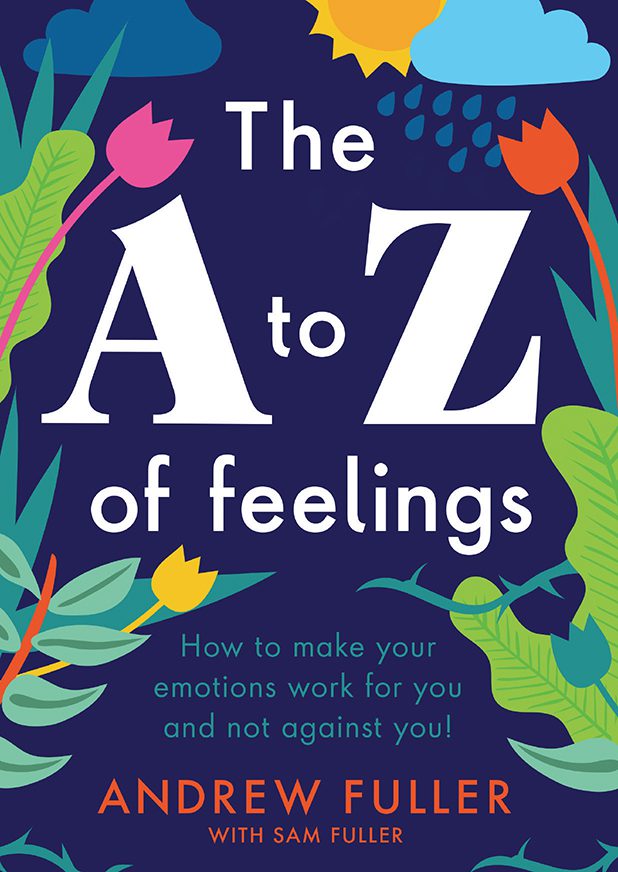
    Psychologist Andrew Fuller addresses these and much more in his new, ground breaking book, The A-Z of Feelings, how they affect us on a daily basis and the effect they have on those around us.

    Designed as a ‘go to’ book the introduction looks at what are feelings and emotions and helps us understand the complexities of our feeling. As he points out, feelings are complex things, which once better understood, offer a clearer picture of why we struggle with feelings at times.

    Written in a way that is easy to understand, and entertaining, the work is a fascinating look into the world of our intricate and intimate make-up, a genetic imprint if you like, that goes far back to the times when language was not used as it is today, and people had to rely on feelings, body language and sensory perception to survive.

    Listed in alphabetical order the most common feelings beginning with Acceptance, moving through Hate, Regret, onward to end at Zest which makes very intriguing reading, as each emotion is set out clearly in four sections, a small chart shows the physical signs of the emotion in question and what can be done to encourage this feeling to work for you.

    How to Stay Sane in a Crazy World is an excellent chapter towards the end of the book, as it is a question asked by all without often any clear answer! There is also a terrific index of feelings to use as a very quick reference guide which helps to link additional feelings for better understanding. An index of Physical Signs rounds out nicely a comprehensive look at who we really are, feelings and all and how we can set about switching on the magic to get feelings to work for you, not against you.

    The A-Z of Feelings is comprehensive; a work which like all good dictionaries will be used time and time again to help better understand feelings in the ever changing demands of modern society.

  • It’s OK to Cry

    It’s OK to Cry

    It’s OK To Cry is one of the valuable books for children that can be read with an adult (allowing discussion) or read alone and thought about. So many children are unable to identify and name specific feelings that it is no wonder that they cannot solve issues that arise from these. Even the happiest children will feel disappointed, cranky, or cross at some time; to identify why and what they can do is hugely important.

    The hard-back picture book is immediately appealing because of the bright colours and intermittent illustrations. The Contents page talks about Boy’s and emotions, then lists different Feelings, with lastly “Things you can do to cope.”  The author suggests that society and things such as ads on TV and books can pass on messages to boys that they have to be tough. I think that there are equally damaging messages for girls, but the author does address this later.

    The next part of the book gets children to identify and name feelings they have “Dog poo on your shoe. Disgusting!”  When your pencil breaks all the time, you feel Irritated. When you are lost, you are feeling distressed.

    When the reader can identify emotions, there is a page on “Steps you can take to help you deal with uncomfortable feelings.” These recommend that the child talks to someone to explain how they feel, or if they are angry with another child explain why they are cross. To end this segment there is a page of notes for parents and carers.  The tips given here are worthwhile and solid. They are a good foundation for young children to build upon.

  • Visions & Emotions

    Visions & Emotions

    There are very few musicians that can contribute much of their skill to their Aunt Mable, but such is the case for Aleksandra Takala as her Aunt Mable, who took her to see ‘Hair’ back in the day, gave her an old player piano which did not even have the full 88 keys.

    Piano lessons followed at $6.00 per lesson from a lady with a great love of the classics, which at the end of the year under her tuition saw Takala composing her first song.  She was 25 years old when she was given that piano, had already some sad experience with life and love, and was beginning to commence a journey into the world of music that was to become her passion

    That diverse background growing up is reflected in her music as she firmly believes that no matter what comes along in life, it never too late to begin something new.

    Each of the songs has a back story such as World Traveller, written in tribute to her mother who finally got to live her dream of travelling outside of the States to such places as China, India and the Amazon River.

    Passing Clouds is unashamedly at 10 minute song written in the studio where there are no clocks to remind of the passing of time, a place where freedom to let the music flow is as the passing of clouds in the sky, blown into new shapes and formations by unseen and heard winds.

    A rather funky, ‘tongue-in-cheek’ tribute to the hurry up society of modern holiday makers is Road Trip (Hurry Up & Slow Down)which is a little something of which we are all guilty, on a so called leisurely holiday. Ah, the plans we all do make!

    Groundwater is a dainty song reminiscent of the waltz, where it is very easy to relax into a time that was slower, more peaceful. It is a stately piece rich in strings, which was written to accompany a set of lyrics penned for Takala’s local choir, reflective of a commune in the forest, a campfire, with night fog slowly drifting in, winding around the base of the trees, settling along the ground; mystical and mysterious.

    A Caribbean orchestra heralds in the final piece on this rather unusual, but very enjoyable collection of songs with Moonlight over Havana, a place rich in history, romantic liaisons and culture. A rich full moon, the exotic, atmosphere, of the tropics at night, the romance of a couple swaying together deeply in love, have been carefully and skilfully woven into the captivating finale.

    In this her debut album, Takala has chosen to share her immense talent and many of her family stories, to create the tapestry that is Visons and Emotions. Different, enjoyable, intriguing and full bodied, Aleksandra Takala’s music covers a wide and diverse range of genres which offers something for everyone.


  • Lessons of a LAC

    Lessons of a LAC

    What is a LAC you ask? A LAC is a Little Anxious Creature. You may have one at home, or know of one in your family. To begin a conversation with a LAC about feeling anxious and insecure one needs a prompt, and for that, this book would be a great resource.

    These creatures (the LAC’s) live on the side of a mountain. They go to school where they learn lessons such as “What if… I’m never going to be able to…I don’t think I can.” These are the only messages they hear and they act accordingly, with fear and trepidation. They never learn calming or friendly thoughts and are so busy being afraid that there is little in life they appreciate. Loppy the Lac decides to visit the top of the mountain one day to look down at the strange group there.

    On the other side of the mountain live the Calmsters. As their name suggests, they go to school and learn uplifting thoughts, which they can put into practice. When Loppy gets to the top of the mountain, he looks through his binoculars and sees….someone, looking right back at him! As the Calmster approaches, Loppy is frozen to the spot. His thoughts are so negative that he cannot move. Luckily Curly the Calmster is friendly and kind. He suggests that he can help Loppy and begins to teach him how to breathe.

    There are a few techniques mentioned for calming worries, and children and adults will be able to discuss others. This is a great way to introduce the topic of anxiety and to let children explore the ideas presented in the book. The art work on the cover and throughout the book is reminiscent of Dr Seuss. It makes this book interesting and fun to read. The pages have a white background, with the text mostly in black, but sometimes interspersed with red.

    There is a website suggested for those who would like to explore this area further and look at other books in the series.