Tag: elephants

  • Elephants with Headlights

    Elephants with Headlights

    Set in India and Australia, this wonderful family saga, Elephants with Headlights is both beautifully written, and evocative, in its story. The descriptive language carries the reader along, immersed in the lives of the characters, their hopes and dreams, loves and desires.

    The Indian family consists of a loving grandmother, a very determined and strong- minded mother, an astute businessman father, and two young adult children. The Indian customs and traditions are thought to be all important for the weddings which must take place for Neel, the son, and Savitri, the daughter.

    It is here that the problems arise. Neel has met an Australian girl whom he wishes to marry. Tota, his mother, is bitterly disappointed in his choice and feels, if she can get rid of Mae, his fiancé, she will find him an Indian girl to wed.

    Savitri has a serious problem in that she was born under a very inauspicious sign, something that will blight any intended relationships. There is great pressure on the parents to help their children wed and settle.

    An ancient Guru comes to town and Siddharth, the father, is taken by his daughter to meet this man. Her father is very dismissive, only thinking about his next business meeting, but the Guru, who senses his disbelief, casts a spell on the man, which complicates both his business life and his family life. There is a great feeling of love and struggle for power in this family, but everyone is desperate to follow their own path.

    Each of the characters is beautifully composed; the ancient grandmother is inactive, but very much a force in the lives of her grandchildren. The desperate need for the family heritage to continue is a huge issue for the older generation. The gentle humour and equally gentle pathos surrounding the ancient grandmother is unforgettable.

    Elephants with Headlights will be a story that will stay with the you for a long time. Despite all the anxiety generated, there is a core of tranquillity which seems to transmit to the reader and bring a sense of peace and comfort.
  • You Can’t Let an Elephant Drive a Digger

    You Can’t Let an Elephant Drive a Digger

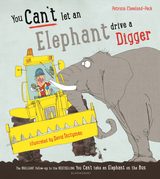
    Following on from the popular You Can’t Take an Elephant on the Bus, this quirky story uses words in such a manner as to make them interesting and enjoyable for young readers.

    A first read it appears there are almost too many words used for each character, but on a second read, this has been done to encourage an exploration of the language that can be used to describe something as zany as Elephants driving diggers and Sharks washing your back in the bath. Who would ever have thought that a Seal may enjoy a meal with you?

    The very colourful graphics that go with each of the crazy characters are extremely comprehensive which in the instance of an Octopus helping you get dressed leads to much hilarity. After all, which tentacle holds what garment and how is the Octopus going to sort things out. After all you could very easily end up with your ‘undies’ on your head, just like the child in the picture.

    Each of the very creative characters plays a part in daily activities and as we all know, Crocodiles have a lot of very nice, very sharp, teeth so who better to be in charge of cleaning your teeth: or maybe not!

    Mayhem rules the pages but it gets a little bit much to bear when at the end of a very busy days sorting out the animals and their desire to help, you discover a skunk, PHEW, has decided to share your bed!

    By the end of this humorous picture book look at life’s little idiosyncrasies, young readers will have enjoyed a great deal of fun learning new words in the English language.

    Join in the mayhem and see if you can guess who does what in the end!

  • Elephant Dawn

    Elephant Dawn

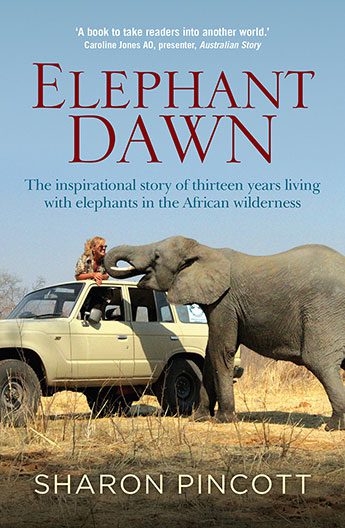
    Elephants are most certainly the love of the author’s life. She has written two other books published in South Africa, and motivated by the death of a very close friend, she decided to devote her days to protecting and documenting the Presidential Elephants of Zimbabwe. Her work has been so comprehensive that it has been profiled in National Geographic, BBC Wildlife and African Geographic. She has done this as a labour of love, unfunded and alone, in a less than friendly country, where white people are easily dispensable, certainly according to Robert Mugabe.

     Several hundred elephants roam a 140 square kilometre piece of land outside the Hwange National Park. In 1990 the president issued a “special protection decree, for the elephants that spent the majority of their time here. They were never to be hunted or culled and were supposed to represent Zimbabwe’s commitment to responsible wild life management”. A grand gesture; one that was impossible to police. The man who arranged for this decree to be formalised, had left the country and no one knows for certain just how many elephants there are. Maybe upward of 300 elephants call this area home.

     To leave a very secure position as an IT expert and live with no possessions, no electricity, and no hot water, is a massive step for someone to take, but Sharon was quite sure this was what she wanted to do. Not quite sure where to start, she began documenting and naming family groups of elephants, easily distinguished by physical traits and holes in the ears. As Sharon’s knowledge grew, she began to photograph and document just how the elephants could be helped. She joined a team looking for elephants that had been snared. Wire was placed in bushes, and either trapped the elephant or, if they broke away, the wire left a festering wound which, if not treated, would kill them.

     Poachers will always be a problem and there are those who wish to sell the ivory and those who wish to eat the meat. However, despite many setbacks and difficulties, the author has become a well-known name and a force to be reckoned with. She has produced wild life documentaries which have been lauded in China and Japan, countries which understand how desirable ivory is.

    As time passes, Life becomes more difficult. Renewing her visa is a constant problem for Sharon, and although many promises are made, land that has been kept for the elephants is being earmarked for other projects. Minister after Minister promised things will be done, however, “Recently released reports reveal that over 100,000 African elephants were slaughtered for their ivory between 2010 and 2012”.

     This story is much more than hardship and despair, though. We see the magnificent sights through Sharon’s eyes, sunsets, elephants in families, lions viewing people with disdain, especially when the author is caught by one when she was having a pee behind a truck! The lions just moved away with heads averted.

     Other happy moments occur, when friends come by to share a G&T, and the joy of seeing animals they have been able to save and heal. These moments are so rewarding and the laughs are plenty. But the true message is always the protection of those beautiful creatures. If you are going on a safari in Africa, check that they are reputable and money from them goes towards wildlife protection.