
Tag: dreams

  • Hydra

    Hydra

    Reading a play can be a two edged sword, in that you interpret it how you choose, not necessarily how playwright intended, but in Hydra, Sue Smith has deconstructed the emotional and destructive love between what is billed as Australia’s famous literary couple Charmain Clift and George Johnston, weaving the words of their acclaimed works throughout their everyday lives into a play that is powerful, raw and as tumultuous as the people themselves, making it very difficult to misconstrue the intent of the piece.

    Set on the Island of Hydra, Charmain Clift and George Johnston have left behind the post war years of Sydney to follow their dream; to live away from the madness of city life, to return to the simple pleasures and to give their children and their writing time to grow and mature.

    Told through the eyes of their oldest son Martin, the years of what turned out to be almost exile on Hydra, paints a fascinating canvas of passion, talent, jealously, obsession and in the final years and days of their life together, illness and alcoholism.

    Charmain dreamed of being free, being able to write, to dream and to fly in her new life on Hydra; George wanted the simple life after the years spent as a War Correspondent, a life where his children could grow without the trappings of a more mercenary civilisation.

    Being the first artists to escape into a modern bohemian lifestyle on Hydra, they were the beginning of an eclectic group who discovered Hydra, believing it to be a place where talent would blossom, that daily life was simple, wholesome and achievable.; sadly this dream turned out to be far less than the shining vision once held.

    Facing poverty, struggling to write the ‘great’ novel, deteriorating health and the crumbling of the dream, George finally begins to write what was to become the award wining novel My Brother Jack, and then the follow-up novel Clean Straw for Nothing. Charmain never realised her dream of writing her great novel, considering George was the focus and her role was that of midwife to his work.

    Their talent was remarkable, their story one of tragedy and despair, their life together one of immense highs and desperate lows.

    Performed in March to huge acclaim by the State Theatre Company of South Australia and Queensland Theatre, Sue Smith has captured to perfection a storyline which will remain with both the reader and the audience: a play which could be considered as on its way to becoming a classic piece for intimate theatre.

  • Starlight Dreams

    Starlight Dreams

    A study in music eventually becoming composition of beauty and delight has been created by composer and pianist Karen Biehl in her first solo album Starlight Dreams, written to offer a romantic classical meditation to help create focus, peace and awareness, a philosophy she has followed most of her life.

    Having always felt a strong connection to the stars and the majesty to be discovered in the night skies she, even as a young child looked to the heavens whenever she needed solace, guidance or relaxation.

    With this work the continuum of the pieces beginning with Awakenings, which is a sharp, take notice piece, was evoked by the desire to be fully awake to the never-ending potential that is offered in dreams. Invocation follows binding the emotions, building the connection until the Union of dreams and reality can be fulfilled.

    These three pieces make a lovely introduction to the body of the work, each of the pieces having been written to tell a story, or to allow a story to evolve from the notes.

    On Angel Wings strong piece, is somewhat unexpected as generally when Angels are being heralded the music is soft and gentle. Biehl takes this one step further as is often the case, particularly when they are trying to make a point!

    Coming in at 5:08 seconds Raindrops is the longest song on the album and is a lovely refreshing piece, washing away the cares with a deluge before settling into lifegiving, refreshing, healing comfort.

    A waltz is always a composition of great beauty allowing the mind to wander into romantic territory, as in the perfect little piece Starlight Waltz, where the figures of two people in love, in the moment can very easily be visualised.

    Ambling along in the autumn leaves, kicking the piles of red, amber and gold beauty into the air once again, has been captured perfectly in Autumn Amble, creating a joyful naughtiness everyone delights in when the leaves are changing colours, falling in glorious profusion to the earth.

    Meditation on a Moonlit Lake is absolutely the most perfect ending to a wonderful, joyful, contemplative journey. The composition is all encompassing with a lovely addition of synth to create the mysterious magic of a lake at night, a full moon hanging in the sky, a perfect moment in time there to be enjoyed. This piece also showcases, with a tiny glimpse, the immense skill of his classically trained pianist, violinist and opera singer.

    Starlight Dreams was names Best Solo Piano Album 2018 by New Aged Music Guide and also voted as one of their top 10 albums. It has also reached Number 2 on the New Age Music Charts in March 2019.


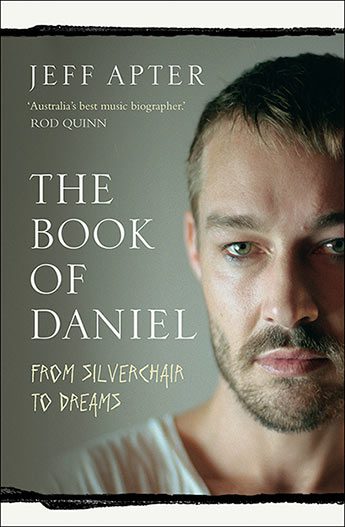
  • The Book of Daniel From Silverchair to DREAMS

    The Book of Daniel From Silverchair to DREAMS

    Arriving, you could hardly say bursting, onto the rock scene in Australia in 1994 the group, which was to go on to attracting an almost cult like following, during and after the years of their rise and fall from stardom, Silverchair, led by Daniel Johns amazing lead vocals, stormed the world at a time when rock or ‘grunge’ music coming out of Australia was at an all-time average level.

    In The Book of Daniel, Jeff Apter takes a journey back over the years to rediscover what it was that saw this group of young schoolboys from Newcastle, originally known as the Innocent Criminals, rise to the very top of the charts, time and time again with hit after hit until their final, of final concerts in 2011.

    The Group received numerous accolades, awards, and in 2008 Daniel Johns won the covered APRA Song Writer of the Year for the hit song, and perhaps one of the best pieces written during their years at the top, “Straight Lines”.

    Silverchair remained together longer than most, but as with all groups, eventually sited an irreparable internal fallout as the reason for their demise. Ill health and a marriage breakup saw Daniel Johns at an all time low in his life, suffering from chronic reactive arthritis, severe depression, an eating disorder and drug addiction. Very slowly he began to climb out of the mess his life had become to emerge as one of the foremost writers of 2018, a man who has faced the horror life at the top can offer and survived against the odds.

    Apter has written an excellent documentary of the life and times of Daniel Johns from the perspective of a Music journalist who has followed this group and Daniel Johns from the beginning to the end with honesty, bringing the life and times of Daniel Johns to life vividly, allowing a glimpse into what can become a very public face and a very private hell.

    Silverchair fans everywhere will enjoy this insider’s view of a man who at forty is still a rebel, still creating magic with his music and with the massive reception to his latest album, performing now under the new and fresh name DREAMS with Luke Steele, his return to the world of hard hitting, biting, driven music of the 21st century.

  • The Sisters’ Song

    The Sisters’ Song

    In the author’s notes, she writes that her novel, “Pays homage to the countless intelligent, insightful and courageous women throughout the centuries, who through no fault of their own, have been prevented from achieving their potential, and following their dreams.” It is certainly true that women had cause to despair in the past, and still today, are not recognised as equal in many areas. This is a story of a family in 1926; there are young parents full of dreams and laughter, and two girls who are part of that happy normality. The story is divided into three parts.

     Disaster strikes the family, and the mother struggles to cope. These were the days when children were seen and not heard, and many of the decisions that were made in their family were quite puzzling. This is also a snapshot of those times where society had no support for those with issues, either financial or medical. It was a hard time, and fulfilment in education, or following a dream, was only for the wealthy.

     The story is narrated by Ida. She has a sister Nora, who is both beautiful and talented, and many times the two are compared. The family has had to move in with grandmother, who is quiet and set in her ways, but sensitive to the needs of the girls. They settle into a new routine and develop into maturity. Ida meets Len at a dance, and feels that her role now is to marry and have children. Nora, on the other hand, has discovered that she has not just a talent for singing, but an extraordinary voice. Thanks to grandmother, this has been recognised, with Nora winning a scholarship to study at the Melbourne Academy of Music.

     This is where the plans and dreams come unstuck for both women. In today’s society, neither Ida nor Nora would have had their pathways truncated by the issues that faced them. However, Ida, always supportive and caring, helps Nora and satisfies a need within herself. Both the husbands of Nora and Ida are loving and patient, and recognise the sisters need each other. In the end, it seems as though the next generation will have the opportunities that were denied Nora and Ida, but this also will not happen without suffering.

     Set in Tasmania, the descriptions of the mountains are quite lovely, and the land in its natural beauty is pristine. Only Nora during her move to Melbourne leaves the island, while Ida and her family have a house near to where they were raised. So many customs are touched on, and the primitive surroundings for those who worked on the land, showed how hard life could be. Progress in every way, on the land, in the characters, in society, and in the views of the next generation, is shown. For these women indeed, many of their dreams were never to be fulfilled, and their greatest hope was for future generations.