Tag: dinosaurs

  • Do You Love Dinosaurs?

    Do You Love Dinosaurs?

    Do You Love Dinosaurs is a brightly coloured picture book begins with rules for dinosaur enthusiasts. Rule number one says, “Never turn your back on a hungry hunter.” The following pages show descriptions and illustrations of some meat-eating dinosaurs, and just how fast they can move. Next, we learn about some tiny, but fierce creatures who live on land, and some who can hunt on land and in the water.

    There are large illustrations of some gentle giants and also the terrifying T Rex to pore over. The vegetarian dinosaur group is drawn along with the raptors. In fact, every dinosaur that you can think of is depicted here, with information about each one given. The raptor could run as fast as a whippet, and the stegosaurus had a very tiny brain.

    Each page of the book shows different creatures and gives interesting facts about them. The illustrations are lively, varied, and colourful. Amusingly, the dinosaurs are shown in some humorous poses which alleviates any misgivings a young reader may have.

    Many children become fascinated with dinosaurs and as Do Your Love Dinosaurs is a very enjoyable book it will answer many questions as well as give added explanations for the experts.

  • Dinomania: Why We Love, Fear and Are Utterly Enchanted by Dinosaurs

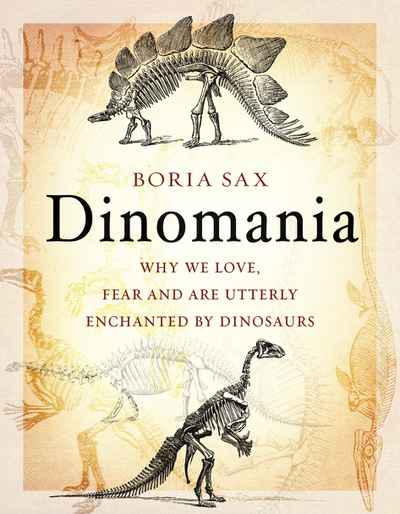
    Dinomania: Why We Love, Fear and Are Utterly Enchanted by Dinosaurs

    We love to be terrified and Dinosaurs somehow manage to do that, unless of course it is Dino out of the Flintstones, a dinosaur that everyone simply loves. The reality is entirely something different and as you work your way through this fascinating work, Dinomania by Boria Sax you will come to understand why these amazingly enormous, well in most cases, Dinosaur are loved and mostly respected.

    They, like many species gone before have a certain amount of folkloric associated with them, even to the point where the mystical dragon could very easily have been a dinosaur that somehow acquired magical, or not so magical, powers or maybe even dragons becoming dinosaurs or visa versa!

    But what is it many ages later that sees these incredible creatures forming what Sax refers to as ‘an unlikely romance’ in a new generation?

    When dinosaur bones where first discovered at the turn of the nineteenth century, the dawning of a new scientific awareness began, offering a very different perspective on geological time and a slowly dawning concept that we as a human race, could also, in times still far distant, become extinct!

    Each of the chapters that make up Dinomania have been well researched and are complied with a very comfortable use of language, allowing this intricate and vast work to have very broad appeal. Sax looks at areas such as How Dragons Became Dinosaurs in which many questions are posed and many answers discovered.

    He investigates the ingrained tales in many cultures relating to these mystical creatures such as St George and the Dragon, the serpent or water dragon found in ancient Egyptian motifs, what makes up  Milton’s hypothesis for Paradise Lost and in later years, the romantic era that turned irregular siting’s of geological formations into creatures such as Nessie, which also raised the issue of ‘Deep Time’, or ‘linear time’ which must be considered when trying to date the age of the Dinosaur.

    The Dinosaur renaissance began with the Americans and there ‘mesmeric sense of their mission as leaders of the free world’. A growing sense of frustration was soon to follow this euphoria and it could be considered the popular TV series The Flintstones is in reality a tilt at the ever-growing commercialism and automation of the 1950’s and 1960’s.

    Hollywood came to the fore with a range of various movies designed to strike terror into the hearts of moviegoers everywhere, with The Ghost of Slumber Mountain in 1918 through to Jurassic Park filmed in 1993. An absolute plethora of literature taps into the vast imaginary and real store house of dinosaur-abilia to enchant, intrigue and terrify.

    Of course, there is the scientific aspect that over the past 100 years or more is still able to have Palaeontologists revisiting and reviewing their past findings, as new sites and skeletal deposits are revealed.

    A treasure trove of photographs, illustration and graphics accompany the text, adding a very unique element to the subject matter, that regardless of which century it is present in still enchants’ and captivates.

    Boria Sax concludes this collection of scientific fact and cultural trends with a lovely philosophical chapter rounding out a wonderful journey through history, fantasy, fact, fiction and literature courtesy of the Dinosaur that, although extinct is still very much a part of modern, everyday life.

  • Weather: An Illustrated History: From Cloud Atlases to Climate Change

    Weather: An Illustrated History: From Cloud Atlases to Climate Change

    From the very beginning there has been weather: it is a simple fact that every planet that sustains life needs to have atmosphere, and to get atmosphere there has to be weather!

    Self-explanatory indeed, but the effect weather has on this our planet, the effect that we as residents on this planet have on the weather, is perhaps not as self-explanatory as we may all like to think, as the debate about carbon emissions and Climate Change rage on global portions.

    The formation of the earth as a planet is a formidable exercise in many sciences, beginning some 4.567 billion years ago; and then there was the moon, which is also a fascinating combination of sciences, believed to have contributed to the formation of a dry, sterile planet, that lightens the night sky.

    But onto the history of Weather which Revkin and Mechaley have presented in chronological order, as the miscellany of facts and accompanying pictures needs to be dealt with in fitting style, as it has such a massive effect on our daily existence and on the future of the planet.

    Beginning with 4.567 billion bce when the earth got an atmosphere, followed by 4.3 billion bce, when Water World arrived, and proceeding from there, they have filled each page with a myriad of facts and figures that remain as fascinating and amazing today, as they were when they were first discovered and recorded.

    Each of the pages is accompanied by a few lines notated as See Also which offers further reading to be had on that subject. Informative captions provide detailed information on each of the accompanying pictures.

    Suitable for a wide range of ages, this is a wonderfully informative collection of things you always wanted to know about weather and history but did not realise until you read the book.

    Weather – an illustrated history is great tool for projects, school research and anyone who loves all those little fact and figures about the planet, that make it a truly fascinating place to live.