Tag: development

  • The Places Where There Are Spaces

    The Places Where There Are Spaces

    Cultivating a Life of Creative Possibilities 

    The art of ‘Living in the Moment’ is a much discussed topic along with ‘Mindfulness’, both of which when discovered, make wonderfully easy changes in the way you view the world.

    Lisa Hopkins shares many of her reflective moments as she has journeyed on her pathway of performer and life coach in a thoughtfully created book The Places Where There Are Spaces, which will become an instant favourite will help you discover a more positive way forward.

    Shared lessons, moments of joy and practical experiences rub comfortably together, as you use this book to set out on a journey of exploring not only who you are, but life itself.

    Lisa Hopkins says in her life as a dancer and performer, there were always moments in between, a space between the leaping and landing that begged to be investigated. And so it is with life; there are always those intriguing spaces which bear further investigation.

    There are fifty-nine small chapters, each one filled with learned wisdom, concluding with a page for jotting down thoughts and reflections. Not meant to be read from cover to cover, but can be if you are a very methodical person, you can simply select a heading that fits the moment under inspection.

    How can such intriguing titles as The Many Shades of You, the very prosaic The Power of Soup or Sorting Through Your Garbage or even Life is a Wide-Open Stage fail to tease you into further investigation?

    The Places Where There Are Spaces is an absolute gem and will be a ‘go to’ to help through those tough, frustrating and infuriating times we all face as we travel down life’s very winding pathway.

  • Why We Sing

    Why We Sing

    Why We Sing poses the question, why do we sing and also establishes why we should continue on singing over the duration of our lives. Beginning with the foetus, Julia Hollander traces the development of the larynx in the unborn child. Scientific discoveries have revealed that the tongue moves in the mouth, lungs begin to expand and the diaphragm practices its movements by hiccupping.

    Following this we learn about the listening skills developing and the mother’s voice becoming recognisable. This is a fascinating way to introduce the topic of singing, along with many interesting facts about cultural differences, birds and history.

    Julia Hollander is a community music teacher and has seen the great benefits that singing can bring. She has done Scientific Research to explore how our bodies create song and how it enables children to access language. We use singing as a show of faith, to pass on political messages and to experience a sense of freedom.

    We then follow the author’s journey as she travels to discover exactly how song is used in other cultures and the many ways it can help all people. From despair, aging, loneliness and death, to celebrations and warrior songs, the scope of these explanations is immense. Julia has also found plenty of evidence to show that singing in schools promotes children’s’ learning.

    In recent times the author joined a protest group to attract attention to the issue of Climate Change. She has found a form of singing that calms the situation while raising awareness of the dire straits of the world. Long may she sing!

  • The Music Advantage: How learning music helps your child’s brain and wellbeing

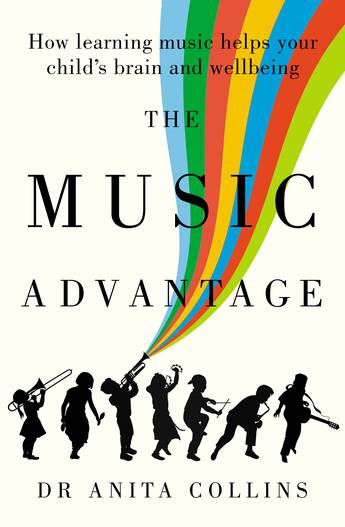
    The Music Advantage: How learning music helps your child’s brain and wellbeing

    It has long been recognised that music helps a child developmentally, and socially. Yet never has it been so easy to prove exactly how this works, and how great is the effect that music can have in our lives. Dr Anita Collins completed her PhD in this area and what she found was so monumental she wanted to share it widely. With advances in technology and equipment such as the MRI machine, the brain can be observed during activities.

    Not only does the scientific testing prove the author’s findings, but now we understand how the development of the brain and music work. From the earliest day’s babies begin to discern music from the sounds and language they hear recognising pitch, rhythm, and dynamics. There is a musical characteristic in the brain which recognises sound and processes it. Not only can a sound be recognised, but also the emotion behind it, showing how the person feels when listening. Sound is the way babies begin to understand their way in the world. The listening function of the brain never turns off.

    The Music Advantage covers the developing child from birth to age 12-14 years. While the links between brain function and music is proved by impeccable research, there is still the question, “How do we get started?” From her own experiences, Collins shares her methods and steps. She was involved in the now famous ‘Don’t Stop the Music Programme’, where children were all given a musical instrument and musical instruction, with the extraordinary results televised.

    Parents, teachers, and school communities should familiarise themselves with this book as the results, academic, social, and musical are proven. To be able to achieve the best outcomes for children, it is compulsory that music plays a part in their lives.