Tag: Darwin

  • Darwin Spitfires: The real battle for Australia, Anniversary Edition

    Darwin Spitfires: The real battle for Australia, Anniversary Edition

    Many people have been to Darwin and visited the war museum there. During the Second World War the extent of the bombing of Darwin was kept quiet but now most people now are aware of that terrible time. Darwin Spitfires: The Real Battle For Australia aims to tell the story of the many later bombings which are largely unknown.

     The air raids on the Northern City were on the 19th February 1942, but for almost two years after that there were constant raids and bombs dropped. Anthony Cooper tells the story of the RAAF’s No 1 Fighter Wing, composed of Australian and British Spitfire pilots.

    In 2011 Anthony Cooper first presented this book. He claimed, so much war time propaganda, poor research, and stories had little to do with the truth and facts presented about this time in Australia’s history. Now, the ability to read past the war time propaganda, and explore all aspects of this era, allows the truth to be presented. His narrative is gripping and tense as we follow the day to day duties, flights, fights and living conditions of these courageous pilots and their support staff.

    Darwin Spitfires begins after the first bombing of Darwin and looks at the situation from many perspectives. The officials who were in command as well as the pilots are all cited, making this a truly comprehensive guide to this period.

    Included are, maps, photos charts, and tables from the pilots, showing their engagements and remarks, such as “Both cannons failed. “To complete this rare piece of Australian History, the Cooper has compiled an intensive Index, a Bibliography, and Reference notes, including Primary Sources. For any war historian this is a must read. It has been endorsed by the War Museum and may be relied upon for the truth.
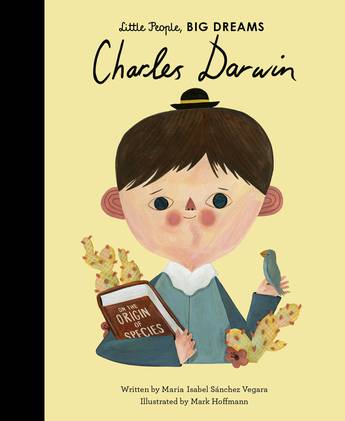
  • Charles Darwin (Little People, Big Dreams)

    Charles Darwin (Little People, Big Dreams)

    Charles Darwin was a little boy with a massive curiosity who went on to become very famous, having places named after him, Darwin in Australia, but more importantly, discovered that after studying a particular species of bird on the Galapagos islands he realised they all had a common ancestor, even though they has vastly different habits and had adapted to eat whatever food was available. Of course this did not go down well in Victorian England as it challenged the religious beliefs of the day.

    But how did a little boy from Shrewsbury who wondered about worms and why they crawled out of the earth, and had they always done this, go on to become such a famous person. He was curious and was convinced that what his teachers told him might not be right, which was also pretty radical for that time, as children were supposed to do and think what they were told to do by adults.

    Charles was very lucky to be born into a family of scientists who believed in curiosity and asking questions, something he did all of his life. When he was still young he joined an expedition to Africa, South America and Australia on the HMS Beagle and there he discovered so much about birds, animals and reptiles and their habits and habitat.

    He also began to realise that animal species were not all fixed as everyone thought, that they changed and adapted to their conditions. This made him even more curious and lead to him writing On the Origin of the Species which is still considered as the most important book ever written.

    His legacy to the world was his curiosity which lead him to discover amazing things and his work then is still offering insights into diversity of life on this earth, which by the way includes humans.

    The series Little People Big Dreams brings to life so many of the people who do amazing things in their lives, many coming from very humble beginnings and all of them going on to make a big difference to the world in which they lived, as well as the world of today.

    Bright colours, an excellent choice of words and end notes presenting a brief description of Charles Darwin make the book suitable for a wide audience.

  • Charles Darwin Scientists Who Changed the World

    Charles Darwin Scientists Who Changed the World

    Charles Darwin was a man who believed in many things as a young man, entering University to study Sciences, becoming a naturalist, botanist and geologist who set the world alight, literally, when he published his confrontational book On The Origin Of Species in 1859 expanding on the theory of evolution. This was the first of several more books that were also considered as controversial.

    While today this may not seem like a particularly big deal, back in 1850 the Church set the tenants of society and believed that God created animals and mankind as they were and still are in many cases.

    As young man Darwin joined the expedition ship HMS Beagle which set sail from Plymouth in 1831. He had with him all the scientific equipment needed for a journey of two years, collecting flora and fauna, to map coastlines to strengthen the British Empire and to bring, what the English considered as civilisation, to the world! This voyage was to last five years.

    In 1936, he and the crew of the Beagle arrived in Australia and Darwin begins to begins to wonder about the terrible plight of the local indigenous people, and his theory of natural selection, as they were dying of simple illness, while the ‘European Australians’ survived. The City of Darwin was later named in his honour.

    Darwin’s theories established a chain of thought and scientific research which is still totally relevant today, and although Darwin struggled to find indisputable proof, modern science, the further discovery of fossils and a huge advance in scientific techniques and equipment, has proven his theories were correct.

    His story is fascinating, his work has gone on to inspire scientists over the past 100 years and more, his legacy to the modern world is outstanding. Anita Cray has presented his story in short form, which makes awe inspiring reading and will prove to be an inspiration to any young person who is, or has, a fascination with any of the sciences.

    Charles Darwin is the third book in the Scientists Who Changed the World series.