Tag: Cricket

  • Murder on the Cricket Green

    Murder on the Cricket Green

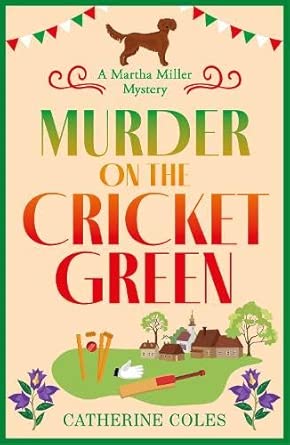
    Murder on the Cricket Green is an engrossing cozy murder set in 1948, Westleham, Berkshire when the world was slowly recovering from the effects of the War.

    The Villagers are looking forward to a Cricket match against the Winteringham side, and a wedding, that of Ruby to Detective Inspector Ben Robertson. Two events that it was hoped would lift a community still struggling with everyday life.

    Societies rules were hard and fast, as Martha Miller had discovered firsthand. Village gossip, founded or otherwise can be dangerous, having been singled out when her husband Stan left to go to work two years prior, never to return.

    A knock on her door changes everything she though she knew about Stan, as he has returned, offering an explanation and trying to put past wrongs right. Unsure of what to make of this, as she has long considered herself an independent woman, one who has deep feelings for the local Vicar which are returned, she is flummoxed.

    When Oliver Beckwith, the local somewhat underhand local Solicitor, is injured in an altercation, Stan is roped in to make up the Westleham team numbers. He goes into bat and collapses at the crease, dying from what appears to the amateur eye, some form of poison.

    Martha, known as a very good amateur Detective decides she needs to try and discover who is responsible for Stan’s death and most importantly why. Recruiting her trusty neighbour Maud, they set about digging deep into Village life. The more they dug, the more astonished they became at what really goes on behind closed doors.

    Book four in the Marth Miller Mysteries from Catherine Coles, Murder on the Cricket Green delivers an intriguing, gently old fashioned, thoroughly entertaining murder which sees everyone, including Martha, considered as guilty until they are proven innocent.

    A most enjoyable read.

  • One Man Down

    One Man Down

    One Man Down is a very tongue in cheek, 1980’s romp, man style, through the world of Advertising, cricket and almost by default, murder, from Alex Pearl, a man who knows plenty about Advertising and very little about murder.

    For those old enough to remember the halcyon days of the 1980’s when almost anything went in the world of Commerce, long, liquid lunches were the order of the day and the rise of the Advertising Agencies was meteoric, will absolutely enjoy this totally irreverent, witty walk down memory lane.

    Angus Lovejoy and Brian Finkle are Advertising Agency executives tasked with coming up with a new campaign for a client whose main source of income is diarrhoea tablets.

    Their somewhat abstract, but funny, pitch failed dismally to impress and so they took themselves of to play cricket at the invite of a friend who needed a quick substitute for a weekend Club match.

    From this point onwards, somehow they manage to get themselves involved in local politics, a scam, a blackmailing attempt, what appears to be murder, but then does not, but maybe really is and emerge almost unscathed, but then again, maybe not.

    One Man Down is definitely a book for boys, the grown up kind, who love the Pub culture of days gone by, the somewhat astonishingly, fascinating and obsessive world of cricket, a good laugh and perhaps a slight mystery to solve over a pint at the Pub after a good day’s cricket.

  • Living The Dream

    Living The Dream

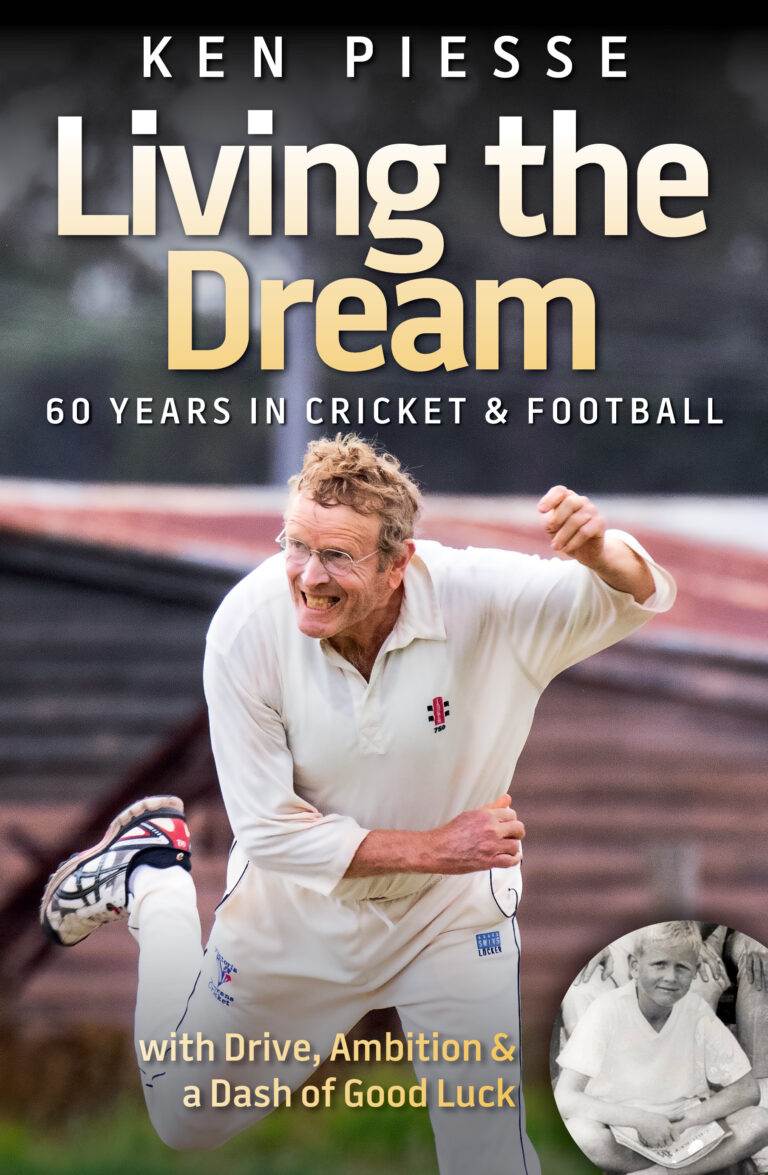
    Well-known Australian author of cricket and football books, Ken Piesse’s passion for these sports is very evident in his 88th and latest book ‘Living the Dream’, which is crammed with experiences and anecdotes of his sporting life. As he engaged with so many Australian sporting superstars and heroes, this book is packed with first-hand interviews.

    In this his latest book, which spans his remarkable 60-year career covering his favourite sports, he gives the reader an insight into the character of well-known cricketers and footballers; information which rarely appeared in the news. The stories, which he shares relate not only to Australian household names like Shane Warne, Ron Barassi, Ian Chappell and Don Bradman but also to stars from other cricketing nations, like Brian Lara and Viv Richards.

    His multifaceted career in sports; journalist, commentator, after dinner speaker and bookseller, come to life in ‘Living the Dream’. He is a man with drive, ambition and some good fortune: no wonder it resulted in Ken Piesse being awarded an array of multi-media awards.

    Readers will find the photos and collections at the end of the book both interesting and informative; a must read book for cricket lovers.

  • Willowman

    Willowman

    At this time of the year cricket takes over the lives of many Australians; they are preoccupied with one or more forms of the highly regarded national game of cricket. However, you don’t need to be a cricket tragic to enjoy prize-winning Australian author, Inga Simpson’s beautifully crafted book Willow Man, which she states was inspired by the life of Phil Hughes. His life was cut short when he was struck by a bouncer on the side of his head, below the helmet.

    Whilst cricket is a central theme, this is a heartfelt story about ordinary Australians who are connected by their devotion to cricket. Passionate cricket enthusiast Allan Reader, whose family has been making cricket bats for generations in England, makes bats in Victoria, Australia, from the white willow, which he grows. After watching a promising young Queensland cricketer batting in the Under 19 completion, he is immediately inspired to craft a bat for this gifted cricketer. When Todd Harrow received the bat there was an immediate connection between bat and player.

    This wonderfully entwined story of cricket, bat making, relationships and music, not only follows the ups and downs of the rising star, Todd Harrow, but also what Alan Reed’s passion for cricket cost him in terms of his finances and relationship with his family. Readers will also appreciate the author’s incorporation of the side story of Todd’s talented cricketing sister Liv and the gradual rise and depth of Women’s Cricket.

    Older readers, who have followed the game for many years will appreciate the author’s extensive research and the fascinating details about white willow, bat making and cricket.

    A highly recommended read for this summer; Willow Man is not a quick read but definitely one worth investing a few days.

  • Fair Game

    Fair Game

    Women’s cricket in Australia has been strong for a very long time, with much of its very recent history happening totally out of the public eye. There have always been fans, who appreciated the talents of exciting women players, but it was not until recent years, that the women’s game caught the eye of the media and hence the general sports’ loving public. It is due to determined, committed women’s players, like Alex Blackwell, who had the conviction that the women’s team deserved more than existing in the shadow of the Australian men’s cricket team that real progress has been made, to enhance the remuneration and working conditions of the women players.

    Not only has Alex Blackwell, former Australian women’s cricket captain, represented Australia 251 times across all its formats – Tests, One Day Internationals and T20 Internationals, she also spent 20 years playing elite cricket, but also spent this time advocating for the women who played the game. Not so many years ago the women’s game was being played on barren grounds with minimal financial support, in front of small crowds, touring players were put up in very basic hotels and they were generally the very poor relatives of Australian cricket.

    Alex’s insightful book, Fair Game, tracks her years as a junior cricketer with her twin sister, to her retirement thirty years later. She, not only recounts her adventures, great highs, the friendships created all around the world and the leadership lessons she learned along the way, but also the development of Australian Women’s Cricket. Throughout the book, she demonstrates her strong support for the inclusion of LGBTQI people; she was driven to ensure a structure within Cricket Australia, which worked towards best practice guaranteeing that cricket is for everybody.

    I highly recommend Fair Game not only to readers who are sports’ fans, but also to those who wish to obtain a greater understanding of women’s struggle for equality and recognition. Women’s cricket has advanced even more since the advent of professionalism, however it still has some way to go to before it is on an equal footing with their male counterparts.

  • Eleven Bats A story of combat, cricket and the SAS

    Eleven Bats A story of combat, cricket and the SAS

    Cricket and the elite division of the Australian Defence Forces (ADF) SAS unit seem to be far apart, but in reality, thanks to Anthony ‘Harry’ Moffitt, joined forces in the streets of Bagdad, the mountains of East Timor, the former palaces of Saddam Hussein, the base at Tarin Kowt and on the green playing fields of his beloved Applecross Cricket Club, in Western Australia.

    A serving soldier of more than twenty years, most of it with the SAS, Harry, as he is known  tells eloquently of his life in the services and how his love of cricket often saved the sanity of the serving troops, providing at times valuable links to the locals in various theatres of War.

    Begun almost by accident, Harry’s first overseas mission, a 10 day reconnaissance patrol in Afghanistan during the chill of an Afghani winter, turned out to be not as busy as first anticipated. Intense training, high stress levels and overnight patrols, saw everyone feeling the need to relax a little, when a game of cricket was proposed; a bat was acquired and a game was held on the base with a mixture of SAS, Americans and locals making up the teams.

    Harry’s eleven bats have a chapter each in which to tell their story, offering a rare insight into the reality of placement into high stress, volatile locations, and the effect it has on the men, their families at home and the theatre of war they served in, often with a great cost in lives.

    Told with confidence and pride in his years with the SAS and the men he worked with so closely, he tells of growing up as a young boy whose father served in the Royal Australian Navy for many years, his dream of becoming a soldier and then his passion to serve in the SAS, all building a picture of exactly what it takes in pride, determination and skill to serve in a theatre of war.

    Fascinatingly told is his journey into Afghanistan in 2002; a married man in his thirties, with two small children, who had stepped out of active service life some years before; recalled to fill a role in the elite division of the SAS once again, this time in a difficult conflict, Afghanistan.

    In many ways confronting, Eleven Bats is about War and also about Cricket, often in some stories neither one nor the other but both; the richness in the telling comes from a man who served with honour during his time, could see that there were serious emotional issues facing people returning from torrid war zones, learning to adjust to civilian life, when many, many years have been spent living in a high adrenalin world.

    Harry decided to do something about it, even if it meant battling the establishment all the way and established a valuable retraining programme for men who wanted to further their education for a vastly different challenge, civilian life. Harry had been studying for his BA in Psychology while still serving in the SAS and realised how vitally important it was to coping with a dramatic and challenging lifestyle change on discharge.

    Each chapter is its own unique story, fascinating and informative, Eleven Bats also tells a story of how this elite division slowly changed over the twenty years of his service and sadly, as this review is written, the SAS is being investigated through the highest legal levels in Australia; a unit far changed from his days in the service of his Country.

    From a young man, proud in his achievements in the ADF to a mature man, saddened and tempered by warfare, Anthony ‘Harry’ Moffitt has painted a unique and very personal biography that shows the power of simple things, such as a how a game of cricket in a desolate and barren landscape, can often lead to the beginning of so much more in life, as well as providing an element of ‘normal’ in a world gone totally mad!
  • Test Match Card Game

    Test Match Card Game

    Test Match is a great card game for all those cricket enthusiasts who have been starved of cricket lately. The Test Match game comes in a solid plastic green box. There are two compartments at the front of the box which opens out to reveal three sets of cards, “Fielding Cards, Stroke Cards, and Force Field Cards. There is also a set of dice, a score pad, and a “Rules of Play” booklet.

    The player places the cardboard divider, in the large compartment, in the box. The umpire dice is placed in the smaller compartment. The two players toss a coin to see who will bat first. The batter takes six stroke cards from the top of the stack, and the fielder takes six cards from the Fielding pack. Then the game begins.

    This is a game with enough choices and variables to keep two young players engrossed and happy for quite some time. There are helpful tips given and a few hours would be needed to see the completion of play. Because the box is so compact, the game could be played in a car, or confined space, and it is easily packed, to pull out at any given moment. Lots of fun for cricket enthusiasts!


  • The Journey  My story, from backyard cricket to Australian Captain

    The Journey My story, from backyard cricket to Australian Captain

    Steven (Steve) Smith is the 45th Australian Test captain to hold this position and ranks as the third youngest, at the age of 25 years, to be offered the job. His debut in the baggy green occurred at GABBA in Brisbane in 2014, when Michael Clarke was injured. The expectation was that Brad Haddin would take over the role but the selectors decided otherwise.

    As decisions went this was a very unusual one, creating a great amount of commentary, but proved to a be a very wise decision, which three years on sees him once again leading the Australian Test side against England in the Ashes series with one win to date and the outcome of the second test of the 2017/18 series still to be decided at Adelaide at the time of writing.

    But what is it that drives a man this young to be able to confidently take on a formidable role at the age of 25 years and be incredibly successful. His Captaincy has seen the team crash and burn and rise again to the heights of success, which is an indicator of a bit more than just skill in his own discipline, which is batting, a bit more than a passion for the game and a love of a sport; it shows a man who is capable of leading by example, showing the way and also, a man who is always thinking of alternatives, if or should plan A fail.

    As a young child he was keen to be able to play cricket whenever the opportunity arose; his father bowled to his bat in the backyard for a many days, weeks and years, always encouraging him to think about the ball, to look for alternatives and never, ever give in.

    His parents, in a chapter written by his father, tell that he was always a keen sportsman, with cricket being his first love, as he was considered far too slight to really become involved in Rugby. Tennis was also a passion but not one that superseded cricket. As he grew up he began representing his State, heading to Britain to play grade Cricket, and then returning to Australia to once again represent his State and also try out and be selected for a variety of first grade Games.

    His rise through the ranks is not that of a ‘golden boy’, it is that of a young man who followed his passion and worked hard at developing his skill levels. Initially his dream was to be a bowler, with a good ability to bat – to become an all-rounder in the game. Although successful as an all-rounder he, along with the coaches, realised he would be far more effective as a batsman and so he once again adapted, changed, focused; the results of his ability to adapt to the situation are there, recorded in time and the annuals of World Cricket.

    In his biography he tells his story as it is which is inspirational, fascinating, revealing; a bit like sitting down and having a chat with this talented young man, over a beer or a coffee, about his pathways and where he sees it leading eventually.

    He freely admits that he could easily become completely obsessed with cricket, but he also says that this obsession needs to be managed, as there will eventually come a day when he is looking at a different future, and the real possibility that there is another passion just waiting to be discovered. Dani, his partner of several years, helps keep him grounded as do his team mates and family. His face is one that is well known to all cricketers and Australians alike. His courage and fortitude is also well-known and respected.

    He talks openly about his rise, and fall and rise in cricket, the effects still felt of the tragic death of Phillip Hughes, a friend from a young age when they competed in opposing sides, to a team mate and opponent at senior level cricket, and the lessons learned along the way.

     The Journey makes for compelling reading which presents an honest and rare insight into a man who will rank amongst Australia’s greatest cricketers, a man whom for any young cricketer or sports person will inspire and encourage them to keep on trying, and to never give up!


  • The Grade Cricketer: Tea and No Sympathy

    The Grade Cricketer: Tea and No Sympathy

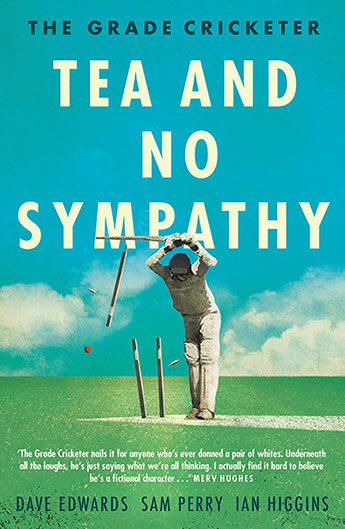
    This is a sorry tale and all to true, which anyone who has ever been inside a change room will all too readily agree. 

    The cricket change room, until recently, was the providence of the male: a place inhabited and immersed in a strange culture only able to be related to by those stalwarts who have all but given their lives, in the name of Grade Cricket. 

    ‘Big Fella’ has given his all, his youth, his career, or at least his University studies, to the game. His game is more often off than on, his post-game blood alcohol levels frequently higher that his batting scores, but he lives and breathes for the cricket whites and the game played out every weekend; the mateship, the after game team bonding, along with the ferocious hangover after the weekend. 

    But there comes a time in his life where he is forced to make a choice, remain as a 30 year old cricket yobbo, or pick up his flailing life and attempt to establish something like a reasonable future. His girlfriend has gone to Guatemala without letting him know, but telling him, via Facebook, that he needs to get a life.

    As nothing seems to be gelling from within in Australia he decides to make the move to Britain; move away from his mates and give up cricket once and for all, but somehow ends up playing for a local team, in his first love, cricket.

    He very soon discovers that yet again, cricket seems to be consuming his life, his studies are on the back burner and life somehow, is beginning to seem pretty much the same as it was in Australia. Nothing much has changed. 

    What does it take to make the ‘Big Fella’ discover that there really is more to life than cricket and that strangely enough, if you get it right you can really have it all – cricket and a life!

    Each of the characters who populate the pages of the book, as well having nicknames such as Nuggsy, Jonesy and Bevo, have real life personas which can recognised by anyone who has ever graced, or not so gracefully, inhabited the change room.

    Therefore, it could be seriously considered that this humorous, tongue in cheek look at cricket from the other side is perhaps not so fictitious after all.

    What does the Grade Cricketer really have to do to consider life worth living? Well firstly, consider reading this book!