Tag: conservation

  • Department of the Vanishing

    Department of the Vanishing

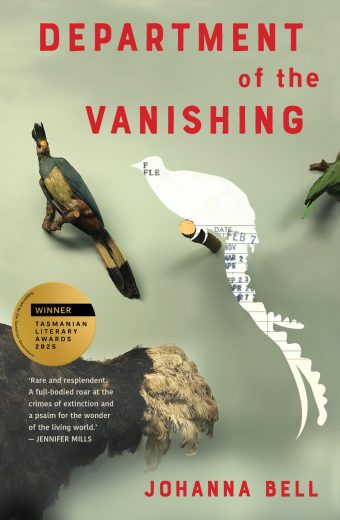
    In this stunning debut novel, Department of the Vanishing, blurs fact and fiction into a chilling and all too real reality. Johanna Bell roars from the highest pinnacle using the iconic Lyrebird to illustrate the tragedy that is environmental destitution.

    The Department of the Vanishing is a most intimate book ranging through the many nuances of the emotional experience of Ava Wilde, a young woman filled with hope and idealism.  In her desire to make an impact, Ava accepts a governmental role as an Archivist in the Department of the Vanishing, the department responsible for archiving the disappearing flora and fauna in this fictional world.

    As the years progress, she begins to realise that she is cataloguing nothing more than the end of everything; reasoning that no matter what she does it will not matter. Ava will not change the course of climate change that is destroying the planet, and specifically her beloved Lyrebird, with its soulful songs that Ava has a special affinity for. The Lyrebird, with its distinctive song, ability to mimic, survival instincts and mating habits is used to illustrate the sadness, the ultimate tragedy should  the final song be sung. Ava comes to realize through her work that perhaps the slow destruction of the earth is an analogy of the way her life has been moving forward.

    Through the introspection initiated by her work, the burning of the planet is much like the growing pressures of unresolved pain in her mind. Her father, a well-known naturalist, went missing more than 30 years ago; her mother holds secrets but is slowly slipping into dementia; her many lists, papers and cuttings that fill up her small home have become her obsession. Ava Wilde seeks normality and catharsis though sex; raw, brutal, and coarse.  She discovers that it is not; it is nothing more than another maladaptive coping mechanism in a life that is already in chaos.

    As the story progresses Ava presents as quiet and hesitant. She has moved past the point of caring, accepting her fate, refusing to admit that her actions were anything more than a woman mired in grief for her life, and the environment.

    The Department of the Vanishing is not your usual read. The book has been created with great thought: the words, poetry, illustrations, photos, Police Statements, lists, and quotes are reflective of the general chaos of her life.

    Fascinating, original, complex and yet beautiful, Department of the Vanishing created by Johanna Bell is already an award winner.  The book artfully articulates a clear environmental message. A list of References she has used are there should you choose to delve further into the many threads of the story.  Eco literature at its finest.

  • The Rewilding

    The Rewilding

    Becoming a corporate whistleblower by blowing the whistle on the Greengate Waste Removal scam his father’s business is running, didn’t come easily to entitled rich boy-man Jagger Eckerman.  The resulting police investigation will implicate him too, as he’d recklessly signed a number of the incriminating documents.

    With his life under threat not only from his father but also the law, Jagger seeks temporary refuge in a cave, with which he had become familiar during his childhood. He is horrified to find ‘The Feral’ (Nia), a self-proclaimed huldra, an ecoterrorist, already ensconced in his cave on the edge of the city, who is determined to save the world.    

    Soon it becomes evident that both main characters have their own reason to fear for their safety and hence need to leave the cave. Despite their different values and priorities, this unlikely pair set off together with a mystery friend of Nia’s in ‘The Feral’s beat-up Landcruiser for safer territory; a thrilling chase ensues.

    The thrust of this novel is extremely topical. Donna Cameron provides a wealth of information about the side effects of global warming and the lack of human care on the environment. It is evident that this Australian author is passionate about climate change and environmental degradation, which she has woven throughout this narrative.

  • Devils in Danger

    Devils in Danger

    The idea of writing a children’s novel around the theme of protecting our wildlife is an excellent one. The story by itself is interesting, current, and appealing. Add to that, a Tasmanian Devil and the interest level rises.

    Killarney is a young girl in grade five, who hasn’t been motivated by school learning. One night at home with her parents she hears a terrible scream. She and her mother are shocked and grab a torch to go out and discover who has been injured. They search around the garden until they realise the noise has come from underneath their house. When they shine the torch there, they see a pair of red eyes.

    Later while walking the dog, the young girl meets a woman who seems very serious and reminds her to keep the dog on the lead. As they get talking, Killarney discovers that the woman is a Zoologist who is researching Tasmanian Devils and trying to protect them. The Scientist is very interested in the story of the red eyes under Killarney’s house and asks permission to come and check the animal out.

    The scientific procedures that are carried out are interesting. The fact that the Devil is denning, (preparing to give birth) is very exciting for the whole family. For a young girl who has been rather aimless, Killarney is now a passionate supporter of the Tasmanian Devil project and comes up with creative ways to support the welfare of these Australian animals. She also makes certain that her school becomes aware of their plight. Now she needs to make sure her whole town is informed.

    Devils in Danger from Samantha Wheeler is a truly motivating novel.

  • Where the Heart Is

    Where the Heart Is

    Where the Heart Is, is a most unusual Picture Book. Irma Gold was inspired by the true story of Joao and the Magellanic penguin who developed an amazing bond with each other. She has recognised the issues which brought the unlikely pair together, interweaving them into the story; an oil spill was the cause of the fisherman and the penguin meeting.

    Joao first found the penguin in 2011 when it was washed up on the beach of his small island. The penguin was exhausted and covered in oil from an oil spill. The fisherman took the penguin home and gently bathed him and fed him fish. Gradually, the penguin regained his strength until Joao felt he was strong enough to return to the sea. Sadly, he rowed the little visitor out to sea and put him in the ocean. When Joao returned home there was the penguin that he had named Dindim waiting for him.

    Dindim stayed for almost a year and then the call of the sea became too great. Joao’s “heart trembled”, as he watched his friend swim away, all the way to Patagonia 8,000 miles away. There is a happy ending to the story.

    Irma Gold chose Susannah Crispe to illustrate this book as the artist had been to the very island where this miracle happened. Her marvellous use of watercolours and digital collage create a gentleness and images of a great bond between human and animal. Issues of conservation and care of the environment are eloquently shown, and the end papers introduce humour and leave the reader with a smile. Where the Heart Is, is truly heart-warming and inspirational.

  • Music for Tigers

    Music for Tigers

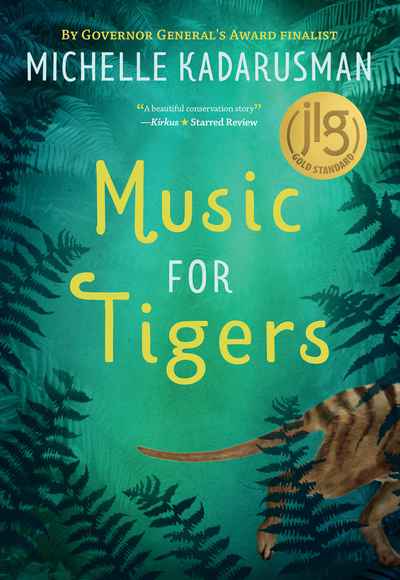
    Once again Michelle Kadarusman has crafted an epic story, Music for Tigers around conservation, acceptance and friendship set in a remote bush camp in the Tasmanian rain-forest, the Tarkine, a place of great beauty and mystery.

    Louisa is passionate violinist totally focused on gaining a place in the  youth orchestra and really is none too happy about being dispatched to the furthest corners of the earth, at least as far as she is concerned, to spend the summer with her Uncle. She should be at home practicing.

    Even though she is greeted with what sounds like the real life version of Vivaldi’s Spring from the Four Seasons suite, she is very worried about snakes, spiders and also her Uncle, the only person waiting at the bus stop. Her first night at the bush camp is filed with dreams, a scraping, snuffling sound and rancid odour, which completely mystifies her.

    Meeting her neighbours Colin and his mother who live at the Eco Lodge and specialise in Eco Tourism, begins what will turn out to be the most momentous summer for Louisa as she, her Uncle, Colin and Mel set out to discover if what they believe could be the last Tasmanian Tiger is living in the area of Convict Rock; an island in the fast flowing river, considered to be haunted.

    Louisa is offered a copy of her Grandmother Eleanor’s Dairies which carefully establishes the background to the conservation of an endangered species begun by her grandmother so very long ago. As the story unfolds so too does an understanding of friendship, letting go, beginning again and acceptance.

    Kadarusman has woven a story with beautiful use of language that captivates from the first sentence, as the wording immediately brings to the mind and sense, the smell and rich beauty of the Tasmanian bush along with the overwhelming awe it inspires when first discovered.

    Music for Tigers contains something very special: the magic of a story well told, that not only demands to be read from cover to cover, but ensures the gently presented messages wrapped within the text remain in the memory for a long time.

  • Tree Beings

    Tree Beings

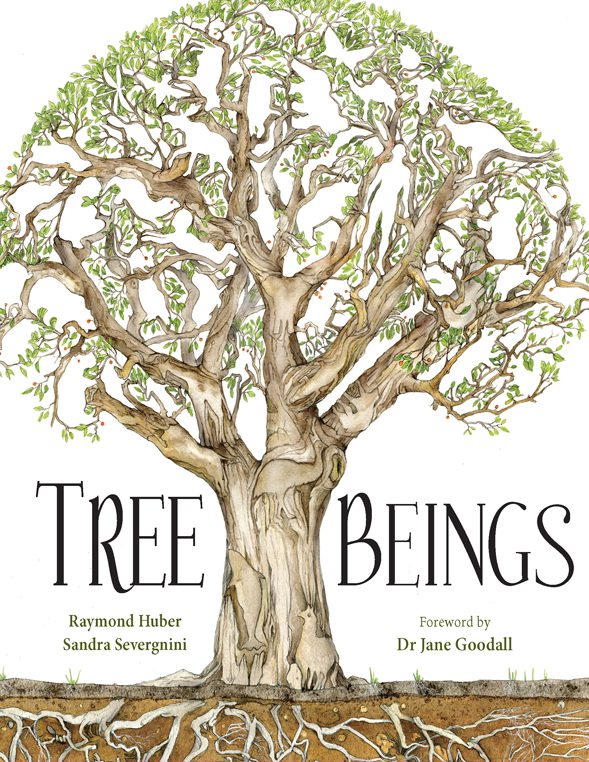
    Tree Beings from Raymond Huber Sandra Severgnini is a fabulous reference book. With a hard back cover and splendid illustrations, there is enough material here to keep a family interested for a long time. It is such a splendid production that it could also be used to present students with an assignment on Trees and their value to society. There is something to interest everyone in here.

    So, are you a “Tree being”? That is a person who loves trees. By the end of this book you will have met people who lived in trees, planted trees, discovered secrets about trees, and discovered the power of trees. Dr Jane Goodall has a story which reinforces the role that trees played in her life with the chimpanzees. Looking at the contents of the book, we find there are sections that describe “Life in the trees, Trees can save us, Trees are like beings, and Trees need our help.”

    Stories are from people such as Julia Butterfly Hill, who lived up a tree for two years. Following the strangeness of this, is a scientific report that explains how trees lift water from the ground sending it into the air. This process produces water vapour, which makes rain. Several times through the book, there is a section called, “Imagine you are there, on that day in….” which tells stories from Jane Goodall, Richard St Barbe Baker, and Vimla who helped to prevent loggers from destroying the forest of her village

    The range of facts and stories about trees is huge. Interspersed with these are beautiful and colourful illustrations which vary from factual to imaginative. Underlying the stories, facts and drawings is the message that is essential to convey to the world that of: Without trees we have no world, and the more trees we have the healthier our planet becomes.

  • No Place for an Octopus

    No Place for an Octopus

    What adventures can be had from a simple day at beach, sand squishing, crunching underfoot; a day when the ocean is resting allowing the many rock pools hidden under the water to be discovered by people big and small.

    A little boy is spending time peering into magical, mystical and intriguing rock pools seeking to find treasure, discovering beautiful things and perhaps he may find something very special

    He finds a lovely, pink octopus, he decides might very well make a jolly good friend. He spends time imagining all the wonderful things they can do together, because surely the octopus must be lonely living in the pool all by himself.

    Oh, the adventures they could have if maybe he took it home with him and it became his pet.

    Captivating illustrations capture the mood of the story perfectly as the little boy, adventure bound, ponders the pros and cons of having a lovely pink octopus for a pet, finally beginning to realise that perhaps, this may not please the octopus at all, and just perhaps, right there in this rock pool, is the perfect place to be, particularly if you are an octopus.

    A clever use of words crafts the entwined message about conservation; the little boys’ thoughts come through crystal clear as he goes about thinking his way through an issue, eventually arriving at absolutely the right decision.

    No Place for an Octopus from award winning Claire Zorn is perfectly tailored for small children, as well as their adults, as an introduction or reminder, to caring about and understanding the natural beauty to be found in every aspect of life.

    The hard cover captures the imagination immediately as there is a deep cut out simulating what can be discovered in a rock pool at the beach when you find an octopus looking back at you!

  • Elephant Dawn

    Elephant Dawn

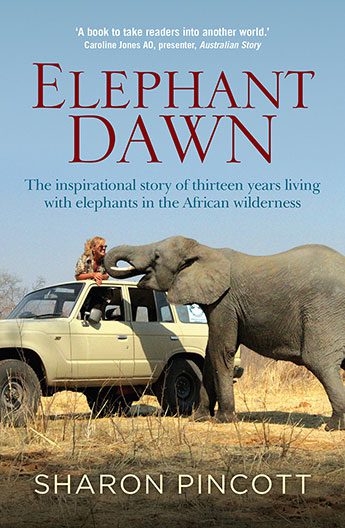
    Elephants are most certainly the love of the author’s life. She has written two other books published in South Africa, and motivated by the death of a very close friend, she decided to devote her days to protecting and documenting the Presidential Elephants of Zimbabwe. Her work has been so comprehensive that it has been profiled in National Geographic, BBC Wildlife and African Geographic. She has done this as a labour of love, unfunded and alone, in a less than friendly country, where white people are easily dispensable, certainly according to Robert Mugabe.

     Several hundred elephants roam a 140 square kilometre piece of land outside the Hwange National Park. In 1990 the president issued a “special protection decree, for the elephants that spent the majority of their time here. They were never to be hunted or culled and were supposed to represent Zimbabwe’s commitment to responsible wild life management”. A grand gesture; one that was impossible to police. The man who arranged for this decree to be formalised, had left the country and no one knows for certain just how many elephants there are. Maybe upward of 300 elephants call this area home.

     To leave a very secure position as an IT expert and live with no possessions, no electricity, and no hot water, is a massive step for someone to take, but Sharon was quite sure this was what she wanted to do. Not quite sure where to start, she began documenting and naming family groups of elephants, easily distinguished by physical traits and holes in the ears. As Sharon’s knowledge grew, she began to photograph and document just how the elephants could be helped. She joined a team looking for elephants that had been snared. Wire was placed in bushes, and either trapped the elephant or, if they broke away, the wire left a festering wound which, if not treated, would kill them.

     Poachers will always be a problem and there are those who wish to sell the ivory and those who wish to eat the meat. However, despite many setbacks and difficulties, the author has become a well-known name and a force to be reckoned with. She has produced wild life documentaries which have been lauded in China and Japan, countries which understand how desirable ivory is.

    As time passes, Life becomes more difficult. Renewing her visa is a constant problem for Sharon, and although many promises are made, land that has been kept for the elephants is being earmarked for other projects. Minister after Minister promised things will be done, however, “Recently released reports reveal that over 100,000 African elephants were slaughtered for their ivory between 2010 and 2012”.

     This story is much more than hardship and despair, though. We see the magnificent sights through Sharon’s eyes, sunsets, elephants in families, lions viewing people with disdain, especially when the author is caught by one when she was having a pee behind a truck! The lions just moved away with heads averted.

     Other happy moments occur, when friends come by to share a G&T, and the joy of seeing animals they have been able to save and heal. These moments are so rewarding and the laughs are plenty. But the true message is always the protection of those beautiful creatures. If you are going on a safari in Africa, check that they are reputable and money from them goes towards wildlife protection.