Tag: classical

  • An Ungrateful Instrument

    An Ungrateful Instrument

    Delicate, sensitive, brutal and unforgettable, as is a classical suite of music, An Ungrateful Instrument from Michael Meehan is a brilliant novel set in 18th century France, in the years before the Revolution, when to be considered a member of the Court of Louis XIV was the epitome of Society.

    The powerful voice of the mute Charlotte-Elizabeth Forqueray, sister to Jean-Baptiste and daughter to the genius, if demonic composer Antoine, himself a child prodigy at the Court, tells the story of love, abuse, decadence and strength, that was the everyday life of the Forqueray family as their father forced his children to become what he once was, a Prodigy to the Court of Louis XIV.

    In his obsession he believes that violence will achieve the desired conclusion, but in his doing so his brutality sees Charlotte Elizabeth choosing to remain mute, refusing to play the viola, Jean-Baptiste taking the force of the obsession, trying to live up to unimaginable expectations.

    Their mother, Henriette-Angélique Houssou, once a talented musician who accompanied her husband on the harpsichord, is now a dreadfully unhappy, broken woman who filled their childhood with wild stories associated with the Greek Gods and other ramblings.

    It is in this setting the powerful voice of the narrator tells of the tragedy, decadence and obsessive hatred of the father for the son, who even at a young age is a fine and rich talent, who takes punishment after punishment in the hope that he will be able to live up to his father’s demands. Eventually n his madness, the father, along with a group of Court lawyers sees the son exiled from France for many years, jailed and left destitute on the streets.

     Threaded through the sad story is the beautiful balance of a woodsman, a craftsman, who crafts a beautiful Viola out of treasured pieces of wood for the young Jean-Baptiste. He is tutored in the fine art of viola construction, each segment explained in detail, each singular piece gifted with its importance to the whole instrument. This in itself is an eloquent tale of beauty in the depth of horror, a light to be held in the darkness.

    Antione Forqueray was considered a genius in his compositions but he considered each piece so unique it should never be repeated, that the work should never be written down, that the piece should only ever be performed by either himself or his son.

    Harpsichord was the only instrument to accompany these works and to this end Antoine in his later years, lusted after the brilliant second wife of Jean Baptiste, a harpsichordist of prodigious talent.

    In a supreme irony, two years after his death Jean-Baptiste published 32 of this works; apparently more than 300 pieces had been composed over Antoine’s lifetime. His work was considered as extremely difficult if not challenging to play, so much so that after his death Jean-Philippe Rameau, Francois Couperin and Jacques Duphly composed works as a tribute to the complex and violent man.

    Michael Meehan has out of tragedy, crafted a work that is exquisite, that sings, as do the strings of a Viola da gamba, voicing brilliance, tragedy, love and lust to tell a story; the words placed on the page with care and precision, so much so, the emotion has been neutralised in the retelling. The voice of Charlotte-Elizabeth more powerful for the precision.

    It is perhaps a necessary conclusion to the work, to listen to one or more of Antoine Forqueray’s compositions, even if you don’t enjoy classical music, to appreciate the magnificent obsession that created such complex compositions. 

  • Kismaros

    Kismaros

    Kismaros, a unique 7 track album was recorded before lunch in the small village of Kismaros, located on the banks of the Danube in Hungary; not by design, more by accident, with the final product of the recordings making it in totality to the album. A trial duo track was being recorded by Kevin Kastning and percussionist Balazs Major in the morning: a piece that mutual friend Sandor Szabo, who appears with Kastning on a number of his previous recording, considered had a good energy, so good that it would be an excellent thing to continue on with the recording process. By lunchtime on that day the work was complete.

    Kevin Kastning also made this recording using only one of his many unique guitars, the 30-string Contra-Alto guitar, a complete change for him and one that as it turned out, proved to be an excellent choice, as it contributes to half of the music recorded on this album. On this album percussionist Balazs Majors incredibly unique sound blends perfectly with the style and vibe of Kastning music, to create a form of music that will appeal to the purist and the lover of seriously good acoustic music.

    Considered as a leader in his field, Kastning’s background, consisting of Classical and Jazz components, contributes to what could be considered as a minimalist style that contains elements of both disciplines. This could very easily be considered as an evolution of both technique and style which is definitely not mainstream in any sense, but if in the right space, enjoyable; a bit like a jazz jam session, which is a style that is unique unto the moment of conception.

    On Kismaros the elements of what Kastnings considers essential ingredients in his work, which are, in his words, “Harmonic density and melodic angularity. Elements of nature. Multi-dimensionality. Abstractions.  Aural paintings. Emotions that can’t be conveyed or made tangible in any other way. Orchestral textures and depth(sic)”, all of which are seamlessly combined to create an incredibly likeable and enjoyable vibe.

    The work is enigmatic, challenging the concept of music and percussion, but somehow the unique and unusual style of the creation, often reminiscent of a classical structure, only to be upstaged by a more abstract  jazz style, permeates to bring freshness to the work which is most enjoyable.


  • Leaving Terra Firma

    Leaving Terra Firma

    Delicate, drifting sound reaches out and wraps around in the 5th album from Stephen Peppos, his first in the field of ambient music, a step away from his usual style.  Ambient music is a genre that is fast becoming a popular mainstream choice with a wide and varied selection, from chill-out to relaxation therapy and simply just the pure enjoyment of music that is not meant to challenge, but to enjoy for the tonal qualities and relaxation benefits that always seems to accompany such creative music.

    At a young age Peppos was influenced by the likes of Jerry Lee Lewis, The Beatles and as he grew up a strong love of the Jazz genre, which after setting up a 4 track recording studio in his parents’ garage encouraged him to make the world of music his choice of career.

    Over the many years he has earned respect for his talent which has seen him establish a 2000 track original music library, compose for marketing, theatre film as well as his ability as a sound engineer.

    In Leaving Terra Firma he has created an album that encompasses much of his talent in the sound recording fields as the music is vast and varied, commencing with the dreamy title track Leaving Terra Firma  that leads you gently into the world of space, endless, mysterious and beautiful.

    As the work unfolds so too does the ambience, with lovely tracks such as Praesenti Animi, followed by Amour Dei a little more upbeat melody offering a complete change of pace, although remaining in harmony with the essence of the music. The voice of Seay is used to create a peaceful chant reminiscent of the Offertories of the Gregorian chant or Cantare.

    Simply reading the track names with titles such as Magnetic fields, Vita Secundom Vita and Sea of Joy takes the idea of a voyage through space into the unknown and makes it a reality. To See introduces, via the magic of electronics, a harp like sound which adds a delicate element to this peaceful composition

    The twelve track album has final track hidden away rounding out the completeness of a beautiful work, which presents a definite end note to a work which is delightful and relaxing.

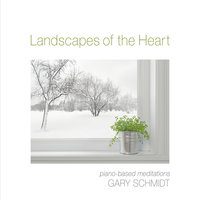
  • Landscapes of the Heart

    Landscapes of the Heart

    Beginning with the final track on this wonderfully elegant collection, is not the usual way of going about reviewing an album, but in this instance makes the various pieces far richer and fuller. Solus comes from the Latin word translating into ‘ a man alone with his thoughts’, which is the basis for the compositions formed and presented on this album. Somewhat sombre and introspective, it is a reflection of what has been and what may, perhaps, be to come.

    A man who is classically trained, has studied and achieved a degree in Sacred Music and Piano Performance, Gary Schmidt uses not just his innate talent for composition, but his firm belief that a minimalist approach to music leaves the end product clean, clear and pure; free of clutter so the true intent of the music is there to be enjoyed.

    This comes through time and time again with each of the pieces. His performance of Gnossienne’s No 1 and No 2, pieces written by Eric Satie in the late 19th century, illustrate the depth of talent on display and are absolutely beautiful.

    Back at the beginning The Beauty We Love is almost a classical introduction to the pure pleasure which is to follow, as When Silence Speaks comes tripping daintily along, underscored by the delicate notes of the  cello played by Eugene Friesen, the understanding that a rare and wonderful treat is unfolding is confirmed.

    A Waltz in Two Four, where Schmidt is joined by Charlie Bisharat on violin, is slow and dreamy, very  special, stepping back to a time when to dance a slow waltz with the one you loved was to be treasured, the memory placed away to be enjoyed time and time again.

    Will Ackerman on guitar and Jill Haley on English horn, join Schmidt in You Already Have Wings, which adds an extra dimension to this elegant composition.

    Treasure each of the tracks as each one comes from a different place, a differing emotion, a unique moment, blended to create an evocative mixture of peace and relaxation

    Produced by the legendary Will Ackerman, his alchemy, added to the richness of the compositions, makes a very, very special mix, which places what can be considered as contemporary new age piano, into a class of its own.


  • Colors in the Diary

    Colors in the Diary

    When Takuchi plays she sees the notes as colours in her mind. Similarly when she sees a beautiful scene this also transposes into notes of music. As she has been diagnosed with ‘synesthesia, a neurological condition, she uses this phenomenon to be able to create music which blends all the aspects of the magnificence of colour and life together in a drifting, slowly enhancing journey to peace and joyfulness.

    As a composer she has managed to capture the essence of whatever has motivated her to create the music. In Green Fields, her inspiration comes from the green fields of spring after a long cold winter. You immediately feel your spirit lift with the delicate notes played with joy and a sense of open space, rebirth and light all around.

    By contrast and yet with that delicacy of touch, Blue Falls relates to the times in between the seasons when the grey skies are slowly moving into the landscape, leaves are changing colours, letting all know change is coming.

    Sparkling notes dance out of the piano with White Mountain when you can easily imagine the white and mysterious nature of snow covered mountains after a fresh snow fall; the sheer majesty and glory seen over the snow-scape as perhaps, a ray of sunshine dances across the pristine whiteness.

    Nostalgia is written as she remembers time and place in her home country of Japan, a place of her culture, family roots and childhood; structured, precises, with a lovely depth of colour, you can sense and feel the many layers of Japanese culture tucked subtly amongst the notes.

    In this her fourth album, she works with Eugene Friesen, world-renown as one of the top new-age cellists, Si-Jing Huang , an acclaimed violist and member of the Boston Symphony Orchestra as well as the much lauded Will Ackerman as producer of this beautiful, evocative album.

    As the music is based in passion, seen and sensed in colou, transcribed into sound with a precise, elegant and emotive touch, the alchemy created as it is all drawn together in a wondrous pot-pourrie of colour and sound, cannot fail to reach out, to touch, to heal and most importantly, simply to be enjoyed.

  • Adore

    Adore

    In ‘Adore’ Joseph Sullinger has created a unique blend of classical and romantic guitar, which allows each of the slightly ethereal pieces to flow gently into the soul, in a style that is as timeless and pleasurable as the setting sun in the evening, the rhythmic ebb and flow of the ocean, the all-pervasive knowledge that music is the very essence of life.

    ‘Mi Amor ‘is created from enticing, tempting and intriguing notes floating gently out of the ether to woo you into settling gently down; allowing the inner self to relax, transport to another time and place; a place of subtle harmonies and pleasure; timeless, endless, beauty.

    Once you have entered the realms of Joseph Sullinger and his guitar you are moved into another time and space, with the light and delicate rhythms of the guitar, entwined with the gentle strains of the violin, creating the deeply relaxing composition ‘In The Evening’, which offers the peace to be found in the settling of the day; the transcendental nature of the evening light as it washes over the lands.

    An upbeat tempo shakes you out of the tranquillity with ‘Adore’, but not so far that you lose the mellow feelings so far discovered.

    Melting into the heart is ‘Aurora’, a delicate piece that changes to a more up-tempo rhythm but slides into the slower pace of a heart, a soul, a spirit at rest.

    ‘Solitude’ is simply that; sitting at rest slowly playing the guitar, gently, subtly but with the sense of being at one with the music; the solitude that comes from being in the moment; that moment which can be given only once.

    Moving gently over the senses is ‘Caravan’, followed by the sharper, more definite melodies of ‘Romance’; portraying the freshness of new love, new beginnings, which flow seamlessly into the mellow nature of constant love, filled with a joyfulness which comes from acceptance, understanding and joy.

    ‘Farewell’ comes all too soon, as the soft sounds of birds and ocean waves breaking gently on the shore bid  you farewell as you are returned to your world feeling softer, more relaxed and at peace.