Tag: charismatic

  • The Last Long Drop

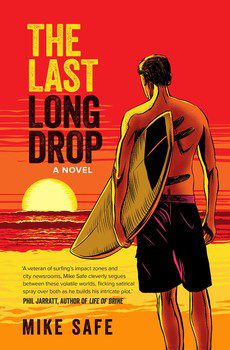
    The Last Long Drop

    As a holiday read, this novel will be a hit. The front cover gives a feel of an almost cartoon like content, but nothing could be further from the truth. The story begins slowly, but gains momentum and complexity as it goes along. The reader rides on the wave with Jonno, not only in the ocean, but as his life takes many twists and turns.

    At the age of 55 John Harcourt was made redundant from his position as a journalist for a newspaper. He had seen the inevitable end as newspapers globally were suffering from the digital era. As a lifelong surfer, and living locally on Sydney’s northern beaches the journalist caught up with his mates and hit the waves. Everyone knew this wouldn’t be enough for him, but it was a temporary pacifier.

    John’s family consists of his wife Tess, a son in England with a band, hopeful to break into the music scene, and a daughter Kirsten. Tess is in publishing while Kirsten has just been photographed topless with a famous but elderly author. In the midst of this family turmoil, Jonno is asked to write a book, for a rather dubious character whose wealth has been amassed by variety of means.

    It is the reality and the layers in this story that make it so compelling. The family issues are dealt with as best parents can; John’s surfer mates keep his feet on the ground, while his integrity as a journalist helps retain his esteem. There are thought provoking moments as well as common issues to enjoy. Put all this together and throw in a gangland murder and you have a super read.

  • The Salamanders

    The Salamanders

    William Lane presents a delightfully woven piece with The Salamanders, into a meditation on family and the nature of art. It begins on a holiday by the ocean, where controversial artist Peregrine holds court while a series of children and old friends drop into and out of their seaside idyll. Beneath what appears to be peace, discontent simmers. Without a reveal as to what exactly went down on that holiday, the story picks up with two of the children, Rosie and Arthur, fifteen years later. Their relationship is complex and laced with the seeds of that seaside holiday, with Rosie returning from England to her adopted family’s hut on the Hawkesbury River.

    Competently written, Lane’s story is compelling and melancholy. A study of a complicated family dynamic led by a capricious patriarch, It’s an enjoyable piece, but the text is slightly too aware of the atmosphere it’s trying to create. It toes the fine line between overwritten and lyrical only sometimes. The imagery can be lovely and is evocative, such as in the early description of the Hawkesbury where “shoals of fish sucked the last oxygen from the shallows, and crosshatched the channel in rippling, reefing river muscle,” but Lane strays towards self-consciously dreamlike once too often. Later on Arthur and Rosie’s road trip, the dust cloud in the wake of a truck is described evocatively as “a churning red demon”, and a gunshot on kangaroo hunt makes it seem, rather overwrought, that “time itself had been shot, a second, and a millennium, irreparably punctured.”

    Lane’s dialogue is detached, lacking the immediacy and realism of actual speech and thus characters feel as if they’re performing, reading a script. This might be a conscious choice due to the thematic meditation on the nature of art and its interactions with life, but it just misses the mark in this attempt.

    Despite this, Rosie is a lovely character, crafted carefully in dealing with her origins of adoption and difficult adolescence. She returns changed by her English experiences and yet is still an independent and vibrant individual who feels large in Arthur’s presence. Contrasted rather deliberately with another character of the same name, Lane illustrates her charm juxtaposed with the small town quiet of the second Rosie.

    Lane’s book is a short read packed with imagery and the echoes that family leave throughout our lives. Its intense poetic nature and dialogue do not always come off as genuine, but there is truth in the observations of art, place, and especially Australian identity that readers will appreciate.