Tag: chant

  • Oceans of Light

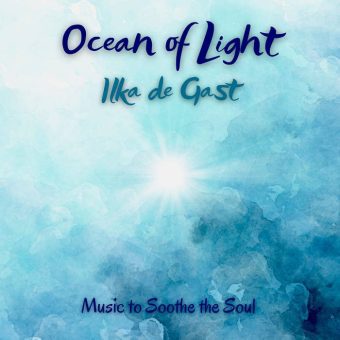
    Oceans of Light

    Music to sooth the soul

    To be bathed in beauty is to listen to the most relaxing and delicate music created by Ilka de Gast with her debut album Oceans of Light.

    Eleven songs transport you to the most mystical of places, as you allow your mind to open to the delicate, carefully woven sound of tonal singing backed with subtle electronic wash and delicate, meaningful chants, each song inspired by the ebb and flow of the Pacific Ocean, a place where Ilka draws her inspiration.

    The softly melodic Spirit Eyes begins a journey into sacred healing and meditation which offers a soothing and gentle moment to simply begin to relax before the almost monotone Ocean Waves Overtones allows the transcendental meditation to commence.

    Each song is uniquely part of the whole, each piece allowing the next step into deep mediation to commence, or should that not be the desire, to sooth, calm and relax the mind for a short moment in time.

    Desert Dance brings in a vastly different technique of tonal singing in the traditional style of the Tibetan and Mongolian Chants and when backed with gentle up-tempo percussion, brings this ancient art form into the modern world, offering a encompassing change of vibration.

    The beautiful Light Sacred Connection is a song which can easily be used as guided meditation but is more of a gentle soothing chant to connect to ‘Source’ as de Gast refers to the world of the spiritual and divine.

    Concluding a deeply immersive work is the chant Healing, sung with gentle precision asking for healing and gentle blessings from the Universe.

    Ilka de Gast is a psychologist, singer songwriter who became fascinated with the field of Cymatics, the effect of sound on matter and began to combine her natural singing voice with tonal music in 2021, discovering this unusual combination became a profound and deeply relaxing vehicle for meditation. Oceans of Light places this music firmly in the world of New Age music with a flourish.


  • Shunia

    Shunia

    Sa Re Sa Sa Sa Re Sa SaSa Re Sa Sa Sa RungHar Re Har HarHar Re Har HarHar Re Har Har Har Rung Translation: That Infinite Totality is here, everywhere, and so begins a most rich and energetic collection of divine mantras offered by Shunia, aka  Lisa Reagan and Suzanne Jackson.

    Their love of chant and the power of the vibration to encourage relaxation drew them together in their more than twenty years with the Washington National Opera. They choose the Sanskrit word Shunia for its meaning: stillness and receptivity as their collective name and as the title of their second album.

    Hassan Hakmoun’s rich voice ushers in the first mantra Sa re Sa Sa underpinned with a melodic base beat before joining with Reagan and Jackson to create melody that lifts the spirit and the soul, before segueing gently into the wonderful poem from Persian poet Rumi, The Breeze At Dawn whose words, written so many years ago are as prophetic and profound today as they were when first written.

    Using their voices as finely tuned instruments, the protective mantra Akal wraps around to protect, to offer comfort and solace during difficult times. A range of eastern instruments threads throughout the melody giving an almost monotone chant a freshness which has great appeal, especially to those who are seeking to enjoy ‘chant’ music for the first time.

    Lest one become too comfortable, the upbeat melody to accompany Har Hare Han Wahe Guru is snappy, featuring the voice of Hassan Hakmoun adding a rich vibrancy to the once again well known and loved mantra. Used as a cleansing to move on from unpleasant situations, the vibration is powerful as one would expect.

    In a mix of Persian melodies and chants the all-enveloping Alleluia is based on the poetry of David, who was later to become King David. Shunia has created a glorious transition from canticle to chant with the incredible mix and range of harmonies which form as one voice, before dividing into two, soaring and flowing individually before returning to one voice, creating an immensely beautiful, modern sound for the beloved hymn Psalm 23.

    No matter how you enjoy this music, track by track or one endless loop of divine chanting , as meditation or simply to usher in change, the immense feeling of calm, of tranquillity and well-being,  a ‘garden of wellbeing’ , is forged. These words used by Lisa Reagan and Suzanne Jackson to describe their work, fit the music perfectly.

    Sa Ta Na Ma is also based on elegant words from Ecclesiastes, symbolic of the circle of life, of beginnings and endings: To everything there is a season, and a time to every purpose under the heaven (chapt 3v1). These very elements have been captured in a delicate, carefully constructed and immensely devotional series of harmonies, enriched with gentle instrumentation perfect for refreshing, healing meditation offering the absolutely perfect conclusion to a divine journey.

    Alive, vibrant and yet containing the very elements of a deeper, healing power, Shunia awakens the very soul to encourage an understanding of the interconnections of all things in life.

  • Deva

    Deva

    Seven tracks of pure bliss have been created by Deva Premal, along with her long-time partner Miten, in this spiritual collection of chants that wash the spirit and soul offering peace, calmness and immense love.

    Seven Chakra Gayatri Mantra begins the bliss filled journey, a piece which is an original composition of Deva’s composed more than twenty years ago, only now having its debut – the intent of the piece is ‘an invocation to illuminate the seven chakras, blessing the seven realms – from the earth plane to the aboded of supreme truth’ a perfect way to commence this journey. As a final piece it is offered as the last track as a Prabhu Mix – the God mix, a fitting conclusion to an album of worship.

    Joined on this work by long-time partner Miten on vocals, Manose on bansuri, vocals and a range of percussive instruments, Joby Baker on piano, keyboard, vocals, guitar and percussion. Anoushka Shankar joins with sitar on two of the pieces, once again bringing together a range of eastern talent to complement Deva’s relaxed and evocative style of chanting.

    Deva and Miten have led the resurgence of sacred chanting, an element of music that is once again becoming popular for its soothing, uplifting, mediative properties and cross-cultural acceptance as a sacred form of music. Add the ancient to the more contemporary style of genre known as world -fusion and you have music with an eastern influence that garners wide appeal over a range of many differing modalities.

    Prabhujee (a prayer to Prabhuji – my sweet lord) was written by Pundit Ravi Shankar and features his daughter Anoushka Shankar on sitar, which blends beautifully with the soothing tones of Deva, as she ushers in a deeper state of refection and meditation within the 8.45sec song; a piece long enough to offer a short, but refreshing moment of contemplation in a busy day.

    As with all of her works the German born chanteur seeks perfection. In the softly hypnotic Buddham Sharanam she has achieved a divine state of stillness with a delicate touch gently enhanced by the occasional use of the bansuri – calm perfection.

    The selection of chants chosen for this album reflect the journey Deva has undertaken over the past twenty years, from her shy beginnings as a back-up singer for Mitten, to a diva in the world of sacred music, bringing to the modern world centuries old chants and music to heal, relax and quite the jangling of the manic world of today.

    Absolutely beautiful, relaxing and divine.