Tag: bush

  • A First Book of Bush Sounds

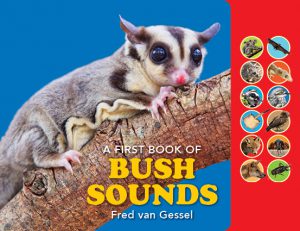
    A First Book of Bush Sounds

    Beginning with the Koala, a well-known Australian marsupial and therefor a terrific bush creature to begin A First Book of Bush Sounds, Fred van Gessel sets out information about the Koala, its habitat, diet, looks, apart from cute, its lifestyle and most importantly the sound it makes, heard by pushing a button on the page.

    Brushtail Possums, Dingoes, Red Foxes, while not indigenous are recorded, House Geckos, yes, they do make a particular sound, and the rather unusually named Brush Thick-knee, a bird of tropical areas that is a ground bird and loves shoreline habitat, to name a d few of the creatures who share their sounds with you. Each animal or bird has just enough information to be informative and entice an interested reader to investigate further.

    Each one of the selected bush creatures has been identified well in language suitable for young readers who want to understand a little more about the native wildlife that surrounds them. The pictures that illustrate the specific animal or bird are accurate, their scientific name is listed under their ‘common’ names with the sounds recorded, often very surprising.

    Koalas growl, Geckos, chuck-chuck-chuck, field crickets chirrup their ‘songs’, something heard often during the long hot summer days. The Southern Boobook Owl can sound like a frog with its distinctive boo-book sound; perhaps that where is common name came from, or a mo-poke call repeated many times. It also has a third call, that of a frog, while the youngsters can sound like a trilling of a cricket. I wonder why?

    Well-presented and filled with just enough detail to interest the beginning naturalist or reader with an interest in scientific things, A First Book of Bush Sounds is fabulous way of introducing a number of the bush creatures to a wide range of ages and reading abilities.

  • Bush School

    Bush School

    When Peter O’Brien was a young teacher his first placements were in City schools where he honed his love of teaching. Back in those days male teachers had to undertake a mandatory two year teaching position in the country. His Supervisor offered him a position in the small rural school of Weabonga, a two day trip by train and mail car from Armidale in New South Wales.

    Arriving in the very small community he was shown where the school was by Bon the mail driver, met his landlady Jill O’Callaghan, was shown his room on the veranda of the house and eventually met the rest of the family. His evening meal was a sparse meal of rabbit and veg, eaten alone. The remainder of the family ate later that evening and so was the pattern of the evening meal established.

    Somewhat astonished, and slightly perturbed Peter set about visiting the school, setting lessons for the coming day and wondering what he had landed into, missing his very noisy Irish family, Patricia who he had not long met before he accepted his rural posting and the very real fact that this was to be his life for the next two years.

    Beautifully told Peter O’Brien’s, Bush School paints a wonderfully rich portrait of life in a community that was remote; a town of few people who faced hardship on a daily basis but were filled with determination to keep their very small school of 18 children, ranging from 5-15 years old and the friendships that formed over his two years of teaching in such a remote location. He firmly believed in child centered learning, which proved to be perfect for a school with a very wide range of ages and learning requirements.

    The pride both he and the children took in accepting the limitations of learning in an under resourced school and excelling despite the enormity of the challenges they had to overcome, saw him able to develop a teaching style based around their lives and community, which taught both he and the children much about life, learning and understanding, which was to stand him in good stead throughout his teaching life.

    All the children Peter taught in those years went on to lead successful lives, the small Weabonga School finally closing in 1968. Peter went on to focus on child-centered learning, ‘Open Education’ learning styles and maintained his interest in indigenous Australians.

    In 2019 Peter finally returned to Weabonga, almost 57 years since he waved goodbye to the townsfolk and his students, reminiscing that although those years taught both him and the children much, they were happy in that small school where they created a learning environment that was genuinely successful.

    Stepping back into a past that seems so far away and primitive by today’s standards, through the eyes of Peter O’Brien is a rich, wonderful tapestry held together with kindness, love, understanding, learning, acceptance and perhaps most importantly resilience!