Tag: behaviour

  • How to be Perfect: The Correct Answer to Every Moral Question

    How to be Perfect: The Correct Answer to Every Moral Question

    How to live a more ethical life has plagued people for thousands of years. According to the author of ‘How to be Perfect’, Michael Schur, it has never been tougher to do so.  Although we all have the potential to be virtuous, the circumstances surrounding an individual’s birth plays a significant part in how ethically that life is led.

    Using wit and deep insight, the author has written an accessible, educational guide to leading an ethical life, by drawing on the last 2,500 years of moral philosophical schools of thought. He explains and compares the theories of thinkers from Aristotle to Kant to Scanlon; each is applied to the sort of ethical dilemmas which arise in twenty first century life.

    His interest in moral philosophy began when he was researching material for his hugely popular TV show ‘The Good Place’. He fell in love with ethics because everything one does has some ethical component. As a result of this passion, he developed four simple questions one can ask oneself when encountering any ethical dilemma; be it great of small:

    What are we doing?

    Why are we doing it?

    Is there something we could do that’s better?

    Why is it better?

    However, by trying to do the right thing all the time, the author warns, will lead to ‘moral exhaustion’ Thus the challenge to readers is to try to improve and be a little better and more thoughtful today than they were yesterday.

    P.S. Don’t forget to read the numerous footnotes, which are not only delightfully humorous, but also add more obscure information which will enhance the enjoyment of this book.
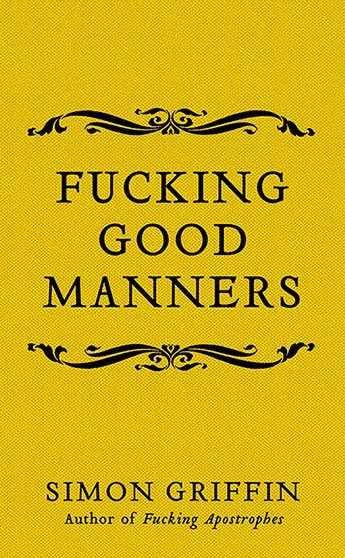
  • Fucking Good Manners

    Fucking Good Manners

    While the title of this book, Fucking Good Manners is amusing, the “F” word is used four hundred and seventy-five times throughout the text. That is about four hundred and seventy times too many. It distracts from the message and breaks the flow of presentation. However, that would be the only criticism of the contents, the message is important and current, in today’s society.

    Simon Griffin makes a point when he says good manners are not going to solve the world’s great problems. However, they do demand respect for other people. Consideration in listening to another point of view, and quietly digesting it for a response, is better than dismissing it or shouting. Think about this in the schoolyard and in Parliament House! He notes that how you behave in private should be quite different to a public presence. Cultural differences emerge; in Japan excessive eye contact is seen as rudeness, but in the USA, it is deemed as courteous.

    Manners have changed from times past, and Simon takes us back to Moses and the ten commandments. He then moves through the centuries and explains why certain customs developed. Later came the code of Chivalry, where respect for others and being brave and generous was a noble ambition. Courtly manners were necessary for survival, and developed in the court of Kings. The historical perspective of acceptable manners is interesting.

    When we leave our house, we are entering a shared space. We interact with people in many ways and if we can do this pleasantly with people who also share this space, life will be easier for all of us. Helping someone cross the road, or opening a door for someone, or often just smiling, can encourage a positive feeling. Just as we have an impact on the environment by being alive, so we impact on the people around us by our very presence.

    Griffin writes about our behaviour and attitude in places such as shops and cinemas, the workplace and on social media. It is a timely reminder that we are not the most important being in the world, and lack of consideration for others should not be a way of life. This is an excellent reference book and so important in today’s society, where many people have not even thought about how annoying their phone conversation might be to others.

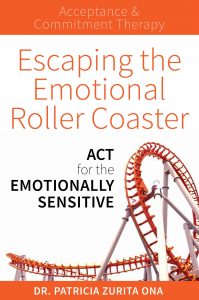
  • Escaping the Emotional Roller Coaster

    Escaping the Emotional Roller Coaster

    ACT – Acceptance & Commitment Therapy is all about just that; Acting, Committing and accepting change in your life is possible and by committing to change or therapy if you choose, you can have a happy, balanced lifestyle for perhaps the first time in your life.

    Written for the people who feel too much emotion in their life, Patricia Zurita Ono (Dr Z.) has offered in book form, her many years as a Clinical Psychologist, dealing with what she refers to as ‘super-feelers’ or people who are just ‘too sensitive’; people whom often finding themselves overwhelmed by their emotions, lashing out, causing hurt and bewilderment, not only to themselves but the people around them; making information on cause, effect and cure available to everyone.

    The level of emotional pain ‘super feelers’ feel varies dramatically, but is without doubt debilitating and destructive, occasionally resulting in the ending of a life and other drastic or anti-social behaviours. Something can be done about changing this behaviour, much of which is explained in this Step-by –Step guide to changing your lifestyle to one of ‘being more than your emotions.’

    This workbook has well defined sections offering clear and easy to understand information about this debilitating condition based on years of clinical practice and study, many case studies, and a dose of humour threaded throughout to lighten the load. This guide offers a way forward, with a little bit of help from your friends, family and therapist, to a better and healthier understanding of the mind, the emotions and the pathway forward.

    At no point does ‘Dr Z’ suggest it is going to be easy to change the habits of many years, but she states over and over again, that is it very well worth the journey to be able to escape from the daily torture of feeling and reacting to much to life. Read the book, carry out the exercises, relate to the case studies and then make an informed decision as to how you wish to spend the rest of your life!

    Regardless of whether you fall into the category of a ‘super-feeler’ or not, reading this book presents a clear and precise understanding of how emotions work and the power of the mind that drives them.

    Discover what truly does mater in your life, take a giant step forward and choose ‘value-driven’ behaviour over ‘out of control’ emotions, to live a life that is full of your own values, which goes on to make a massive difference to how you relate to and connect with your loved ones and the many others you will meet on your chosen pathway through life.

    Escaping the Emotional Roller Coaster could be considered as a beacon of light in what many perceive as a world of turbulent and dark distress, and one which can make a difference by shining light into dark corners of the emotion and the psyche that drives them!