Tag: Anzac

  • Anzac Ted (10th Anniversary Edition)

    Anzac Ted (10th Anniversary Edition)

    The story and importance of the Anzac Legend is rather difficult to convey to younger children. It is so fitting that Anzac Ted has been reprinted after ten years as it explains those concepts very well. The story presents themes on many different levels, but all of them accessible to the reader.

    Ted is not a beautiful bear. He is battered and worn. He doesn’t win favourite toy at school or have appeal for other children. Like many bears, Ted holds many secrets.

    Ted was Grandpa Jack’s bear when war was declared. Jack enlisted and left behind a wife and baby. His Grandma packed his Ted and said, “Take Ted, I know he’ll bring you home.”

    So Anzac Ted went to Greece, Africa and Turkey with Grandpa and his mates. Ted gave the men moments of peace and became their mascot. In his own way Ted was a hero who travelled with the men, and like many of the men he returned home with wounds. So, he is not beautiful, but a hero in his own way.

    Following this story, the author has written an explanation of what happened at Anzac Cove. She acknowledges the Turkish troops there and their admiration of the Aussie and New Zealand Soldiers. Today we still salute the Anzac Spirit, and each generation of Australian and New Zealanders remembers the courage and pride that moved these men on.

    The illustrations and gentle humour portrayed help to ease the reader into difficult topic. This is an important explanation of a part of our history.

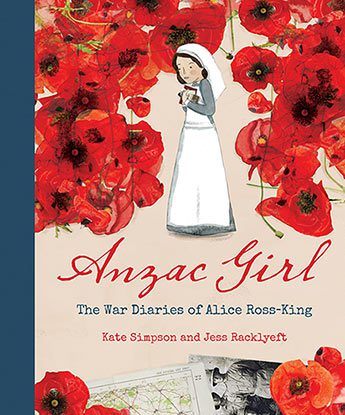
  • Anzac Girl: The War Diaries of Alice Ross-King

    Anzac Girl: The War Diaries of Alice Ross-King

    There is not a lot written about the many women who went to war, particularly those who went to World War 1, during a time in society when women were frowned upon for being different.

    Alice Ross-King was a woman who love Nursing: it was her passion, the one thing she had always wanted to do was to become a Nurse. In 1914 when War broke out, she felt she had to go as her country needed her to try and help the men wounded in battle.

    Her parents did not want her to go, but realised she was not going to be stopped and so bravely waved her off on the ship that was to eventually take her to Cairo, Egypt in 1915. She found out that no matter what she had thought, war and the injured soldiers was far worse than anything she could have ever imagined.

    Anzac Girl is her story; the story of a brave young woman who went to War to do what she could to help the wounded.

    She spent time in Egypt, before being moved with her hospital to Rouen, France, where she was told her young man, Harry Moffitt had been killed in action. This made her terribly sad, as they had talked of getting married after the War had ended. She then went to Armentieres, now known as the Battle of Fromelles, one of the bloodiest battles to be waged on French soil, before moving to Rouen in 1918, where she remained until the ceasefire in November 1918.

    Based on her diaries, her story has been wonderfully told, along with simple, powerful illustrations from Jess Racklyeft and photographs taken during her years away, which allows children of all ages a glimpse into what the world was once like more than one hundred years ago.

    Alice Ross-King died in 1968, a woman who was much lauded, and considered by the Australian Department of Defence to be the most decorated woman in Australia. It is fitting that Kate Simpson has told her great grandmothers’ story, the story of a woman who ‘marched to the beat’ of her own drum and by doing so helped to change the world for women.

    If you would like to know more about Alice Ross-King and her life during her War years, her diaries are available on the Australian War Memorial website.

  • The Honest History Book

    The Honest History Book

    In this collection of 19 essays we are introduced to another, perhaps more intimate, and definitely factual look at the basis of what has become in Australia, one of the country’s most influential, widely celebrated cultural and historic events, that of Anzac Day and the legend, folkloric, the myth, the barbarism that has created the legend of Anzac and what is often referred to as ‘Anzackery’.

    But what is it that has created such a modern day juggernaut of an event, where actions both heroic and appalling, more than 100 years old are celebrated, are remembered, as are the men and women who gave their lives, their sanity, their all, to go to a foreign country and enter into a fight that claimed hundreds of thousands of lives, all in the name of King and Country, certainly not in the name of Australia!

    Each of the essays takes a very salient point from our Anzac history, dissecting the events, placing them into context and then aligning them with modern times. What is presented is extremely confrontational, certainly presents a far wider view of the issues which started the events in the first place and in many cases, explodes the myth, the legend, which has grown up around an event to gloss over, make far more palatable, the very unpalatable issues which many would say should be better left undisturbed.

    The words of Mustafa Kemal Ataturk, (1881-1938)recalled some 15 years after his death by Sükrü Kaya (1883-1959), which are now embedded in history, is one such case where politics far overrules reality and goes a long way to gloss over the very real tragedy that was Gallipoli.

    The central point to this collection though, is not to degrade what is a right and fitting remembrance of the wars Australia has been involved with right up to current commitments, the right to look back and remember and pay tribute, but to put into place that far more has gone into Australia’s history than just wars fought overseas on behalf of other countries.

    The reality is presented poignantly by Paul Daley in chapter 17, Our most important war: the legacy of the frontier, where he looks back to the beginning of the white settlement in Australia and the horrific events that took place over many years and almost succeeded in completely wiping out the indigenous people of Australia.

    So much more, goes into building a country that eventually came of age as Rebecca Jones presents in chapter 10, devoted to the harsh climate of Australia where year’s long droughts can wipe out communities, which are then often followed by rains that create massive flooding, then the devastation of bushfires takes its terrible toll; all these factors  and many more bring out the resilience which is what the Anzac legend, myth, folkloric is really all about : the mateship when the going gets tough, almost impossible, the strong resilience that allows the rebuilding, the faith and hope that tomorrow the sun will shine and things will begin to get better.

    There is definitely more, far more, to the tradition of Anzac than the involvement in wars far from our shores. As each chapter unfolds you will find that you have developed a fresher, far more balanced and informed understanding of exactly what it is that makes up the wonderful, glorious tradition of ANZAC, but you will also have a better understanding that there is considerably more to Australian history, to the Australia people and character, than one period in the timeline of modern Australia (1770 –   ), that of World War I, which most certainly set the standard, so very long ago.